

Voter outreach is defined as the organized effort to contact, educate, and mobilize eligible voters through coordinated communications across multiple channels. Campaign managers call this practice "voter contact" in formal field operations, but the broader term covers everything from peer-to-peer texting to door knocking to absentee voter outreach strategy. Integrated multi-channel outreach consistently outperforms single-channel approaches in both voter retention and engagement. The importance of voter outreach extends beyond winning elections. It shapes democratic legitimacy by pulling underrepresented communities into the process and closing participation gaps that have persisted for decades.
What are the main types and methods of voter outreach?
Voter outreach methods fall into five core categories: peer-to-peer (P2P) texting, phone banking, door knocking, direct mail, and digital outreach. Each channel serves a distinct purpose depending on the campaign phase and the voter segment you are targeting.
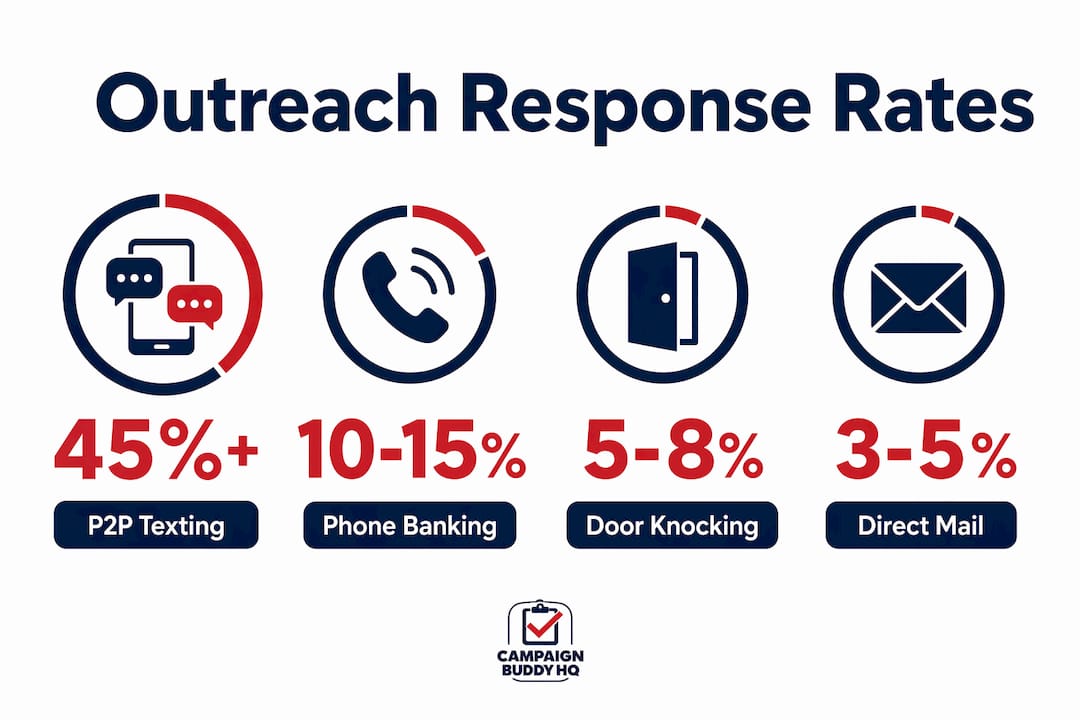
P2P texting is the highest-response channel available to campaigns. P2P texting achieves a 45%+ response rate, making it the go-to tool for rapid voter ID and get-out-the-vote (GOTV) mobilization. That response rate dwarfs every other channel, which means texting should anchor your final-week push.

Phone banking delivers a 10–15% response rate and works best for voter ID surveys and persuasion calls earlier in the cycle. Direct mail lands at a 2–5% response rate but remains valuable for reaching older voters and low-digital households. Door knocking is the most persuasive channel of all, but it is also the most resource-intensive. Reserve canvassing for persuasion phases when you have time to work a neighborhood thoroughly.
| Channel | Response rate | Best use case | Campaign phase |
|---|---|---|---|
| P2P texting | 45%+ | GOTV, rapid mobilization | Final 30 days |
| Phone banking | 10–15% | Voter ID, persuasion surveys | 3–6 months out |
| Door knocking | Highest persuasion | Deep persuasion, relationship building | 3–6 months out |
| Direct mail | 2–5% | Broad awareness, older voters | Any phase |
| Digital outreach | Varies | Awareness, event promotion | Any phase |
Pro Tip: Never run channels in isolation. A voter who receives a mailer, then a phone call, then a text is far more likely to act than one who receives three texts in a row. Coordinate your multi-channel outreach so each touchpoint reinforces the last.
How does voter segmentation enhance outreach effectiveness?
Voter segmentation is the practice of dividing your universe into groups based on likelihood to vote and likelihood to support your candidate. Campaigns that skip segmentation waste resources contacting people who will never move.
The four standard segments are:
- Likely supporters: High-propensity voters who already lean your way. Contact them early for volunteer recruitment and donor asks, then shift to GOTV reminders in the final 30 days.
- Persuadables: Voters who are undecided or weakly aligned. This is where your persuasion budget belongs. Campaigns should focus limited resources on high-propensity persuadable voters before expanding to broader lists.
- Low-propensity supporters: People who agree with you but rarely vote. These voters require more touchpoints and a stronger GOTV push to move.
- Opposition: Do not waste time here. Suppress this segment from your outreach lists entirely.
Sequencing matters as much as segmentation. A persuadable voter who does not answer your phone call should receive a follow-up text within 24 hours. Dynamic, triggered outreach based on voter response increases contact rates and efficiency far beyond what static weekly call schedules can deliver. Think of your outreach calendar as a living document, not a fixed schedule.
Pro Tip: Build suppression logic into your voter database from day one. When a voter converts, removes themselves from a list, or confirms their vote, that action should automatically update every subsequent outreach step. Duplication and contact fatigue are the two fastest ways to lose a voter you already had.
What is the recommended timeline for voter outreach activities?
A well-sequenced outreach timeline separates winning campaigns from reactive ones. The phases below reflect standard field practice for a November general election.
- 6+ months out: Voter ID. Build your universe. Run phone banks and digital surveys to identify supporters, persuadables, and opposition. Register new voters through public-place drives and online channels. Voter registration drives improve participation significantly when paired with clear, neutral messaging.
- 3–6 months out: Sustained persuasion. Shift resources toward persuadable voters. Door knocking is the priority channel here. Supplement with phone calls and targeted mail. Run issue-based messaging that connects your candidate's positions to voter concerns.
- Final 30 days: GOTV ramp-up. Increase contact frequency across all channels. Begin absentee voter outreach strategy by identifying voters who requested mail ballots and confirming they returned them. Shift door knocking toward confirmed supporters who need a reminder to vote.
- Final 72 hours: All hands on deck. Door knocking is most persuasive but inefficient for last-minute GOTV. Texting and phone calls dominate this window because of their speed and scale. Every confirmed supporter who has not yet voted gets a contact attempt.
- Election Day: Turnout confirmation. Pull your voter file against real-time poll data if available. Contact anyone on your GOTV list who has not yet checked in at the polls.
Legal compliance runs through every phase. Nonpartisan organizations operating under 501(c)(3) status must keep messaging strictly neutral and conduct outreach eligible to all voters. Nonprofits can conduct registration and outreach if they follow formal timelines and partner with established groups like the League of Women Voters for materials and training. Check your state's specific deadlines for voter registration cutoffs, as they vary widely and affect your phase-one timeline.
How can campaigns ensure inclusivity in voter outreach?
Inclusive outreach is not a moral add-on. It is a practical requirement for campaigns that want to maximize turnout and build lasting coalitions. Cultural and socioeconomic barriers reduce voter turnout, and campaigns that ignore those barriers leave votes on the table.
Language access is the most common gap. Campaigns operating in multilingual communities need translated scripts, bilingual volunteers, and materials printed in the languages spoken by their target voters. Transportation barriers are equally real, particularly in rural districts and low-income precincts. Offering ride-share coordination or connecting voters to existing transit programs removes a concrete obstacle.
"Voter outreach shapes democratic legitimacy by including marginalized communities and closing participation gaps that have persisted for generations. Campaigns that treat inclusivity as optional are not just making an ethical error. They are making a strategic one, because underrepresented voters, once engaged, become some of the most loyal supporters a campaign can build."
Partnering with trusted nonprofit organizations that already have relationships in underrepresented communities accelerates trust-building faster than any cold contact program. Groups like the League of Women Voters carry credibility that a campaign office cannot manufacture on its own. Use those partnerships to co-host registration events, distribute materials, and train community volunteers who can speak to their neighbors in culturally relevant ways.
The 2026 field guide on voter contact outlines specific approaches for low-density and rural communities where traditional canvassing routes are impractical. Adapting your outreach model to the geography and demographics of your district is not optional. It is the difference between a plan that looks good on paper and one that actually moves voters.
Key Takeaways
Effective voter outreach requires a coordinated, multi-channel approach timed to campaign phases and tailored to specific voter segments to maximize turnout and democratic participation.
| Point | Details |
|---|---|
| Multi-channel outreach wins | Combining texting, calls, mail, and canvassing outperforms any single-channel approach. |
| Segmentation saves resources | Focus persuasion budgets on high-propensity persuadable voters before expanding your universe. |
| Timing drives results | Sequence voter ID, persuasion, and GOTV efforts across defined phases for maximum efficiency. |
| Inclusivity increases turnout | Removing language, transport, and cultural barriers expands your coalition and strengthens democratic participation. |
| Dynamic follow-ups beat static schedules | Triggered outreach based on voter responses increases contact rates and reduces duplication. |
What I've learned about voter outreach after watching campaigns win and lose
Most campaigns I've observed fail at the same point: they treat their outreach calendar as a fixed plan rather than a feedback system. They build a beautiful 12-week schedule in a spreadsheet, then run it exactly as written even when the data tells them something different. That rigidity costs votes.
The campaigns that consistently outperform their resources share one habit. They update their voter universe in real time and let those updates drive the next contact attempt. A voter who answers a persuasion call and expresses strong support should immediately exit the persuasion queue and enter the GOTV track. That shift should happen automatically, not at the next weekly staff meeting.
The second mistake I see constantly is overinvesting in broadcast media at the expense of the ground game. Expensive TV and radio buys feel like momentum, but costly broadcast media is less effective than ground-level contact for actual persuasion. A volunteer knocking on a door and having a real conversation moves a voter more reliably than a 30-second ad.
My honest recommendation for 2026: build your outreach plan around your persuadable high-propensity voters first, lock in your channel sequencing logic before you launch, and treat every non-contact as a trigger for a different channel rather than a missed opportunity. The campaigns that win are the ones that adapt fastest, not the ones with the biggest budgets.
— Billy
How Campaignbuddyhq supports your voter outreach plan
Running a coordinated outreach program across texting, phone banking, canvassing, and mail requires more than a spreadsheet. Campaignbuddyhq is built specifically for campaign managers and organizers who need to track every door knocked, call made, and text sent in one place.
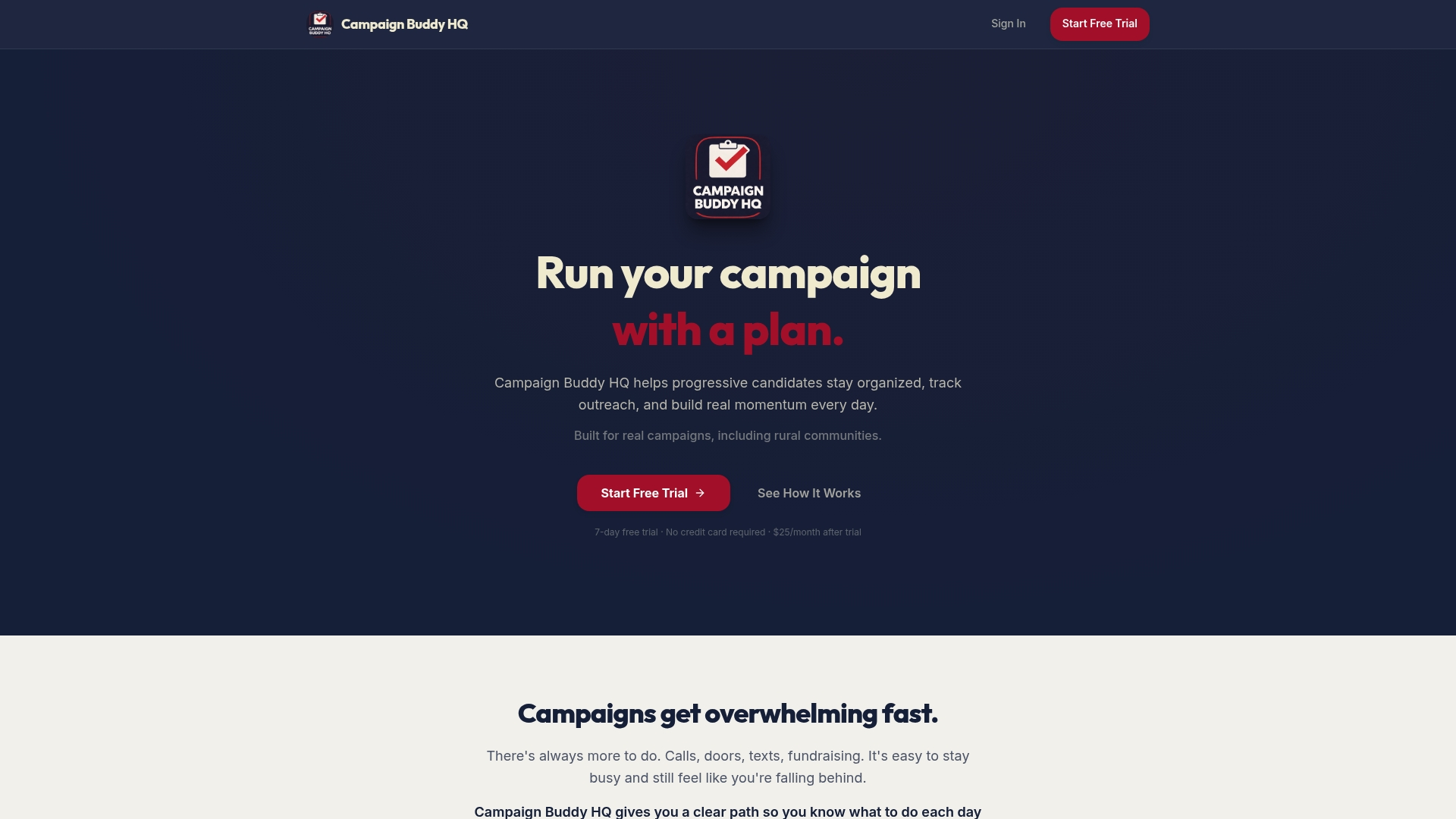
The platform supports daily and weekly outreach planning, real-time activity logging, and supporter tracking across all campaign phases. Whether you are managing a rural canvassing program or a high-volume GOTV text push, Campaignbuddyhq keeps your team aligned and your data current. The outreach planning tools at Campaignbuddyhq are available with a free 7-day trial and no credit card required. If your campaign needs structure, consistency, and a clear view of progress toward your goals, this is where to start.
FAQ
What is voter outreach?
Voter outreach is the organized effort to contact, educate, and mobilize eligible voters through coordinated communications across multiple channels. It includes methods like texting, phone banking, door knocking, and direct mail.
What are the most effective types of voter outreach methods?
Peer-to-peer texting achieves the highest response rate at 45%+, making it the top channel for GOTV mobilization. Door knocking is the most persuasive method for earlier persuasion phases.
What is voter registration outreach?
Voter registration outreach is the process of identifying and assisting eligible but unregistered citizens in completing their voter registration. Nonpartisan organizations can conduct this outreach legally under 501(c)(3) rules if messaging remains neutral and compliant.
How does an absentee voter outreach strategy work?
An absentee voter outreach strategy identifies voters who requested mail ballots and follows up to confirm they returned them before the deadline. This reduces vote loss from unreturned ballots and is most effective in the final 30 days before an election.
When should campaigns start voter outreach?
Campaigns should begin voter ID outreach at least six months before Election Day. Persuasion efforts run from three to six months out, with GOTV mobilization intensifying in the final 30 days and peaking in the final 72 hours.