

Outreach tracking is the systematic monitoring of campaign communications, contacts, and results to improve engagement and reduce wasted effort. Political campaigns that implement structured tracking reduce cost-per-meeting by 20–35%, cutting typical costs from over $500 down to the $350–$483 range. That kind of efficiency gain does not happen by accident. It comes from applying a clear framework, measuring the right metrics, and reviewing results on a consistent schedule. This guide gives you the exact steps to build that system, whether you are running a precinct-level canvass or a statewide phone program.
What are the key outreach tracking metrics campaigns should monitor?
The right metrics framework has three layers, and most campaigns only track one of them. Leading organizations use a three-layer reporting framework covering top-of-funnel activity, mid-funnel engagement, and bottom-of-funnel outcomes. Skipping any layer leaves you blind to where your program is breaking down.
Top-of-funnel metrics
Top-of-funnel metrics count raw activity: doors knocked, calls made, texts sent, and contacts reached. These numbers tell you whether your team is executing the plan. They do not tell you whether the plan is working.

Mid-funnel engagement metrics
Mid-funnel metrics measure response quality: answer rates on calls, reply rates on texts, and door-open rates during canvassing. Tracking and refining outreach sequences improved reply rates from 3.5% to 5.5%, a 57% gain, by cutting unresponsive contacts and tightening messaging. That improvement only becomes visible when you track at this layer.
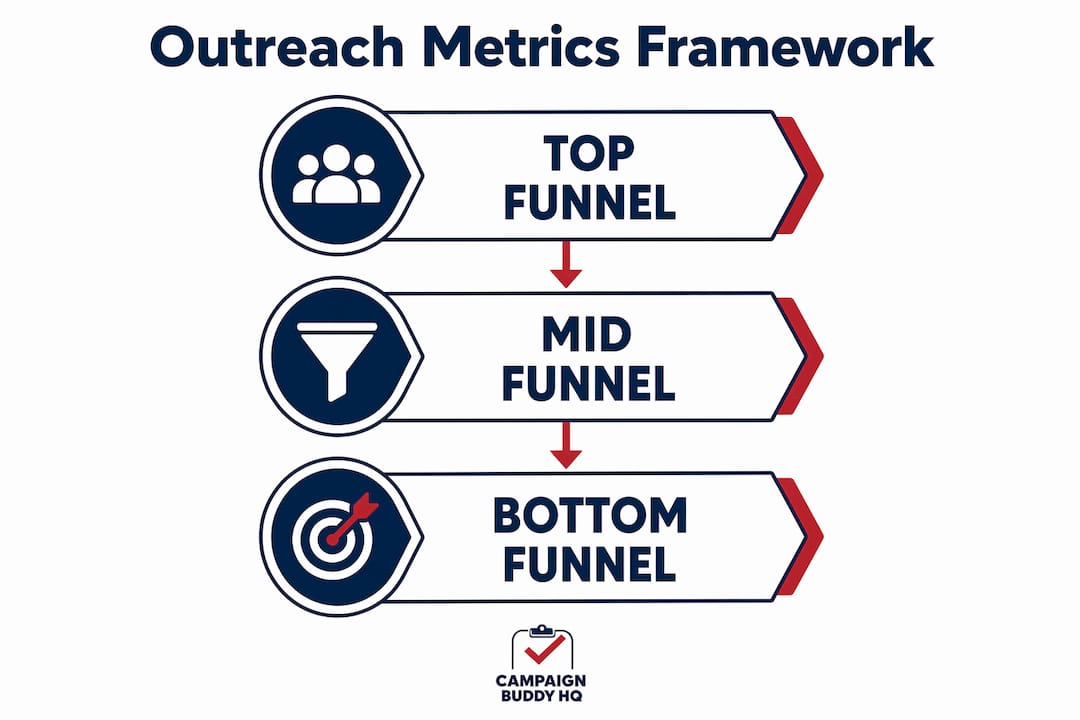
Bottom-of-funnel outcome metrics
Bottom-of-funnel metrics are where campaigns win or lose: voter registrations completed, volunteer commitments secured, and donations received per 1,000 contacts. Pipeline generated per 1,000 contacts is the true north star metric for outreach success. Opens and clicks are diagnostic signals. They help explain why engagement is low, but they are not the outcome you are working toward.
Key metrics to track at each layer:
- Top-of-funnel: contacts attempted, contacts reached, outreach volume by channel
- Mid-funnel: answer rate, reply rate, positive response rate, contact-to-conversation rate
- Bottom-of-funnel: registrations per 1,000 contacts, volunteer sign-ups per 1,000 contacts, donations per 1,000 contacts
- Segment-level: performance broken down by geography, demographic group, or outreach method
Segment-level data separates campaigns that improve from campaigns that plateau. When you see that door knocking in one precinct converts at twice the rate of another, you can reallocate resources before the election window closes.
Which tools do campaigners need to track outreach effectively?
Every reliable outreach tracking system rests on three tool categories: a CRM, an outreach logging platform, and a reporting dashboard. Without all three, data fragments across spreadsheets, volunteer notebooks, and memory.
CRM systems
A CRM is the backbone of outreach campaign tracking. It stores contact records, logs every interaction, and links activity to outcomes. Without CRM logging and source tagging, campaigns lose track of which outreach methods drive qualified supporters or donations. That leads to incomplete measurement and poor resource decisions. For campaigns evaluating CRM options, a review of nonprofit CRM tools can help identify platforms suited to advocacy and field work.
Outreach logging platforms
Outreach logging platforms record field activity in real time: doors knocked, calls completed, texts sent, and responses received. Entry-level field apps handle basic logging for small campaigns. Enterprise platforms add automated data sync, sequence tagging, and multi-channel tracking. The right choice depends on your team size and the volume of contacts you manage weekly.
Reporting dashboards
A reporting dashboard pulls CRM data and outreach logs into one view. Effective outreach tracking dashboards measure metrics that lead to behavior change within a week, focusing on leading indicators rather than lagging outcomes. A dashboard that only shows final vote totals is useless mid-campaign. You need weekly conversion rates so you can act before it is too late.
| Tool category | Core function | Key capability |
|---|---|---|
| CRM | Contact and interaction storage | Source tagging, reply logging, supporter history |
| Outreach logging platform | Field activity recording | Real-time entry, sequence tracking, channel segmentation |
| Reporting dashboard | Metric visualization | Weekly conversion rates, funnel-stage breakdowns |
| Data integration layer | Syncing tools together | Automated sync, reducing manual data entry |
Pro Tip: Set up CRM tags for every outreach channel and campaign phase before your first contact is made. Retroactively tagging thousands of records wastes hours and introduces errors that corrupt your conversion data.
Campaignbuddyhq combines outreach logging, supporter tracking, and campaign phase management in one platform. That integration removes the data fragmentation that plagues campaigns using disconnected spreadsheets and generic apps.
How to implement outreach tracking step by step
A tracking system that works on day one requires setup before the first door is knocked. Skipping the preparation phase is the most common reason campaigns end up with unusable data.
-
Define your goals and segments. Set specific numeric targets: registrations, volunteer recruits, or donor contacts per week. Divide your contact universe into segments by geography, voter file score, or prior engagement history.
-
Configure your CRM and tagging structure. Create tags for each outreach channel, campaign phase, and contact segment. Every interaction logged must carry at least two tags: channel and segment. This is what makes your data sortable later.
-
Set up your reporting dashboard. Build views for each funnel layer. Your weekly dashboard should show top-of-funnel volume, mid-funnel conversion rates, and bottom-of-funnel outcomes side by side. Learn how campaign dashboards drive week-over-week improvements in political outreach programs.
-
Run a baseline week. Execute one week of outreach without changes. Record every metric across all three funnel layers. This baseline is your reference point for every future comparison.
-
Conduct your first weekly review. Pull your dashboard data and identify the weakest conversion rate between funnel stages. Is your contact-to-conversation rate low? That points to list quality or timing. Is your conversation-to-commitment rate low? That points to messaging or ask structure.
-
Make one targeted change. Fix the weakest link first. A structured weekly review cycle allows campaigns to identify the weakest funnel link, take corrective action, and validate improvements within 4–6 weeks. Changing multiple variables at once makes it impossible to know what worked.
-
Repeat and document. Run the revised approach for one week, review results, and document what changed and why. Build a running log of changes and outcomes. This log becomes your campaign's institutional knowledge.
Pro Tip: Assign one person as the weekly data owner. When everyone is responsible for data quality, no one is. A single owner who pulls, reviews, and distributes the weekly report creates accountability and catches errors before they compound.
Common pitfalls to avoid during implementation:
- Logging activity without tagging the source channel
- Tracking volume metrics only and ignoring conversion rates
- Waiting until the end of a campaign phase to review data
- Changing messaging and targeting simultaneously during a test week
Effective outreach strategies require discipline in the setup phase. The time you invest in configuration before launch pays back in clean, usable data throughout the campaign.
How do you troubleshoot and optimize outreach tracking?
Most tracking problems trace back to one of three root causes: poor list quality, inconsistent logging, or misread metrics. Identifying which one is causing your issue determines the fix.
"High activity alone often wastes resources and harms inbox reputation. Tracking should prioritize conversion metrics over sheer activity, as high activity alone often wastes resources." The campaigns that win are the ones that track fewer contacts better, not more contacts carelessly.
Troubleshooting checklist:
- Low reply or answer rate: Check list quality first. Outdated contact data is the leading cause of low response rates. Scrub disconnected numbers and undeliverable addresses before blaming your message.
- Low conversation-to-commitment rate: Review your ask structure and timing. If volunteers are reaching the right people but not converting them, the message or the ask is the problem, not the list.
- Data gaps in your dashboard: Audit your logging process. Find where contacts are being recorded without tags or where interactions are not being entered at all.
- Metrics that never change week to week: You are likely tracking lagging indicators. Shift your dashboard to leading indicators that drive behavior change within a week so you can act on what you see.
- Inconsistent results across segments: Run a segment-level breakdown. One geographic area or demographic group may be dragging down your overall numbers while others perform well.
Tracking conversion rates between outreach stages weekly reveals specific message or segment weaknesses that volume metrics hide entirely. The 'weakest link' approach, auditing one funnel stage per week, drives steady improvement without burning out your team. Trying to fix everything at once produces noise, not signal. Pick the stage with the worst conversion rate, fix it, and move to the next.
Follow-up consistency is another overlooked factor. Campaigns that log first contacts but skip follow-up tracking lose visibility into one of the highest-converting touchpoints in any outreach program. Build follow-up logging into your standard workflow from day one. For a deeper look at organizing outreach activities efficiently, Campaignbuddyhq's blog covers the workflow structures that prevent these gaps.
Key Takeaways
Systematic outreach tracking, built on a three-layer metrics framework and weekly review cycles, is the single most reliable way to improve campaign engagement and reduce wasted resources.
| Point | Details |
|---|---|
| Use a three-layer framework | Track top-of-funnel activity, mid-funnel engagement, and bottom-of-funnel outcomes every week. |
| Focus on conversion metrics | Pipeline or commitments per 1,000 contacts matters more than raw activity volume. |
| Configure tools before launch | Set CRM tags, dashboard views, and logging workflows before the first contact is made. |
| Fix one funnel stage at a time | Audit the weakest conversion stage weekly and make one targeted change to validate improvement. |
| Assign a data owner | One person responsible for weekly reporting prevents data gaps and keeps the team accountable. |
What consistent tracking taught me about campaign discipline
Campaigns treat tracking as an afterthought until they lose a race they should have won. I have seen well-funded operations knock 50,000 doors and come up short because nobody could tell them which precincts were converting and which were dead weight. The data existed. Nobody was looking at it.
The shift that changes everything is treating your weekly review as a non-negotiable meeting, not an optional debrief. When your team sits down every week and asks "where is our conversion rate dropping?" the answer is almost always obvious once you see the numbers. The problem was never the data. It was the habit of looking at it.
The other thing I would push back on is the instinct to track everything. More metrics create more noise. Pick five numbers that connect directly to your campaign goal, build your dashboard around those five, and ignore the rest until you have a specific reason to look deeper. Discipline in what you measure is just as important as discipline in how you measure it.
Outreach performance analysis is not a technical skill. It is a management habit. The campaigns that build that habit early, even imperfectly, consistently outperform the ones that wait until the final weeks to figure out what is working.
— Billy
Campaignbuddyhq: built for political outreach tracking
Campaignbuddyhq is a campaign management platform built specifically for political campaigns, issue advocacy groups, and fundraising organizers who need to track outreach at scale.
The platform covers outreach logging for doors, calls, texts, and registrations, along with daily and weekly planning tools, supporter tracking, and campaign phase management. Every feature connects back to one goal: giving your team clear visibility into what is working before it is too late to act. Campaignbuddyhq works for grassroots operations in rural communities and larger coordinated campaigns alike. A free 7-day trial requires no credit card, so you can test the full platform against your next outreach cycle without any upfront commitment.
FAQ
What is outreach tracking in political campaigns?
Outreach tracking is the systematic recording and analysis of campaign communications, including doors knocked, calls made, and texts sent, to measure engagement and improve results over time.
Why use outreach tracking instead of just counting activity?
Activity counts alone miss conversion quality. Tracking conversion metrics between funnel stages reveals where contacts drop off, so you can fix the right problem instead of just doing more of the same.
What are the most important outreach tracking metrics?
The three most important metrics are contact-to-conversation rate, conversation-to-commitment rate, and commitments generated per 1,000 contacts. The last one connects your outreach directly to campaign outcomes.
How often should campaigns review their outreach data?
Weekly. A weekly review cycle identifies the weakest funnel stage and allows campaigns to validate improvements within 4–6 weeks of making a change.
Can small campaigns benefit from outreach tracking?
Yes. Even a single-precinct campaign benefits from tracking which contacts converted and which did not. The framework scales down to a spreadsheet and a weekly 30-minute review if needed.