
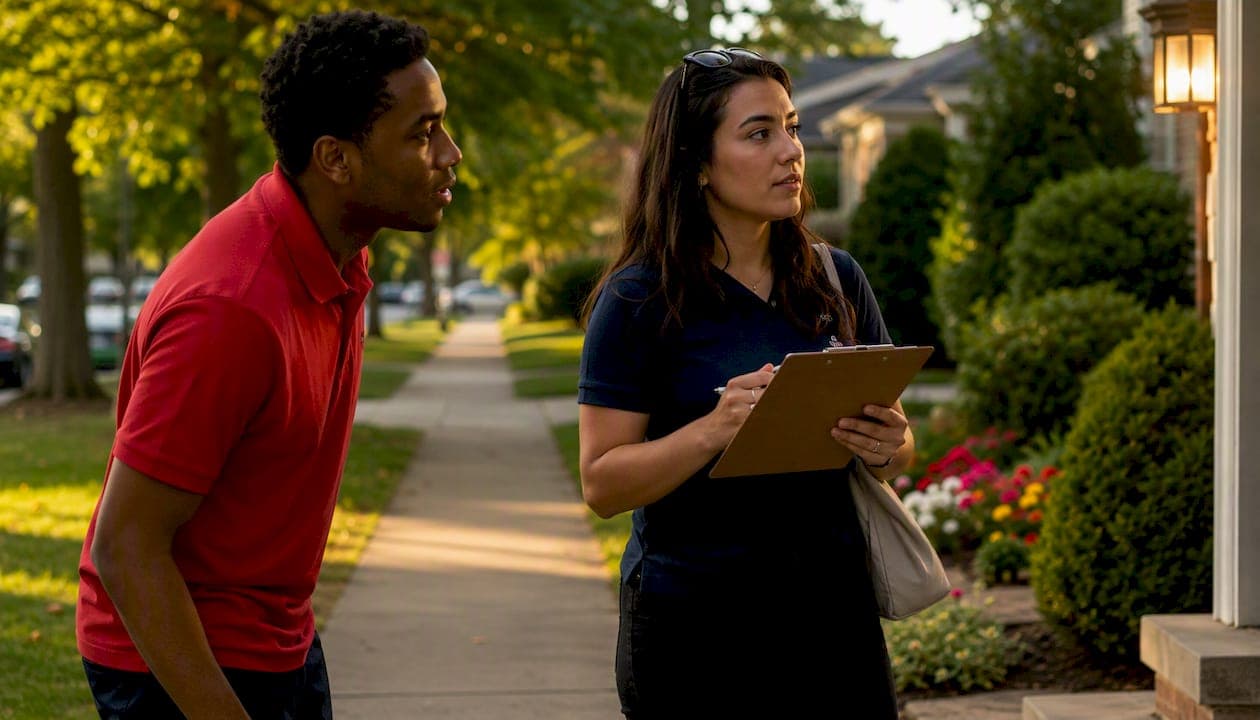
The most effective approach to political organizing is to build a base through repeated relational contact, then escalate with targeted pressure on a specific decision-maker. Before you run a single phone bank or knock a single door, you need three things: a clear goal, a named target, and a small team of organic leaders who will recruit others.
Copy this organizing sentence and fill it in before you do anything else: "We are organizing [people] to [strategic goal] through [tactics] by [timeline]." Every decision you make — which tactics to run, who to recruit, when to escalate — flows from that sentence.
Three actions to take in the next 72 hours:
- Hold one-on-one conversations with people in your community to identify who already has informal influence (these are your organic leaders).
- Build a rough power map: list every person or institution that can grant or block your goal, and draw lines showing who influences whom.
- Recruit organic leaders and give each one a concrete, low-stakes first ask (a structure test) to gauge commitment.
The NLIHC organizing cycle formalizes this sequence into five phases. Relational organizing frameworks like Empower and Indivisible's VET model give you the scripts and tools to run it. Campaignbuddyhq is the recommended operations tool for logging outreach, tracking progress, and keeping your team accountable across every phase.
Pro Tip: Write your organizing sentence on a whiteboard and keep it visible at every team meeting. When a tactic debate breaks out, the sentence cuts it short — if the tactic doesn't serve the goal, skip it.
Table of Contents
- Which tactics work for which campaign goals?
- How do you turn tactics into a coherent campaign plan?
- What operational tools and training does your team actually need?
- How do you measure whether your organizing is working?
- Why does relational organizing outperform every other tactic?
- Key Takeaways
- What experienced organizers wish they had known
- Campaignbuddyhq keeps your organizing on track
- Sources and further reading
Which tactics work for which campaign goals?
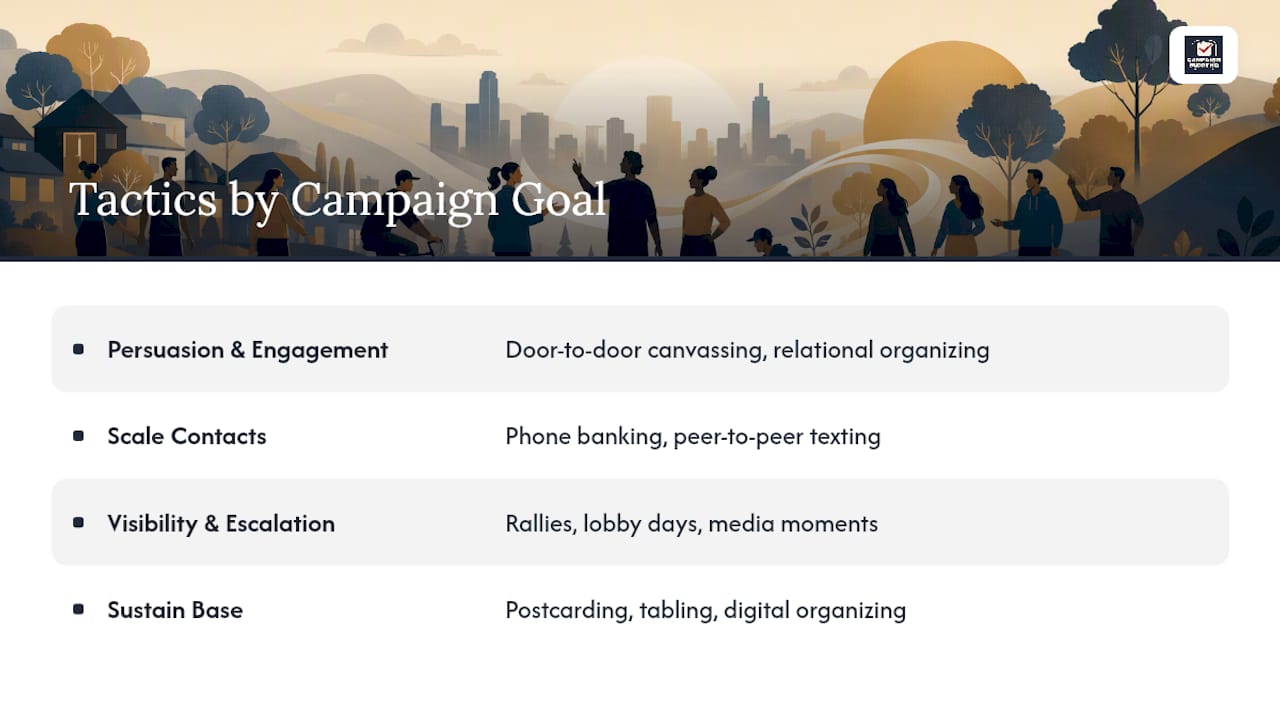
For persuasion and deep engagement, door-to-door canvassing and relational organizing win. For scaling contact volume quickly, phone banking and peer-to-peer texting are the right tools. For visibility and escalation, rallies, lobby days, and media moments apply pressure. For sustaining the base between peaks, postcarding, tabling, and digital organizing keep people connected.
Door-to-door canvassing
Canvassing produces the deepest interactions of any contact method. A trained volunteer at a door can identify supporters, persuade undecideds, and recruit new leaders in a single conversation. According to the REAMP Grassroots Tactics Planning Guide, door canvassing consistently outperforms phone contact for quality of engagement.
Steps:
- Pull a walk list from VAN or MiniVAN filtered to your target universe.
- Brief volunteers on the script, the goal (persuasion, recruitment, or GOTV), and safety protocols.
- Knock, introduce yourself, deliver the opening rap, and listen more than you talk.
- Record responses in MiniVAN immediately — never batch-enter at the end of the day.
- Flag anyone who expressed interest in getting more involved for a follow-up one-on-one.
- Debrief the team within 24 hours.
Sample door rap: "Hi, I'm [name] with [organization]. We're talking to neighbors about [issue]. Have you been following what's happening with [specific local impact]? [Listen.] We're organizing people to [goal] — would you be open to coming to a meeting next week?"
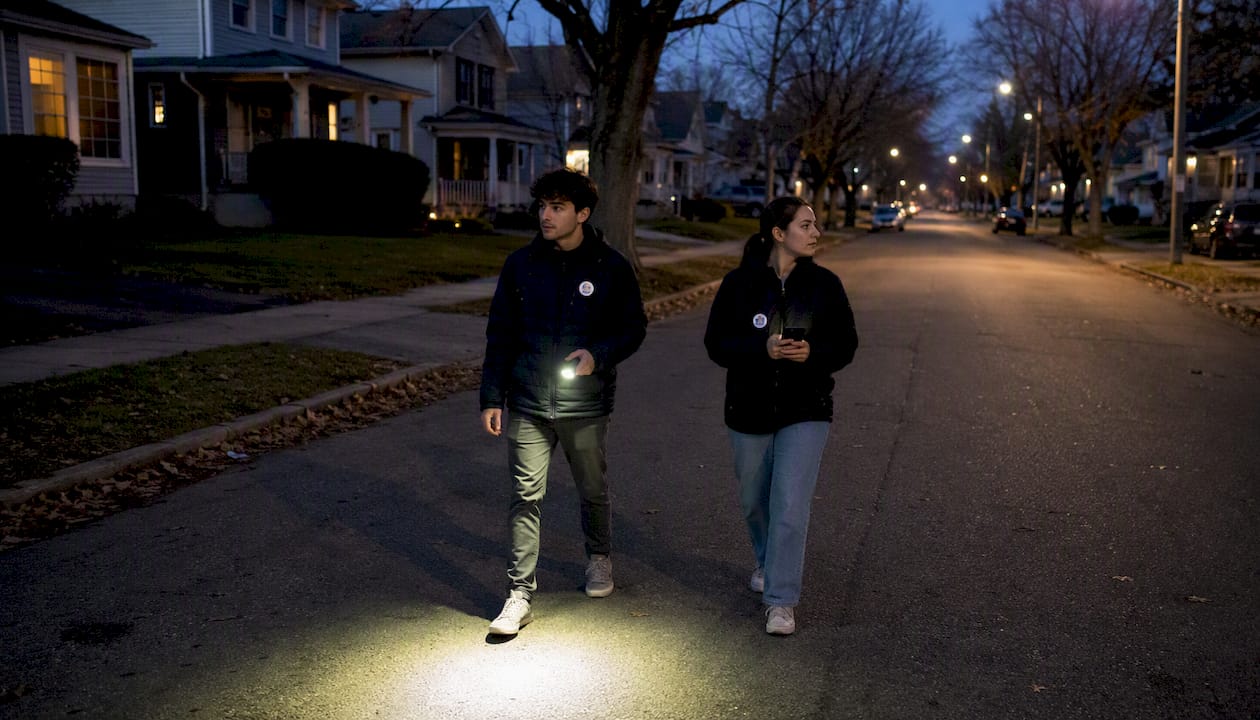
Safety and legal notes: Always canvass in pairs after dark. In the U.S., you generally have the right to knock on doors in public residential areas, but respect posted "No Soliciting" signs and private property rules. Never misrepresent your affiliation.
Phone banking
Phone banking scales contact volume when you can't put enough bodies on the ground. It's less effective for deep persuasion but strong for GOTV reminders and event recruitment. Use VAN to manage call lists and track dispositions in real time.
Steps:
- Set up a calling event in VAN and assign lists to volunteers.
- Train callers on the script and how to handle common objections.
- Run a 10-minute practice round before going live.
- Log every call result immediately — "not home," "supportive," "hostile," "wants more info."
- Export a follow-up list of warm contacts within 48 hours.
Relational organizing
This is the highest-leverage tactic for durable power. Relational organizing asks volunteers to have structured conversations with people they already know — friends, coworkers, neighbors, family members. People trust people they know. The Sierra Club Movement Organizing Manual frames this through the "story of self, us, now" approach: your personal story connects to a shared story, which connects to an urgent call to action.
Steps:
- Give each volunteer a contact list of 10–15 people they know personally.
- Train them on the one-on-one conversation structure (ask, listen, connect to the issue, make an ask).
- Track commitments in a shared spreadsheet or Empower.
- Follow up with every warm contact within a week.
- Invite the most engaged contacts to a house meeting or training.
Postcarding, tabling, and other contact methods
Postcards work for low-cost, high-volume voter contact — especially for GOTV and issue awareness. Tabling at community events builds visibility and captures new contacts. Neither replaces relational organizing, but both feed the base of the ladder.
"Effective voter-engagement programs combine direct voter contact with indirect methods — the combination creates multiple touchpoints that reinforce each other." — Indivisible VET Guide
Lobby days and rallies
Lobby days are structure tests: they show decision-makers that your base is real and organized. Rallies create public visibility and media moments. Both work best when they're part of an escalation sequence, not standalone events. A lobby day with 50 trained constituents who each have a scheduled meeting with their representative lands differently than a rally with 500 people who don't know their rep's name.
Digital organizing tactics
Peer-to-peer texting (P2P) through platforms that integrate with VAN reaches supporters at scale with a personal feel. Social microtargeting on Facebook and Instagram can identify and recruit new supporters in specific zip codes. Storybanking — collecting short video or written stories from supporters — gives you shareable content that converts online interest into offline action. The Community Organising Guide emphasizes that digital tactics work best when they have a clear offline next step: every text, post, or email should ask the recipient to do something in person.
Fundraising tactics
Fundraising isn't separate from organizing — it's a leadership development tool. When you ask a supporter to host a fundraising house party, you're giving them ownership of the campaign. Recurring donor asks tied to specific milestones ("We need 50 people giving $10/month to fund our canvass through November") connect money to movement. Event fundraising — dinners, concerts, community gatherings — builds community while generating revenue.
Pro Tip: Tie every fundraising ask to a concrete organizing goal. "Help us knock 10,000 doors this month" raises more money than "support our campaign" and recruits donors into the organizing story.
Coalition building
Coalitions multiply your power without multiplying your budget. Identify organizations that share your goal (even if their primary mission differs), map their self-interest, and design a shared ask that serves everyone. The Organizing for Power visual guide recommends approaching potential coalition partners the same way you approach organic leaders: learn what they value first, then make a specific ask.
For coalition-building in politics, the key is a written shared agreement that defines the goal, the decision-making process, and what each partner contributes. Coalitions without written agreements fracture under pressure.
How do you turn tactics into a coherent campaign plan?
Your target is always a specific person with decision-making authority, not an institution. "City Hall" can't make a decision. The mayor can. "The school board" can't be pressured. The board chair can. Naming a person forces you to research their self-interest, map their relationships, and design escalation steps that actually reach them.
Building your escalation plan
Escalation means increasing pressure in a sequence of steps, each one more visible and costly to the target than the last. The sequence should start with private asks (research meetings, letters) and move toward public pressure (rallies, media, lobby days) only when private asks fail. Organizing for Power recommends designing escalation around structure tests: small, measurable actions that tell you whether your base is ready to move to the next level.
Escalation checklist:
- Research meeting with the target (intelligence-gathering, not persuasion)
- Formal letter or petition with signatures from named constituents
- Small public action (10–20 people) at a visible location
- Media moment (press release, op-ed, earned media)
- Lobby day with trained constituent meetings
- Large public rally or demonstration
- Electoral accountability action (if applicable)
Timeline template for a 3–6 month local campaign
- Weeks 1–4 (Foundational phase): Run one-on-ones, build your power map, recruit organic leaders, form your core team.
- Weeks 5–8 (Kick-off): Hold a public launch event, begin canvassing and phone banking, establish your cadence.
- Weeks 9–16 (Periodic peaks): Run structure tests, escalate with a lobby day or small public action, recruit new volunteers from each action.
- Weeks 17–20 (Final peak): Execute your highest-visibility action (rally, large lobby day, media moment).
- Weeks 21–24 (Resolution): Deliver your demand, evaluate the outcome, celebrate wins, debrief losses, and begin the next cycle.
Campaign design checklist:
- Organizing sentence written and shared with the full team
- Target named (a specific person, not an institution)
- Power map completed with allies, opponents, and persuadables identified
- Escalation sequence designed with at least five steps
- Structure tests defined for each phase transition
- Pew Research data on civic participation patterns reviewed to identify underrepresented groups in your outreach universe
- Timeline posted and shared with all team leaders
What operational tools and training does your team actually need?
The four operational pillars are data, people, training, and compliance. Skip any one of them and your tactics will underperform regardless of how well-designed they are.
Data and tools
VAN (Voter Activation Network) is the standard voter database for progressive campaigns in the U.S. It stores voter contact history, demographic data, and supporter scores. Most state Democratic parties provide VAN access to affiliated campaigns and organizations.
MiniVAN is VAN's mobile canvassing app. Volunteers use it to pull walk lists, record door-knock results, and sync data in real time. Logging results immediately — not at the end of the shift — is the single most important data discipline a canvass team can develop.
Empower is a relational organizing platform that lets volunteers manage their personal contact lists and track conversations with people they know. It integrates with VAN and is particularly effective for field organizing in communities where cold contact is less effective than warm introductions.
BallotReady provides voter-facing information about candidates and ballot measures. Organizers use it to help supporters understand what's on their ballot and to drive informed turnout.
Volunteer training checklist
- One-on-one training session covering the campaign's organizing sentence, the issue, and the ask
- Script practice with role-play and feedback (minimum two rounds)
- Safety briefing: canvassing in pairs, de-escalation basics, what to do if confronted
- Accessibility accommodations: know your route's physical accessibility, have materials in multiple languages if needed
- Data entry training: how to log results in MiniVAN or your tracking sheet
- Debrief cadence: every shift ends with a 10-minute team debrief
U.S. legal basics
Campaign finance rules, solicitation laws, and lobbying disclosure requirements vary by state and by whether your organization is a 501(c)(3), 501(c)(4), PAC, or candidate committee. The Federal Election Commission governs federal campaigns; state ethics commissions govern state and local activity. Before you run a fundraising event, send a mass solicitation, or register as a lobbyist, get a one-hour consultation with a campaign finance attorney. The cost is far lower than a compliance violation.
Pro Tip: Log every outreach activity the same day it happens and run a weekly data report every Monday morning. Campaigns that report weekly catch problems early — a canvass team logging only 60% of contacts is a data problem you can fix in week two, not week ten.
How do you measure whether your organizing is working?
Three metrics matter above all others: participation rate (how many people took an action), engagement depth (how many moved up the ladder), and target response (did the decision-maker change their position or behavior?). Everything else is context.
Sample campaign dashboard
| Metric | What it measures | Reporting cadence |
|---|---|---|
| Doors knocked / calls made | Contact volume | Weekly |
| One-on-ones held | Relationship depth | Weekly |
| People moved up the ladder | Engagement progression | Monthly |
| New volunteers recruited | Base growth | Weekly |
| Lobby meetings secured | Target access | Per action |
| Decision-maker responses | Target movement | Per escalation step |
| Fundraising revenue | Sustainability | Monthly |
After-action template
Run this debrief within 48 hours of every major action:
- What was the goal? (Specific, measurable)
- What happened? (Actual turnout, media coverage, target response)
- What worked? (Name specific tactics and people)
- What didn't? (Be honest — vague answers don't improve the next action)
- What do we do differently next time?
- Who showed up that we should follow up with?
Report results to your base within a week of every action. People who took a risk to show up deserve to know what happened. Silence after an action is one of the fastest ways to lose volunteers. For campaign reporting best practices, track both outputs (doors knocked) and outcomes (supporters identified) so you can distinguish activity from progress.
Why does relational organizing outperform every other tactic?
The research consensus is clear: relational organizing produces more durable power than any other method, and storytelling increases both recruitment and retention. The reason is straightforward. People trust people they already know. A friend asking you to attend a meeting is categorically different from a stranger calling from a list.
The Sierra Club Movement Organizing Manual grounds this in the "story of self, us, now" framework. Your personal story (why you got involved) connects to a shared story (what we have in common), which connects to an urgent call to action (what we need to do right now). That three-part structure converts a conversation into a commitment.
"Organizing works because it builds relationships of mutual accountability — not just networks of people who agree with each other, but teams of people who have made specific commitments to each other and to a shared goal." — Commons Library, Community Organising Guide
Pew Research data shows that civic participation correlates with education and income — which means standard outreach methods systematically underreach lower-income and less-educated communities. Relational organizing, which works through existing social networks rather than cold contact, is the most effective way to reach those communities.
Practical checklist for running structured one-on-ones:
- Schedule 30–45 minutes in a quiet, comfortable location.
- Open with a genuine question about the person's life, not the campaign.
- Listen for values, not just opinions — what do they care about most?
- Share your own story using the "story of self, us, now" structure.
- Make a specific ask before you leave (attend a meeting, make three calls, host a house party).
- Log the conversation and any commitments within 24 hours.
- Follow up within one week.
Mini case study: In a 2023 local housing campaign in a mid-sized Midwestern city, a small team of six organizers ran 200 structured one-on-ones over eight weeks. They identified 22 organic leaders — people who already had informal influence in their buildings or blocks. Those 22 leaders each recruited an average of four additional participants for the campaign's first public action, producing a turnout of roughly 110 people with no paid advertising. The escalation-ready base they built in those eight weeks sustained three subsequent actions over six months.
Key Takeaways
Effective political organizing requires a relational base, a named target, a sequenced escalation plan, and consistent data discipline — campaigns that skip base-building in favor of early mobilization consistently underperform.
| Point | Details |
|---|---|
| Organizing vs. mobilization | Organizing builds new leaders and capacity; mobilization activates an existing base for a specific ask. |
| Five-phase cycle | Base building, issue selection, research, action, and evaluation form a repeatable cycle — skip phases at your peril. |
| Relational organizing wins | Structured one-on-ones and the "story of self, us, now" framework produce more durable commitment than cold contact. |
| Escalation requires a person target | Name a specific decision-maker, not an institution, and design each escalation step to increase pressure on that person. |
| Campaignbuddyhq for operations | Campaignbuddyhq tracks outreach activity, logs one-on-ones, and visualizes campaign progress across every phase. |
24-hour actions:
- Write your organizing sentence and share it with your core team.
- Hold three one-on-one conversations with potential organic leaders.
- Build a first-draft power map with at least 10 names.
7-day actions:
- Recruit your core team of organic leaders.
- Run your first canvass or phone bank shift and log results in VAN or MiniVAN.
- Hold a team meeting to review your power map and confirm your target.
- Set up your campaign dashboard with the three core metrics.
90-day actions:
- Complete your base-building phase with a substantial number of one-on-ones logged.
- Run your first structure test (a small public action with an appropriately sized group).
- Hold a research meeting with your target or a key ally.
- Recruit your first wave of ladder-climbers into a leadership training.
- Launch your first fundraising ask tied to a specific organizing milestone.
What experienced organizers wish they had known
The biggest mistake in grassroots campaigns isn't a bad tactic. It's transactional outreach — treating people as bodies to move rather than leaders to develop. You can run a perfect phone bank and still lose, because phone banks don't build the kind of trust that sustains a campaign through setbacks. Relationships do.
Leadership development gets cut first when campaigns get busy. That's exactly backwards. The moment you're too busy to run one-on-ones is the moment you most need new leaders to share the load. If your campaign depends entirely on one or two people, it's not an organization — it's a project, and projects end.
Escalation planning is where most campaigns are weakest. Organizers design a rally, it goes well, and then... nothing. The target doesn't respond, the base gets demoralized, and the campaign loses momentum. The fix is to design your escalation sequence before your first action, so every action has a predetermined next step regardless of outcome. If the target responds, you have a follow-up meeting ready. If they don't, you have a larger action ready.
On internal conflict: coalitions fracture over process, not just substance. When two partner organizations disagree, the argument is usually about who has decision-making authority, not about the actual issue. Solve it before it starts with a written coalition agreement that names the decision-making process explicitly. A 30-minute conversation about governance at the start of a coalition saves weeks of conflict later.
Volunteer burnout is real and predictable. It spikes after a major action that doesn't produce an immediate win. The antidote isn't a pep talk — it's a clear next step and a genuine celebration of what the team accomplished. People can sustain effort through setbacks if they feel seen and if they understand why the next step matters.
Campaignbuddyhq keeps your organizing on track
Running these tactics without a system means losing data, missing follow-ups, and watching momentum stall between actions. Campaignbuddyhq gives progressive campaigns and advocacy groups a single place to log every door knocked, call made, and one-on-one held — so your team always knows where you stand against your goals.
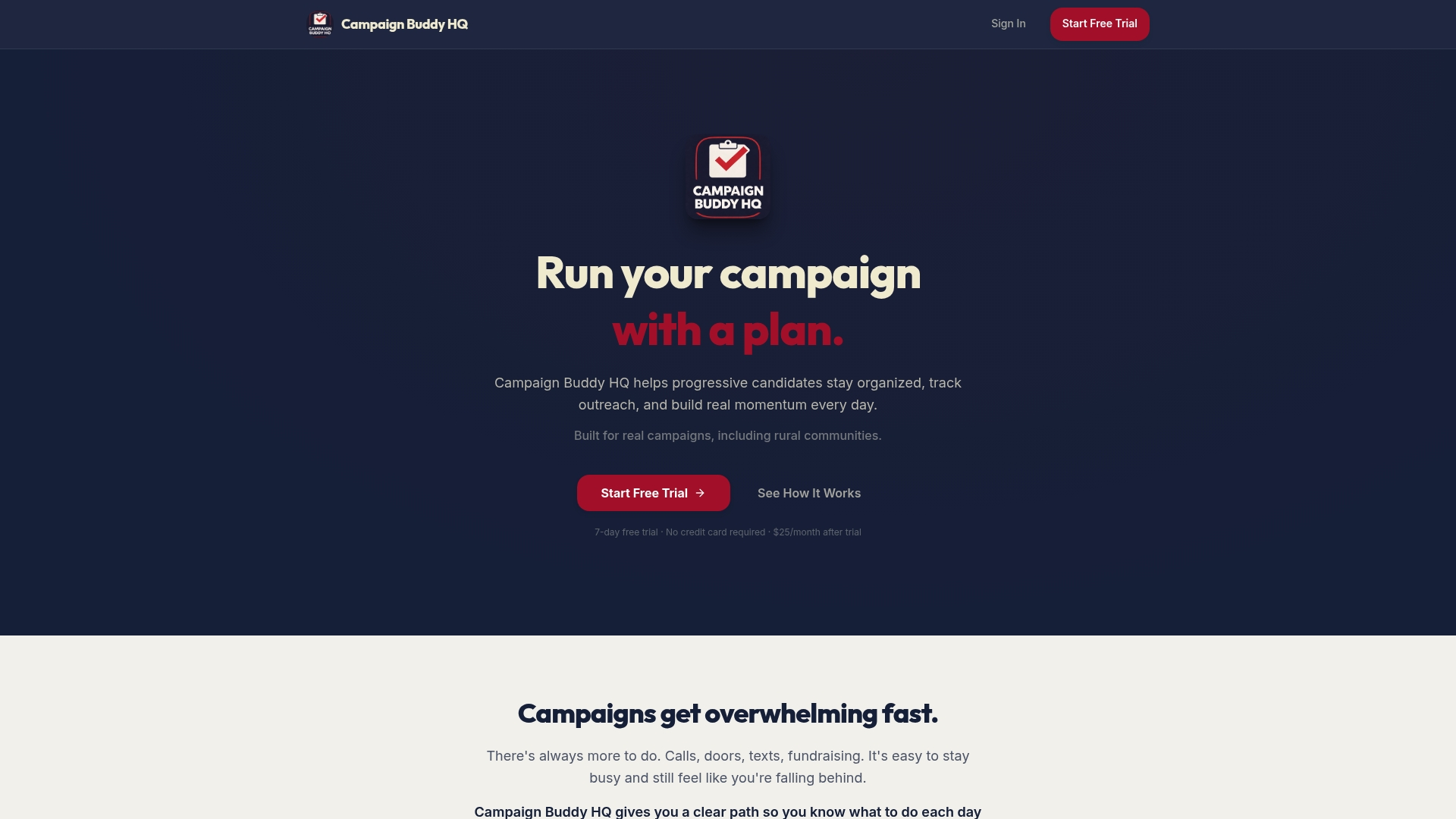
The platform's daily and weekly planning tools map directly onto the campaign phases covered in this guide: you can log outreach by phase, track supporter movement up the ladder, and visualize progress toward your organizing milestones. For campaigns in rural or low-density communities where every contact counts twice, the outreach logging and progress visualization features make the difference between guessing and knowing. AI-assisted content tools help you draft stump speeches and social posts without pulling your organizers off the field.
No credit card required. Start your free 7-day trial at Campaignbuddyhq and see how much cleaner your campaign runs when every action is logged, every volunteer is tracked, and your timeline is visible to the whole team.
Sources and further reading
-
ORGANIZING TO BUILD POWER — NLIHC: — The foundational text for the five-phase organizing cycle (base building, issue selection, research, action, evaluation) and leadership development principles. Essential for anyone building a new base.
-
The Sierra Club Movement Organizing Manual — Leading Change Network: — The best practical guide to relational organizing and the "story of self, us, now" framework. Read this before you train your first volunteer on one-on-ones.
-
ORGANIZING FOR POWER: A Visual Guide — Organizing4Power: — A visual, accessible guide to organic leader identification, structure tests, and escalation planning. Particularly useful for teams that are visual learners.
-
Organizing: People, Power, Change — Commons Library: — Covers the five leadership practices, the organizing sentence, and the snowflake leadership structure. Includes downloadable templates and workbooks.
-
REAMP Grassroots Tactics Planning Guide: — Step-by-step instructions for canvassing and phone banking, including sample scripts. The most practical tactical reference on this list.
-
The VET Guide — Indivisible: — Documents VAN, MiniVAN, Empower, and BallotReady in the context of voter engagement programs. Use this to set up your operational workflow.
-
It's All About the Base — Community Catalyst: — The definitive reference for the pyramid/ladder of engagement model, with examples of staged asks and base-building strategies.
-
The Community Organising Guide — Commons Library: — Practical tools for relational meetings, community mapping, and converting online interest into offline leadership. Strong on digital-to-offline strategy.
-
Americans with higher education and income are more likely to be involved in community groups — Pew Research Center: — Demographic data on civic participation patterns. Use it to identify gaps in your outreach universe and design equity-focused recruitment tactics.