

A CRM, or customer relationship management system, is the central platform political campaigns use to unify voter data, coordinate outreach, and drive supporter engagement across every channel. The role of CRM in campaigns goes far beyond storing contact lists. Platforms like Salesforce and HubSpot, along with purpose-built tools like Campaignbuddyhq, give campaign managers a single source of truth for every interaction, from door knocks to donation records. When CRM is used correctly, it replaces scattered spreadsheets with structured data that powers smarter decisions at every stage of a race.
How does CRM improve segmentation and targeting in political campaigns?
CRM software transforms raw voter data into precise targeting by pulling information from multiple sources into one place. Voter files, canvassing apps, donation platforms, and event sign-up forms all feed into the CRM, creating a complete picture of each supporter. That unified view is the foundation of every effective outreach strategy.

CRM platforms unify supporter data into a single source of truth, enabling personalized and coordinated campaign engagement. This matters because generic messaging wastes time and money. A first-time volunteer needs a different message than a three-cycle donor, and your CRM is the tool that tells you which is which.
Segmentation inside a CRM works across three dimensions:
- Demographic: Age, location, party registration, and precinct data let you target the right voters in the right geography.
- Behavioral: Who opened your last email, attended a rally, or donated in the past 30 days tells you who is warm and ready to act.
- Engagement level: Supporters who have taken three or more actions are prime candidates for volunteer recruitment, not just another ask.
Lifecycle messaging based on history and intent improves campaign relevance and conversion rates. Sending the right message at the right moment is not a luxury. It is the difference between a supporter who stays engaged and one who unsubscribes.
Pro Tip: Set up custom data fields in your CRM for campaign-specific signals, such as "attended town hall," "knocked doors in October," or "donated twice." These fields let you build hyper-specific segments that generic contact lists cannot replicate.
How does CRM integration with marketing automation enhance outreach?
Connecting your CRM to marketing automation tools is where the real efficiency gains appear. Automation handles the repetitive work so your team can focus on high-value conversations. The results are measurable and significant.
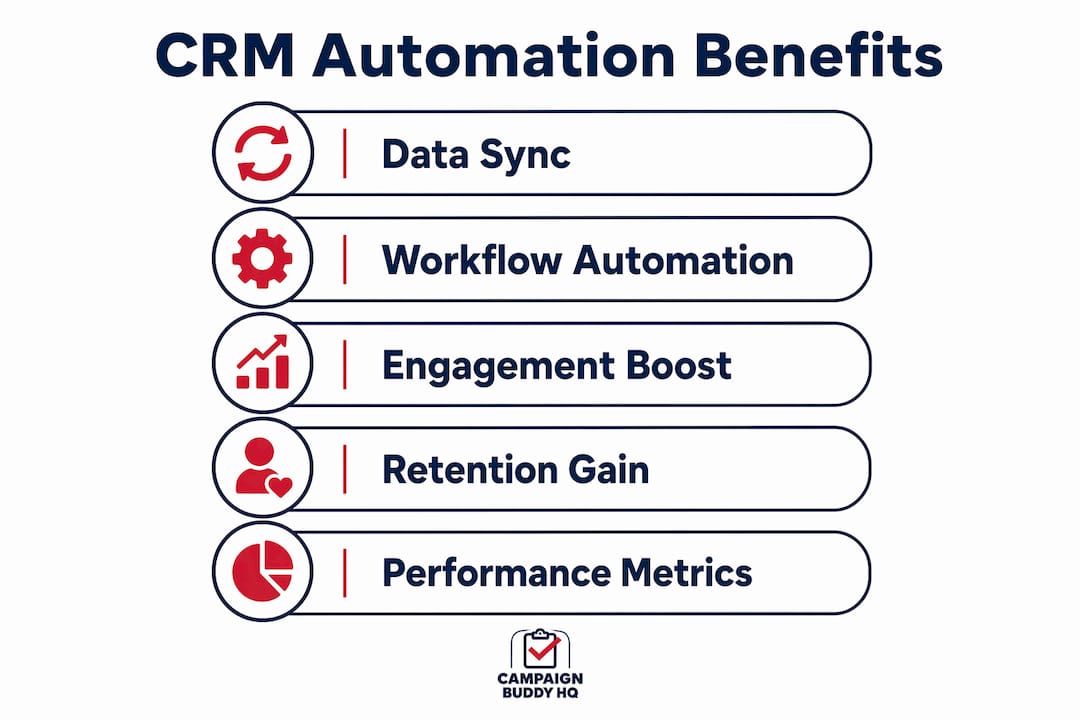
Integrating a CRM with marketing automation can increase lead conversion rates by up to 77%. For a campaign, that means more volunteers activated, more donors converted, and more voters mobilized from the same outreach effort.
Here is how a connected CRM and automation setup works in practice:
- Triggered emails: A supporter who fills out a volunteer form automatically receives a welcome email, a training link, and a calendar invite without anyone on staff lifting a finger.
- SMS follow-ups: Voters who attended a canvass kickoff get a text the next morning thanking them and linking to the next shift sign-up.
- Social media retargeting: CRM data exports feed custom audiences on Facebook and Instagram, so your ads reach people who already know your candidate.
- Donation re-engagement: Lapsed donors who gave six months ago receive a personalized email sequence timed to a key campaign milestone.
Workflow automation also prevents the gaps that kill momentum. Without it, a new volunteer who signs up on a Saturday might not hear from your campaign until Tuesday. By then, their enthusiasm has cooled. Automated workflows close that window and keep supporters moving through your engagement funnel.
CRM has evolved from a simple contact log into the central decision-making framework for coordinated, multi-channel engagement. Campaigns that treat it as a passive database miss the operational advantage entirely.
What operational changes does successful CRM adoption require?
Most CRM projects fail not because of the software but because of how the team treats it. Between 30% and 70% of CRM implementations fail to meet their objectives because organizations treat them as technology projects rather than operating model changes. Political campaigns make the same mistake constantly.
Adopting a CRM means changing how your team works every single day, not just adding a new app to the stack. That requires three structural commitments:
- Governance: Decide who owns the CRM data. One person or team must be accountable for data quality, field definitions, and access levels. Without ownership, the data degrades fast.
- Decision rights: Establish clear rules for who can add, edit, or delete records. Lack of governance and decision rights is one of the leading causes of CRM failure across organizations of all sizes.
- Daily workflow integration: CRM use cannot be optional. If your field organizers log doors in a spreadsheet and transfer data to the CRM weekly, you lose real-time visibility and create duplicate records.
Common pitfalls at this stage include letting staff revert to personal spreadsheets, skipping data entry during busy periods, and failing to train new volunteers on the system. Each of these creates data chaos that compounds over time.
Pro Tip: Assign a CRM lead on your campaign staff, even if it is a part-time role. This person sets standards, runs weekly data audits, and serves as the go-to resource for the team. Campaigns that skip this step almost always end up with unusable data by Election Day.
Building a solid campaign supporter database from the start makes CRM adoption far smoother and reduces cleanup work later.
How does CRM measurement and analytics drive smarter campaign decisions?
CRM analytics turn outreach activity into evidence. Instead of guessing which message worked or which precinct is underperforming, you have data that tells you exactly where to focus next.
Proper CRM implementation improves supporter retention by up to 25% in the first year. Retention matters in campaigns because re-engaging a lapsed supporter costs far less than recruiting a new one. Your CRM dashboard shows you who is drifting away before they disappear entirely.
The metrics that matter most for political campaigns inside a CRM include:
| Metric | What It Measures | Why It Matters |
|---|---|---|
| Supporter retention rate | Percentage of active supporters who stay engaged over time | Identifies drop-off points in your engagement cycle |
| Outreach response rate | Percentage of contacts who respond to calls, texts, or emails | Measures message effectiveness by channel |
| Volunteer conversion rate | Percentage of sign-ups who complete a first shift | Reveals gaps in your onboarding workflow |
| Donor re-engagement rate | Percentage of lapsed donors who give again | Tracks the ROI of re-engagement campaigns |
Businesses using CRM-driven marketing see 29% higher revenue on average compared to generic outreach methods. For campaigns, substitute "revenue" with "votes mobilized" and the principle holds exactly the same way.
CRM dashboards also let you run A/B comparisons on message variants. Send two versions of a fundraising email to two matched segments, then let the data pick the winner. Scale the winning version to your full list. This is how data-driven campaigns consistently outperform gut-feel operations.
Tracking your campaign outreach activities inside a CRM gives you the reporting foundation to make those comparisons meaningful and repeatable.
What are common CRM pitfalls in campaigns and how do you avoid them?
Most CRM failures in campaigns are predictable and preventable. Knowing the warning signs before they become problems saves you weeks of cleanup and lost momentum.
The most common pitfalls include:
- Treating CRM as a tech deployment: Buying a platform and expecting results without changing workflows is the single biggest mistake. The software does not fix process problems on its own.
- Relying on spreadsheets in parallel: Campaign teams often bypass CRM systems for spreadsheets, which creates duplicate records, version conflicts, and data gaps that are nearly impossible to reconcile under campaign pressure.
- Overbuilding from day one: Trying to track every possible data point immediately turns your CRM into a cluttered mess. Starting with a small set of lifecycle programs and iterating based on measured outcomes is the proven path to sustainable CRM management.
- Skipping training: Staff who do not understand why the CRM matters will not use it consistently. Brief, role-specific training sessions are non-negotiable.
- No data review cadence: Weekly or biweekly data audits catch errors before they multiply. Campaigns that skip audits often discover data problems too late to fix them before a critical outreach push.
The fix for most of these pitfalls is the same: treat CRM adoption as an organizational discipline, not a software installation. Start with your core use cases, get the team using the system consistently, and add complexity only after the basics are solid.
Key takeaways
CRM works in political campaigns because it unifies supporter data, automates outreach, and gives managers the metrics they need to make faster, smarter decisions at every stage of the race.
| Point | Details |
|---|---|
| Segmentation drives results | Use CRM data fields to build demographic, behavioral, and engagement-based segments for precise targeting. |
| Automation multiplies output | Connecting CRM to automation tools can increase lead conversion by up to 77%, according to research. |
| Operationalization is required | Assign CRM ownership, establish governance, and integrate the system into daily workflows or adoption will fail. |
| Analytics improve retention | CRM measurement can improve supporter retention by up to 25% in year one by identifying drop-off early. |
| Start small and iterate | Launch with core lifecycle programs first, then expand based on measured performance to avoid data overload. |
Why most campaigns underuse their CRM (and what to do about it)
I have watched campaign after campaign invest in solid CRM software and then use maybe 20% of what it can do. The tool sits there logging contacts while the real work happens in a Google Sheet someone made in 2022. That gap between what CRM can do and what campaigns actually do with it is the most expensive problem in modern political organizing.
The reason is almost never the software. It is culture. Field organizers are under pressure to hit door numbers, not to log data correctly. Finance staff are chasing end-of-quarter deadlines, not cleaning donor records. Nobody has time to think about the CRM until the data is so messy it is useless.
The campaigns that get this right treat the CRM as a daily accountability tool, not a reporting afterthought. They check dashboards every morning the same way a field director checks weather before a canvass. They build workflows that make data entry the path of least resistance, not an extra step. And they assign someone, even part-time, to own the system and hold the team to it.
CRM is now viewed as essential for relationship-building, delivering value at the right moment rather than just mass messaging. That shift in mindset is what separates campaigns that use CRM as a contact database from campaigns that use it as a strategic advantage. If you are managing a race right now, the question is not whether you have a CRM. The question is whether your team is actually living inside it.
— Billy
Put your CRM strategy into action with Campaignbuddyhq
Understanding CRM strategy is one thing. Having a platform built for the realities of political campaigns is another.
Campaignbuddyhq is designed specifically for campaign managers and organizers who need to track doors, calls, texts, and registrations without a steep learning curve. The platform handles daily and weekly planning, outreach logging, supporter tracking, and campaign phases, all in one place. It works for grassroots operations in rural districts and high-volume urban campaigns alike. You can start your free trial with no credit card required and see exactly how it fits your workflow before committing. If you want to sharpen your outreach approach before diving in, the campaign outreach guide is a strong next step.
FAQ
What is the role of CRM in political campaigns?
CRM serves as the central platform for managing supporter data, coordinating outreach, and tracking engagement across channels like calls, texts, and canvassing. It replaces scattered spreadsheets with a single, organized system that drives smarter decisions.
How does CRM improve voter engagement?
CRM enables segmentation by demographics, behavior, and engagement history, so campaigns send the right message to the right person at the right time. Research shows this approach improves supporter retention by up to 25% in the first year.
What CRM tools work best for campaign management?
Platforms like Salesforce and HubSpot offer broad marketing automation features, while purpose-built tools like Campaignbuddyhq are designed specifically for political campaign workflows, including outreach logging and supporter tracking.
Why do CRM implementations fail in campaigns?
Between 30% and 70% of CRM projects fail because teams treat them as technology deployments rather than operational changes. Without governance, training, and daily workflow integration, the system goes unused or fills with bad data.
How does CRM measurement help campaign decision-making?
CRM dashboards track metrics like outreach response rates, volunteer conversion rates, and donor re-engagement, giving managers real-time visibility into what is working. Campaigns using CRM-driven data see 29% higher performance on average compared to generic outreach methods.