

Social media is the primary channel for political news for over 50% of Americans, making it the single most important communication tool for campaigns in 2026. The role of social media in political outreach goes far beyond broadcasting messages. It enables direct, two-way dialogue between candidates and voters, shapes political opinion through algorithmic exposure, and mobilizes communities at a speed no traditional channel can match. Campaigns that treat social media as a megaphone miss its real power. The ones winning in 2026 use it as a listening device, a trust-building engine, and a precision outreach tool all at once.
How do algorithms and platform mechanics affect political outreach on social media?
Feed algorithms are the invisible architects of political opinion. A 2026 study found that switching users from chronological to algorithmic feeds over seven weeks increased engagement and shifted political opinions toward more conservative policies. That finding matters because it proves algorithms do not just filter content. They actively reshape what voters believe.
The effects are also persistent. Users who gained new followers under an algorithmic feed kept those followers even after reverting to a chronological feed. This asymmetry means the political information environment a voter builds under algorithmic conditions outlasts any single campaign cycle. Campaigns that understand this dynamic can build durable audiences, not just election-season spikes.
Platforms in 2026 punish passive viewing and reward content that generates real back-and-forth. Posts that spark comments, shares, and replies get amplified. Posts that get scrolled past get buried. This is not a minor technical detail. It is the central logic that should drive every content decision you make.
Pro Tip: Run a weekly poll or Q&A session on your main platform. These formats signal active community engagement to the algorithm and cost almost nothing to produce.
Tactics that work with platform mechanics include:
- Live video sessions that invite real-time voter questions
- Polls and surveys tied to local policy issues voters actually care about
- Reply threads where campaign staff respond directly to constituent comments
- Community updates posted consistently to train the algorithm to prioritize your content
Understanding how algorithms shape public perception is not optional for campaigns. It is the foundation of every distribution decision.
What is the value of local influencers and trusted messengers?

Local, non-political influencers outperform national celebrities in vote conversion. Internet stardom does not always win votes. A barista with 2,000 loyal local followers who trust your candidate can move more votes than a national figure with 2 million followers who has no connection to the community. Credibility is local. Persuasion is personal.
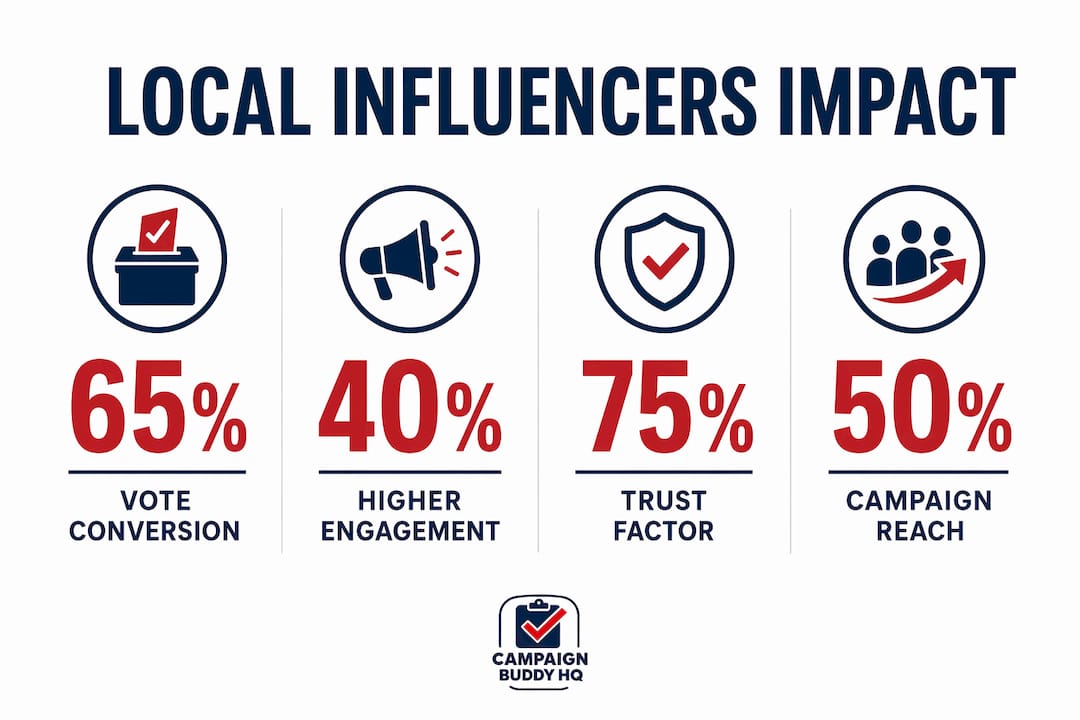
This is one of the most underused insights in political social media strategy. Campaigns spend heavily on celebrity endorsements and broad digital ads while ignoring the coffee shop owner, the youth soccer coach, or the neighborhood Facebook group admin who already has the trust of the exact voters they need to reach.
WhatsApp deserves special attention here. Its trust network structure makes it the most credible platform for localized political communication. Tiered group hierarchies, where a campaign coordinator manages a network of local group leaders who each manage smaller community groups, allow highly credible messages to travel through existing social trust rather than fighting for attention in a crowded public feed.
Here is a practical framework for building a local influencer network:
- Map your community. Identify trusted voices in each neighborhood, workplace, and civic group. Think teachers, coaches, faith leaders, and small business owners.
- Recruit before you need them. Build relationships with local messengers months before the election, not weeks.
- Give them real content. Provide talking points, short videos, and shareable graphics they can post authentically in their own voice.
- Activate WhatsApp groups. Establish a tiered structure where your campaign feeds information to community leaders who then share it within their own trusted circles.
- Track and respond. Monitor what local messengers are hearing from their communities and feed that intelligence back to your campaign messaging team.
Pro Tip: Identify three to five hyperlocal creators in each district who post about community life, not politics. A single authentic post from them reaches voters who actively avoid political content.
Which content formats drive the best results for voter outreach?
Video content drives higher engagement than static posts across every major platform. Short-form video on platforms like Instagram Reels and YouTube Shorts reaches younger voters who skip traditional ads entirely. Live streams build the kind of unscripted authenticity that polished campaign ads cannot replicate. Campaigns that commit to a consistent video presence see compounding returns as the algorithm learns to prioritize their content.
Authenticity is not a soft concept. It is a measurable driver of engagement. Voters in 2026 have seen enough produced political content to recognize and reject it instantly. A candidate filming a 90-second video from their car after a town hall outperforms a $10,000 studio ad in organic reach and comment engagement. The production value voters respond to is honesty, not lighting.
Platforms reward active engagement over passive consumption. This means campaigns must shift from content publishing to community management. Posting is the beginning, not the end. Responding to comments, acknowledging constituent concerns by name, and following up on previous conversations builds the kind of digital relationship that translates into real-world turnout.
Paid media still has a role, but its function has changed. A 2020 study involving 60,000+ participants found that removing political ads from social feeds had no measurable effect on political knowledge or voter turnout. Paid ads alone do not move voters. The better use of ad budget is to amplify organic content that is already performing well. Put money behind the video that got 500 comments, not the one your team spent three weeks producing.
For campaign activity ideas that translate social engagement into real-world action, the most effective formats combine digital interaction with offline follow-through.
How do misinformation, surveillance, and ethics shape political outreach?
Misinformation is the fastest-moving threat to campaign credibility on social media. A false claim about your candidate can spread across platforms in hours. Campaigns need a rapid response protocol that identifies false narratives early, issues clear corrections through official channels, and equips local messengers with accurate information to share within their trust networks. Silence reads as confirmation.
Perceived government surveillance suppresses political participation online. Research modeling political behavior across five countries found that even tech-savvy users reduce their online political activity when they believe they are being watched. This effect is strongest in high-surveillance contexts but appears across all environments. Campaigns targeting communities with high surveillance awareness need to address digital safety directly, not assume voters will engage freely.
Ethical use of data and AI tools is not just a legal question. It is a trust question. Voters who discover their data was used without clear consent do not just disengage. They actively campaign against the candidate who used it. Transparency about how you collect, store, and use voter data is a campaign asset, not a compliance burden.
"Campaigns that treat voter data as a resource to extract will lose the trust they need to win. The campaigns that treat it as a responsibility to protect will build the kind of loyalty that survives a bad news cycle."
Key ethical practices for social media outreach include:
- Clear opt-in consent for all data collection, including text and email lists built through social media
- Transparent AI use when AI tools generate or personalize campaign content
- Fact-checking workflows that verify claims before publishing, not after a correction is demanded
- Digital safety messaging for communities where surveillance concerns suppress participation
Key Takeaways
Social media outreach works best when campaigns combine algorithmic awareness, local trust networks, authentic content, and ethical data practices into a single coordinated strategy.
| Point | Details |
|---|---|
| Algorithms shape opinion | Switching to algorithmic feeds shifts political views and builds persistent follower patterns that outlast campaigns. |
| Local voices convert votes | Non-political local influencers and WhatsApp trust networks outperform national celebrity endorsements for vote persuasion. |
| Video and authenticity win | Short-form video and unscripted content drive more organic engagement than polished political ads. |
| Paid ads amplify, not replace | Ad budgets work best when they boost already-performing organic content rather than substitute for community engagement. |
| Ethics protect credibility | Transparent data use and rapid misinformation response are core campaign functions, not optional compliance tasks. |
What I've learned about social media outreach that most campaigns get wrong
Most campaigns treat social media as a broadcast channel with a comment section. That framing costs them the election. The campaigns I have watched succeed in 2026 do something fundamentally different. They listen first. They use social listening to identify the exact words, concerns, and frustrations their target voters use, and then they build messaging that reflects that language back. Voters do not respond to candidates who sound like candidates. They respond to candidates who sound like them.
The other mistake I see constantly is chasing viral moments at the expense of consistent community building. One viral video does not win an election. A candidate who shows up every week in the same community spaces, responds to comments, and remembers what voters said last month builds the kind of trust that actually moves people to the polls. Viral is a bonus. Consistency is the strategy.
Local trusted voices are the most underinvested asset in political social media. Every campaign I have seen pour money into national influencer deals while ignoring the local pediatrician, the union steward, or the PTA president who already has the trust of 500 voters in a swing precinct. Those relationships are worth more than any paid placement. Build them early, treat them as partners, and give them the tools to speak in their own voice.
The 2026 outreach trends that matter most are not about new platforms or new ad formats. They are about the fundamentals: authenticity, consistency, and community. Every platform change, every algorithm update, every new content format rewards the same underlying behavior. Show up, be real, and build relationships that outlast the election cycle.
— Billy
How Campaignbuddyhq helps campaigns put this into practice
Political outreach on social media generates a lot of activity. Tracking which doors, calls, texts, and digital touchpoints are actually moving the needle requires a system built for campaigns, not spreadsheets.
Campaignbuddyhq gives political campaigners, activists, and organizers a single platform to plan daily outreach, log supporter interactions, and monitor progress toward campaign goals. Whether you are coordinating a local influencer network, tracking community engagement across WhatsApp groups, or managing a rapid response workflow, Campaignbuddyhq keeps your team organized and your momentum visible. The platform is built for real-world campaign conditions, including rural and low-density communities where every contact counts. Start with a free 7-day trial and see how much cleaner your outreach operation can run.
FAQ
What is the role of social media in political outreach?
Social media connects campaigns directly with voters through two-way communication, content distribution, and community mobilization. Over 50% of Americans rely on it as a primary source of political news.
How do algorithms affect political campaigns on social media?
Algorithmic feeds increase engagement and can shift political opinions, with effects that persist even after the algorithm changes. Campaigns that create interactive content perform significantly better than those that post static updates.
Are local influencers more effective than national celebrities for campaigns?
Local, non-political influencers are more persuasive than national celebrities for vote conversion. Trusted community voices, including small business owners and civic leaders, carry more credibility with the voters campaigns need to reach.
How does misinformation affect social media political outreach?
Misinformation spreads faster than corrections and directly damages campaign credibility. Campaigns need a rapid response protocol and a network of trusted local messengers who can distribute accurate information quickly.
Does perceived surveillance affect voter engagement on social media?
Research across five countries confirms that perceived government surveillance reduces online political participation, even among tech-savvy users. Campaigns in high-surveillance communities should address digital safety concerns directly to encourage engagement.