
Digital outreach is the coordinated use of digital channels, data-driven tools, and automated communication to find, engage, and mobilize voters in political campaigns. Campaign managers who treat it as a system rather than a collection of tactics see the biggest gains. The role of digital outreach spans SMS messaging, email, social media, and AI-assisted content creation, all working together to move voters from awareness to action. Text messages alone carry a 98% open rate, making them one of the most reliable direct communication tools available. Campaigns that combine those channels with strong internal contact lists consistently outperform those that rely on paid ads alone.
What are the main components of digital outreach in campaigns?
Effective digital outreach in political campaigns is built on five core components: targeted contact lists, content creation, automation and scheduling, direct messaging, and data tracking. Each component depends on the others. A great message sent to the wrong list wastes money. A perfect list with no follow-up system loses momentum.
Targeted contact lists are the foundation. Without a clean, segmented database of supporters, volunteers, and persuadable voters, every other tactic loses precision. Building internal supporter lists gives campaigns a direct line to people who have already shown interest, which is far more reliable than chasing cold audiences through paid platforms.
Content creation and AI assistance now play a growing role in campaign operations. A 2026 survey found that 77% of campaign professionals use AI to increase production volume, primarily for drafting emails, social posts, and ad copy. Only 23% use AI for voter targeting. That gap matters because it shows AI is currently a productivity tool, not a replacement for human judgment on who to reach.

Direct messaging channels include SMS platforms like TextMyGov, email, Facebook, and Instagram. Two-way texting is especially powerful. Automated keyword responses let voters text a word like "VOTE" and instantly receive polling location details, reducing staff workload and cutting misinformation at the source.
Data tracking closes the loop. Campaigns that log every door knock, call, and text can identify which outreach activities convert and which do not. Without tracking, you are running blind.
- Build and maintain an internal contact database before launching any paid channel
- Use SMS for time-sensitive reminders and FAQ responses
- Use email for longer-form updates, fundraising, and volunteer recruitment
- Use Facebook and Instagram for awareness and event promotion
- Track every outreach activity to measure what drives real voter movement
Pro Tip: Start list-building on day one of your campaign. Viral content fades. A contact list you own compounds in value every week.
How does digital outreach compare to traditional offline methods?
Online and offline outreach produce similar positive effects on vote share, according to research based on the 2019 Estonian Candidate Study. That finding challenges the assumption that digital is inherently superior. Voters respond to consistent, credible messaging regardless of the medium it arrives through.
The more important insight is that the two channels reinforce each other. Voters exposed to intensive online campaigning also increase their offline voting activity, and the reverse holds true as well. Treating digital and offline as separate budgets is a strategic mistake.
| Factor | Digital outreach | Offline outreach |
|---|---|---|
| Speed | Instant delivery via SMS, email, social | Slower, requires physical presence |
| Scale | Reaches thousands simultaneously | Limited by volunteer capacity |
| Cost per contact | Low, especially for SMS and email | Higher due to printing and travel |
| Personal connection | Lower, though two-way messaging helps | Higher, especially door-to-door |
| Data feedback | Real-time open rates, click rates, replies | Harder to measure precisely |
| Rural reach | Requires internet or phone access | Strong in low-density communities |
| Credibility | Can face misinformation concerns | Seen as more personal and trustworthy |
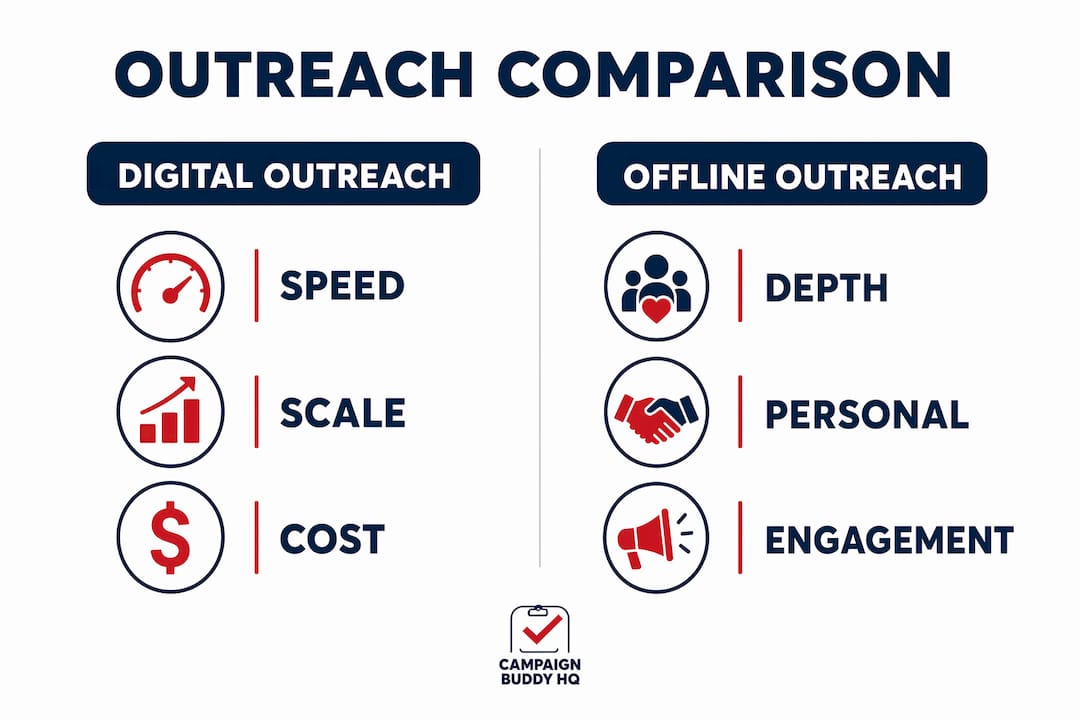
The practical takeaway is that digital outreach scales your message while offline outreach deepens it. A voter who receives a text reminder and then gets a door knock from a volunteer is far more likely to turn out than one who only experiences one channel. Coordinating both channels should be a non-negotiable part of your campaign plan.
What does research reveal about digital outreach effectiveness?
The most counterintuitive finding in recent political research is that digital ads alone move almost nothing. A large randomized experiment removed political ads from Facebook and Instagram for 6 weeks before the 2020 US election, covering over 62,000 users. The result: no detectable change in political knowledge, polarization, voter turnout, or participation. A separate study confirmed the same null effect across both Democrats and Republicans.
That does not mean digital outreach fails. It means paid ads without a follow-up system fail. Digital outreach works when it functions as an enabling system: ads build awareness, SMS reminders drive action, email funnels convert supporters into donors and volunteers, and data tracking tells you what to do next.
Key evidence-based conclusions for campaign managers:
- Political ads on Facebook and Instagram show no reliable direct effect on turnout when used in isolation
- Text messaging with 24/7 automated responses reduces misinformation and staff workload simultaneously
- 74% of campaign professionals say AI will be essential soon, but transparency about AI use remains low amid voter concerns about disclosure
- Two-way texting creates genuine voter engagement, not just broadcast communication
"Digital outreach should be treated as an enabling system with lists, reminders, and funnels — not as a standalone persuasion tool."
Pro Tip: Use official two-way messaging tools like TextMyGov to answer voter FAQs automatically. Authoritative, instant responses from your campaign reduce the window for misinformation to spread.
How can campaigns integrate digital outreach into a broader voter strategy?
Integration is where most campaigns leave votes on the table. They run digital and offline programs in parallel but never connect the data or the messaging. The result is a voter who gets contradictory information or no follow-up at all after an initial contact.
A coordinated approach follows a clear sequence:
- Build the contact database first. Every event sign-up, door knock, and phone call should feed a central list. Strong digital operations rely on frequent communication via email and SMS to mobilize volunteers and fundraise, not on one-off viral moments.
- Plan cross-channel conversion paths. A voter who likes your Facebook post should receive an email within 48 hours. A voter who texts your campaign should be added to your SMS list for election-day reminders.
- Combine digital reminders with live volunteer activity. Text a voter the morning of a canvass, have a volunteer knock that afternoon, and send a follow-up SMS that evening. Each touchpoint reinforces the last.
- Track every outreach activity. Log doors, calls, texts, and registrations in a single system. Tracking campaign activities lets you identify which combinations of contact produce the highest conversion rates.
- Use AI to augment staff, not replace voter contact. AI tools work best for drafting content, researching opposition, and summarizing data. Direct voter contact still requires a human voice.
The campaigns that win are the ones that treat every digital interaction as the start of a relationship, not the end of a transaction. A text message that gets a reply is worth ten ads that get a scroll.
Key Takeaways
Digital outreach works as a system, not a single tactic. Campaigns that combine targeted lists, direct messaging, cross-channel coordination, and consistent tracking outperform those that rely on paid ads alone.
| Point | Details |
|---|---|
| Ads alone do not move votes | Large experiments show political ads on Facebook and Instagram produce no detectable effect on turnout in isolation. |
| Text messaging leads in open rates | SMS carries a 98% open rate and delivers instant, authoritative voter communication around the clock. |
| Online and offline reinforce each other | Research confirms both channels produce similar vote-share gains and mutually increase voter turnout. |
| List-building is the core asset | Internal contact databases enable repeated follow-up, which drives more impact than any single viral moment. |
| AI boosts production, not targeting | 77% of campaign professionals use AI for content volume; only 23% apply it to voter targeting decisions. |
Why most campaigns misread what digital outreach actually does
I have watched campaign managers pour budget into Facebook ads and then wonder why their numbers did not move. The research now confirms what experienced organizers have known for years: ads create awareness, but awareness does not vote.
The campaigns I have seen succeed treat digital outreach as infrastructure, not advertising. They build lists obsessively. They send texts that voters actually respond to. They connect every digital touchpoint to an offline action. The Mamdani campaign's digital operation is a recent example worth studying. Its strength came from list depth and communication frequency, not from a single viral moment.
My honest concern about the current AI wave is the transparency gap. When 74% of professionals say AI will be essential but disclosure to voters remains low, that is a credibility risk waiting to surface. Use AI to write faster and research smarter. Do not use it as a substitute for genuine human contact with voters.
The campaigns that will win in 2026 are the ones that combine smarter digital strategies with disciplined offline execution. Digital outreach is not a replacement for knocking doors. It is the system that makes every door knock count more.
— Billy
How Campaignbuddyhq supports your outreach program
Campaignbuddyhq is built for exactly the kind of integrated outreach described in this article. The platform lets campaign managers log doors, calls, texts, and registrations in one place, plan daily and weekly outreach schedules, and track progress toward campaign goals across every phase.
For grassroots organizers running campaigns in rural or low-density communities, Campaignbuddyhq provides the structure to stay consistent when volunteer capacity is limited. The supporter tracking feature connects your contact database directly to your outreach log, so no follow-up falls through the cracks. Campaignbuddyhq offers a free 7-day trial with no credit card required. See how it works and start building the outreach system your campaign needs.
FAQ
What is the role of digital outreach in political campaigns?
Digital outreach is the coordinated use of SMS, email, social media, and data tools to engage and mobilize voters. It functions as an enabling system that connects awareness to action across multiple channels.
Do Facebook and Instagram ads actually increase voter turnout?
Research from a randomized experiment covering over 62,000 users found that removing political ads from Facebook and Instagram had no detectable effect on voter turnout or participation. Ads work best when paired with direct follow-up through SMS and email.
Why does text messaging outperform other digital outreach channels?
Text messaging carries a 98% open rate and supports two-way communication, allowing campaigns to answer voter FAQs automatically and deliver instant election reminders. That combination of reach and response capability makes it the most reliable direct channel available.
How should campaigns use AI in their digital outreach strategy?
Campaign professionals currently use AI primarily for content production and internal research, not voter targeting. AI is most effective when it helps staff draft faster and analyze data, while human volunteers handle direct voter contact.
Is digital outreach more effective than door-to-door canvassing?
Research shows online and offline outreach produce similar positive effects on vote share. The two channels reinforce each other, so campaigns that coordinate both consistently outperform those that rely on only one method.