
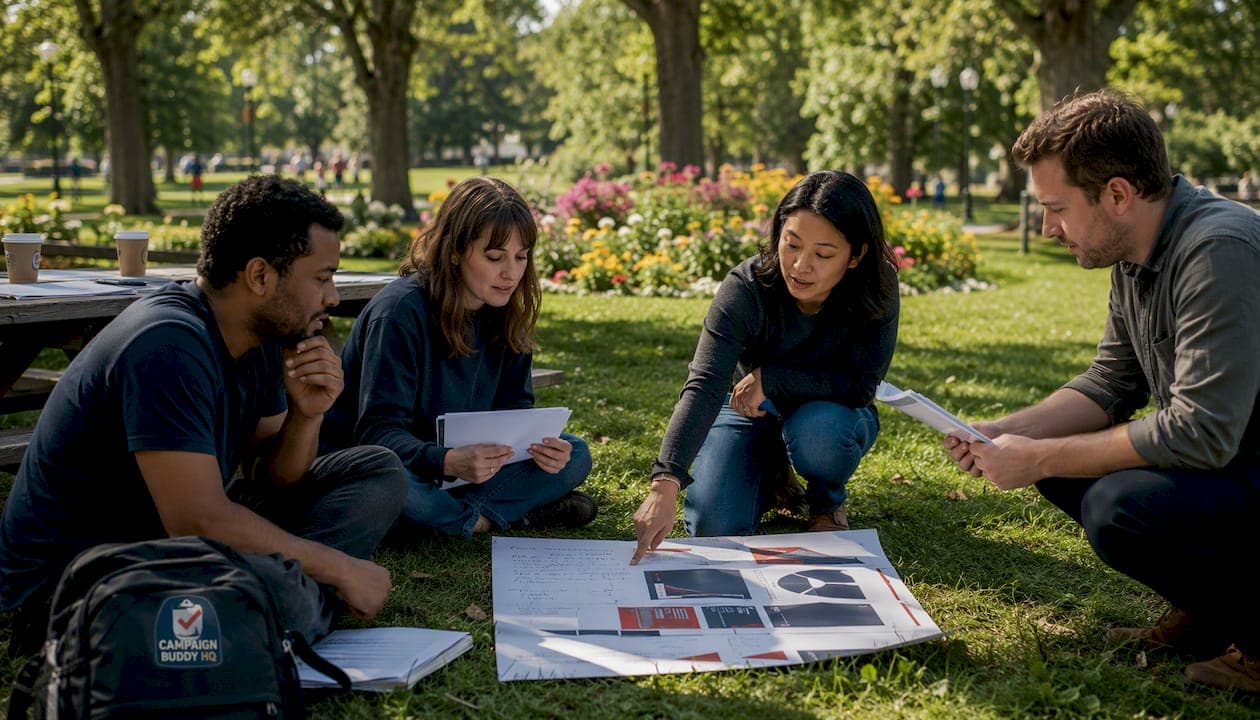
Start with six experiment-driven tips for community-driven campaigns, each following the one-objective, one-audience, one-KPI rule. These aren't abstract principles — they're the moves that separate campaigns that build real momentum from ones that burn out volunteers after week two.
- Pick one goal per experiment. Define whether you're building awareness, generating pledges, or recruiting volunteers — never all three at once.
- Identify one audience segment. Precinct captains, first-time voters, and rural supporters each need a different ask.
- Set one primary KPI before you launch. Completion rate, doors knocked, or registrations — choose one and track it daily.
- Map your coalition before assigning tasks. Know who covers phones, who covers doors, and who owns digital before the sprint begins.
- Run 3–5 day sprints, then repeat. Short cycles with predictable themes sustain participation far better than open-ended drives.
- Log everything in a campaign platform. Campaignbuddyhq tracks outreach activity, volunteer hours, and KPI progress so your data survives staff turnover.
One FEC reminder: any digital outreach, paid or organic, that expressly advocates for a federal candidate must carry proper disclaimers and be reported. Check your state's equivalent rules for state races.
Table of Contents
- What core principles make community-driven campaigns succeed?
- How do you design a reproducible campaign experiment?
- How do you build an activation cadence that keeps people coming back?
- How do you map stakeholders and build a coalition that reduces duplication?
- When should you use digital tools versus in-person outreach?
- What KPIs and reporting cadence should you track?
- What mistakes kill campaign momentum, and how do you fix them?
- How does Campaignbuddyhq support experiment-driven community campaigns?
- Key Takeaways
- What most campaign guides get wrong about community
- Campaignbuddyhq: run your experiments without the spreadsheet chaos
What core principles make community-driven campaigns succeed?
Community-led growth works when it prioritizes authentic peer-to-peer interaction over broadcast messaging. Four principles hold across nearly every successful grassroots effort.
Measurable experiments over one-off events. Every initiative should generate data you can act on. That means a clear hypothesis, a defined audience, and a metric you check before you declare success or pivot.

Restraint beats volume. Two well-run initiatives produce cleaner data and stronger volunteer morale than five half-finished ones. When your team is stretched, cutting a project is a strategy, not a failure.
Community is not a channel. A Facebook group, an email list, and a text broadcast are channels. A community is a space where members talk to each other, not just to you. Authentic connections and participatory structures — polls, spotlights, shared decisions — are what make growth durable.
Local coalition-building reduces duplication. When teachers, parents, small-business owners, and neighborhood groups each run their own outreach, you get overlap and conflicting messages. A formal coalition assigns lanes and aligns talking points before anyone makes a single call.
Pro Tip: In rural or low-density districts, create named roles like "precinct ambassador" that survive staff transitions. Institutionalizing the role preserves organizing infrastructure when original volunteers move on.
How do you design a reproducible campaign experiment?
One objective. One audience segment. One primary KPI. That's the rule. Every other decision flows from it.
- Write a hypothesis. "If we run a 5-day phone sprint targeting low-propensity voters in Ward 4, we will increase pledge rate by at least 10% compared to our last unstructured drive."
- Define the audience. Pull a specific segment from your supporter list — not "everyone" but a named cohort with shared characteristics.
- Choose your primary KPI. Pick one: pledge rate, doors completed, texts responded to, event RSVPs. Secondary metrics are fine to log, but only one drives your go/no-go decision.
- Set a measurement window. Three to six weeks works for most field experiments. Shorter windows miss the mid-campaign dip; longer ones lose focus.
- Estimate resources. Count volunteer hours, any small-event costs (venue, materials), and your tech subscription. A realistic budget line prevents mid-sprint surprises.
- Define your decision rule. "If pledge rate is below 8% by day three, we adjust the script and re-test on day four."
For task sizing, keep daily asks under 20 minutes for digital participants and under two hours for field volunteers. Fuzzy goals and oversized daily asks are the two most common reasons challenges collapse before they finish.
A quick KPI checklist before launch:
- Is the KPI measurable within the experiment window?
- Does one person own the daily tracking?
- Is there a defined threshold that triggers a pivot?
- Are volunteers briefed on what success looks like?
How do you build an activation cadence that keeps people coming back?
Engagement follows a predictable decay curve: novelty peaks on day one and drops sharply by day three. The fix isn't more energy — it's a predictable shape. When participants know what's coming next, they return.
Start with 3–5 day sprints, then repeat monthly with a consistent theme structure. Here's a sample cadence:
| Cycle | Format | Primary Metric | Retention Tactic |
|---|---|---|---|
| Week 1 | Onboarding sprint (3 days) | New volunteer sign-ups | Welcome message + buddy pairing |
| Week 2–3 | 5-day challenge | Daily check-in completion rate | Mid-challenge spotlight on top participants |
| Week 4 | Mobilization weekend | Doors/calls completed | Live leaderboard + recap post |
| Monthly close | Town-hall recap | Returning participant rate | Public recognition + next-cycle preview |
A few rules that make the cadence hold:
- Active participants get direct daily nudges; quieter members get a weekly summary, not daily pings.
- Every cycle ends with a public recap that names contributors and previews the next sprint.
- Themes rotate (voter registration, issue education, fundraising) but the structure stays identical so volunteers know the rhythm.
Check out progressive campaign activity ideas for theme variations that map to specific electoral phases.
How do you map stakeholders and build a coalition that reduces duplication?
Map roles, strengths, and outreach channels before assigning a single task. Successful advocacy coalitions connect diverse groups — teachers, students, parents, local businesses — and divide outreach work so no one duplicates effort.
A simple mapping matrix:
| Partner / Role | Organization | Capacity | Geographic Reach | Best Task Fit |
|---|---|---|---|---|
| Precinct captain | Local party | 10 hrs/week | Ward 3 | Door canvassing |
| Parent organizer | School PTA | 5 hrs/week | District-wide | Phone banking |
| Small-business owner | Chamber | 3 hrs/week | Downtown corridor | Peer texting |
| Faith leader | Community church | 2 hrs/week | Neighborhood | Event hosting |
Once the matrix is built, draft a one-page coalition charter covering three things: the shared objective (one sentence), messaging guardrails (three approved talking points), and a communication cadence (weekly check-in, biweekly debrief). Onboarding a new partner group takes less than 30 minutes when the charter exists.
For volunteer recruitment and retention tactics that complement coalition-building, the linked resource covers training structures and handoff protocols.
When should you use digital tools versus in-person outreach?
Digital tools should coordinate and document. In-person work should build trust. Mixing those up is where campaigns lose authenticity.
Use digital for:
- Scheduling shifts and sending reminders
- Logging outreach activity and tracking KPIs
- Sharing recaps, spotlights, and next-cycle previews
- Coordinating coalition partners across geography
Keep in-person for:
- Town halls and community listening sessions
- Leader training and volunteer onboarding
- Conflict resolution and sensitive conversations
- Any ask that requires a real relationship to land
Technology scales coordination but cannot replace the face-to-face moments that create lasting commitment. A volunteer who attended one training session in person retains more and recruits more than one who only received digital onboarding.
Pro Tip: Before every digital campaign, confirm your data practices comply with FEC guidelines and your state's campaign finance and privacy rules. One sentence in your coalition charter — "We collect and store supporter data in compliance with applicable federal and state law" — sets the standard for every partner group.
What KPIs and reporting cadence should you track?
Measure participation and conversion separately. One tells you if people are showing up; the other tells you if the campaign is working.
| KPI Type | Metric | Interpretation |
|---|---|---|
| Engagement | Daily check-in rate | Below 60% by day 2 — adjust the ask size |
| Engagement | Volunteer retention rate | Below 70% week-over-week — add a mid-cycle spotlight |
| Conversion | Pledge / registration rate | Primary outcome KPI — drives go/no-go decisions |
| Conversion | Doors completed vs. goal | Field efficiency — flag if pacing falls below 80% |
Reporting cadence:
- Weekly: operational check — are daily KPIs on track? Any scripts to adjust?
- Biweekly: tactical review — is the experiment producing usable data? Pivot or hold?
- Monthly: strategic debrief — what scaled, what didn't, what's the next hypothesis?
Decision rule example: if pledge rate is below your threshold by the midpoint of the experiment window, change one variable (script, time of day, channel) and re-measure for the remaining days. Don't change two variables at once — you won't know which one moved the number.
Pair this with campaign outreach checklists to keep operational details from falling through the cracks during reporting cycles.
What mistakes kill campaign momentum, and how do you fix them?
- Unclear goal → Write the hypothesis before the sprint starts. One sentence, one metric.
- Daily ask is too large → Cap field volunteer shifts at two hours; digital asks at 20 minutes.
- No visible proof of participation → Post a daily completion count or leaderboard update.
- No plan for the mid-challenge dip → Schedule a spotlight post for day three, when energy reliably drops.
- Overloaded calendar → Run one experiment at a time. Document the outcome before launching the next.
Pro Tip: When a challenge stalls after day three, a mid-sprint spotlight — naming two or three participants publicly — reliably restores momentum. It costs nothing and signals to quieter members that real people are completing the work.
The restraint rule applies here too. Campaigns that document two completed experiments have more to show funders, volunteers, and coalition partners than campaigns that attempted six and finished none.
How does Campaignbuddyhq support experiment-driven community campaigns?
Campaignbuddyhq maps directly to the templates in this article. The platform handles planning, outreach logging, cohort targeting, and KPI tracking in one place — so your experiment data doesn't live in three different spreadsheets.
Feature-to-template mapping:
- Experiment templates: build your hypothesis, audience, and KPI into a structured planning doc
- Outreach activity logs: track doors, calls, texts, and registrations per volunteer per day
- Activation cadence scheduler: set recurring sprint cycles with theme labels and milestone dates
- Stakeholder and coalition lists: assign roles, geographic reach, and task fits to partner groups
- KPI dashboards: monitor daily check-in rates, completion rates, and conversion metrics in real time
- Volunteer hour tracking: log and report staff and volunteer time for budget and compliance purposes
A small municipal campaign used Campaignbuddyhq to run a short voter-registration challenge targeting first-time registrants in two precincts. The team logged daily outreach activity, tracked completion rate against their daily threshold, and used the mid-cycle dashboard to identify which volunteers needed a check-in call. By the end, the campaign held steady on completion rate and exceeded its registration goal by several contacts — data they reused to design the next sprint.
Key Takeaways
Community-driven campaigns succeed when every initiative is designed as a measurable experiment with one objective, one audience, and one KPI — then repeated with a predictable cadence that keeps volunteers coming back.
| Point | Details |
|---|---|
| One-objective rule | Each experiment needs a single goal, audience, and KPI before launch. |
| Cadence beats novelty | Monthly themed sprints with predictable structure retain participants better than one-off events. |
| Coalition mapping first | Assign phone, door, and digital tasks only after mapping partner roles and capacity. |
| Restraint produces data | Two well-run experiments generate cleaner results than five half-finished ones. |
| Campaignbuddyhq | Tracks outreach logs, KPI dashboards, and sprint cadences in one platform for experiment-driven teams. |
What most campaign guides get wrong about community
Most playbooks treat community-building as a warm-up act for the real campaign work. That framing is backwards. The community infrastructure — the coalition charter, the named roles, the documented experiments — is the campaign. Everything else is execution.
The other thing guides underestimate is the cost of ambiguity. A volunteer who doesn't know what success looks like by day three will disengage by day four. That's not a motivation problem; it's a design problem. Specific goals, visible proof, and a mid-cycle spotlight aren't nice extras — they're the scaffolding that holds the whole structure up.
What I keep coming back to is the restraint principle. The campaigns that document two completed experiments and share the results with their coalition are the ones that attract better volunteers, stronger partners, and more credible funding conversations. The campaigns that launch six initiatives and finish none have nothing to show for the effort.
Build the experiment. Run it clean. Document the outcome. Then build the next one.
Campaignbuddyhq: run your experiments without the spreadsheet chaos
Campaignbuddyhq gives progressive campaign teams a single place to plan sprints, log outreach, and track the KPIs that actually matter — without stitching together a dozen disconnected tools.
The platform is built for the workflow this article describes: set your experiment hypothesis, assign your coalition roles, log daily outreach activity, and watch your KPI dashboard update in real time. Whether you're running a 5-day voter-registration challenge or a month-long mobilization cycle, every data point stays in one place and survives staff turnover.
- Plan and schedule recurring activation sprints with theme labels
- Log doors, calls, texts, and registrations per volunteer
- Track completion rates and conversion KPIs against your defined thresholds
- Manage stakeholder and coalition lists with role and capacity notes
No credit card required. Start a 7-day free trial at Campaignbuddyhq and import your first experiment template before your next sprint begins.