

For progressive campaigns in 2026, the segmentation mix that delivers the most operational impact combines three layers: behavioral signals (what supporters actually do), psychographic profiles (what motivates them), and community-based clusters (how they self-organize online). Start there, not with demographics alone.
Three actions to take this week:
- Tag every supporter who has opened an email, attended an event, or donated recently as "active engaged"
- Run five 10-minute phone interviews to capture the exact language supporters use about your issue
- Build one community cluster using follow-graph or shared-interest data and test a single outreach message against it
Tools like Campaignbuddyhq make this executable without a data science team. The RFM framework (recency, frequency, monetary value) gives you a scoring baseline, and platforms like Pulsar Platform show how community-based analysis is reshaping how campaigns understand their audiences in 2026.
Table of Contents
- What are the core campaign supporter segmentation methods?
- How do you collect the data that powers these segments?
- How do you turn raw signals into live, validated segments?
- How do you put segments into action across channels?
- How do you know whether segmentation is delivering value?
- What mistakes do campaign teams make most often?
- What does a realistic timeline look like for small and medium campaigns?
- How does Campaignbuddyhq map to the segmentation workflow?
- Key Takeaways
- Why demographics are the floor, not the ceiling
- Campaignbuddyhq gives you a running start on segmentation
- Useful sources and further reading
What are the core campaign supporter segmentation methods?
Seven methods cover the full range of supporter classification. Each serves a different campaign goal.
Demographic and geographic segmentation is the fastest to build. Age, zip code, precinct, and housing type come straight from the voter file. Use these for mail targeting, localized event invitations, and precinct-level turnout planning. They are necessary but not sufficient on their own.
Behavioral segmentation tracks what supporters actually do: email opens, SMS clicks, event attendance, donation history, and door-answer rates. RFM scoring gives you a clean baseline. A supporter who donated twice in the last 60 days and opened your last three emails scores differently from someone who gave once two years ago and has gone quiet.
Psychographic and attitudinal segmentation is where most campaigns leave money on the table. Surveys and direct interviews reveal the motivations and language that actually move people. Teams that stop at demographics produce operationally useless segments unless they add qualitative research to capture those motivations. A supporter who cares about housing affordability needs different framing than one whose primary driver is climate policy, even if they live in the same precinct.

Life-stage segmentation groups supporters by where they are in life: first-time voter, new parent, recent retiree, college student. Life stage shapes both channel preference and message resonance. It pairs well with demographic data but needs behavioral confirmation to be reliable.
Engagement-based segmentation maps the supporter lifecycle: new, active, lapsed, and major-gift prospect. Donors who haven't given in two years have very low reactivation probability and need bespoke re-engagement messaging or should be deprioritized entirely.
Community-based segmentation is the fastest-growing method. Pulsar Platform's 2026 research shows a clear shift toward clustering audiences by how they self-organize online, using follow-graph and shared-interest signals rather than demographics alone. This approach surfaces organic micro-influencers and cultural clusters that demographic slices miss entirely.
Pro Tip: Combine behavioral and psychographic methods for first-time donor cultivation. A supporter who attended your kickoff event (behavioral) and expressed concern about economic fairness in a survey (psychographic) is your highest-probability first gift prospect. Message them differently from a cold email subscriber.
For persuasion goals, lead with psychographic. For turnout, lead with geographic and behavioral. For fundraising, use RFM plus engagement-based lifecycle segments.
How do you collect the data that powers these segments?
The best data is already sitting in your CRM, voter file, and email platform. The gap is usually collection discipline, not access.
Five core data sources to activate:
- Voter file pulls via your state party or a vendor like L2 or TargetSmart: precinct, party registration, voting history, and modeled scores
- CRM fields: donation history, event attendance, volunteer hours, and contact preferences logged in Campaignbuddyhq or your existing platform
- Email and SMS engagement: open rates, click-through rates, and unsubscribe signals by message type
- Survey responses: 6–8 item surveys that capture issue priorities and channel preferences (deploy via text or email after an event)
- Social listening signals: follow-graph clusters, hashtag engagement, and comment sentiment from platforms your audience uses
For qualitative data, a 10–15 minute phone interview beats a 40-question survey every time. Ask: "What made you get involved?" "How do you talk about this issue with people who disagree?" "What would make you give again?" Those answers give you the language your copy needs.
Survey template essentials (6–8 items):
- Top issue priority (single select, 5 options)
- How they heard about the campaign (origin story)
- Preferred contact channel (email, text, phone, mail)
- Likelihood to volunteer in the next 30 days (1–5 scale)
- One open-text field: "What would you tell a neighbor about why this campaign matters?"
Privacy note: Collect only what you need for a defined outreach purpose. Honor opt-outs immediately, store data in a system with access controls, and map your data handling to your organization's internal policies and applicable U.S. privacy norms. Building a clean supporter list from the start prevents compliance headaches later.
Pro Tip: After any event, send a two-question SMS within 24 hours: "What issue brought you out tonight?" and "Can we count on you for [next action]?" Response rates are significantly higher than cold surveys, and the answers feed directly into psychographic tags.
How do you turn raw signals into live, validated segments?
Raw data does not become a segment until you define a threshold, name it, and test it.
A four-step process:
- Score your database. Assign RFM points (1–5 for recency, frequency, and monetary value), then add behavioral engagement points (email opens, event attendance, volunteer hours) and psychographic flags from survey responses or interview notes.
- Name and tag segments. Use a consistent naming convention:
[Campaign Phase]-[Segment Type]-[Priority Level]. Example:Primary-ActiveDonor-High. This keeps Campaignbuddyhq tags interoperable across your field, digital, and fundraising teams. - Set minimum thresholds. A segment needs at least 50 records to be worth a dedicated message. Below that, merge it with the closest adjacent group.
- Validate with a small test. Run an A/B test on two lists of 100–200 records each. Measure lift on one KPI only: open rate, donation conversion, or event sign-up. If you cannot see a measurable difference, the segment is not ready to scale.
Before you build 12 segments, build two and prove they work. A campaign that runs three validated segments consistently outperforms one that runs ten segments inconsistently. Start with your highest-engagement 20% and prove the model there first.
Pro Tip: Use a holdout group of 10–15% of each segment who receive your standard message. Compare their conversion rate against the segmented version. That gap is your proof of value when you need to justify the extra work to leadership.
How do you put segments into action across channels?
Segments are only useful when they drive different behavior from your team.
Workflow template per segment:
- Owner: who is responsible for this segment's outreach (field lead, digital lead, or fundraising director)
- Cadence: how often they are contacted according to segment priorities
- Content pillar: the core message frame tied to their psychographic profile
- Primary CTA: one ask per touch (donate, attend, share, volunteer)
For automation, set triggers in your CRM for lifecycle moves. A supporter who makes their first gift should enter a welcome series automatically. A lapsed donor who opens three emails in a row should move from "lapsed" to "re-engaged" without manual intervention. Campaignbuddyhq's outreach tracking features log door, call, and text activity so behavioral tags update in near real time.
Cross-channel mapping for one segment:
- Email: subject line and opening sentence matched to psychographic frame
- Phonebank: script opening line tailored to their issue priority
- Door list: canvasser talking points aligned to neighborhood-level community cluster
- Paid social: custom audience built from the same CRM export
Pro Tip: For psychographic segmentation in messaging, the DISC framework helps your field team adapt their communication style to different supporter personalities, not just their issue priorities. It takes 20 minutes to train volunteers on the basics and pays off in better door conversations.
How do you know whether segmentation is delivering value?
| KPI | What it measures | Target signal |
|---|---|---|
| Conversion rate | % of contacts who complete the ask | Lift vs. unsegmented baseline |
| Cost per conversion | Digital spend divided by donors or sign-ups | Declining over campaign cycle |
| Engagement lift | Open/click rate vs. control group | Positive delta on A/B test |
| Retention/upgrade rate | % of donors who give again or increase gift | Rising in active segments |
| Segment movement velocity | How fast supporters move between lifecycle stages | Acceleration = healthy pipeline |
Run a weekly snapshot that tracks each active segment's conversion rate and engagement lift. At the campaign level, a dashboard showing segment size, movement velocity, and cost per conversion tells you which segments to scale and which to retire.
For A/B tests, a minimum of 100 records per variant gives you enough signal for directional decisions. For fundraising tests, aim for 200+ per variant to account for lower base conversion rates.
What mistakes do campaign teams make most often?
Stopping at demographics. The fix: add three psychographic interview questions to your next volunteer training call and tag responses in your CRM the same day.
Over-segmentation. Twenty segments with 30 records each is worse than five segments with 300 each. Start with the top 20% of your database by engagement score and build from there.
Siloed data. Field, digital, and fundraising teams running separate lists with different naming conventions produce contradictory outreach. Centralize segment logic in one CRM and enforce a single tagging taxonomy.
Ignoring maintenance. Segments go stale fast during an active campaign. Review segments at least quarterly, or monthly when you are actively changing supporter behavior. Set automation rules so supporters move between segments based on behavior, not manual updates.
What does a realistic timeline look like for small and medium campaigns?
Small campaign (lean team of 2–3 people):
- Week 1–2: Pull voter file, clean CRM, and tag the top 20% of your database by engagement score
- Week 3–4: Run two A/B tests on your highest-priority segment and measure one KPI
- Roles needed: one data lead (part-time) and one field lead
Medium campaign (5–10 person team):
- Weeks 1–2: Data audit, voter file integration, and CRM field standardization
- Weeks 3–5: Run 200 qualitative interviews, build psychographic tags, and layer onto RFM scores
- Weeks 6–8: Three channel tests (email, phonebank, door) across two segments; measure and iterate
- Roles needed: data analyst, digital lead, and field coordinator
Minimum tech stack: a CRM with tagging and automation (Campaignbuddyhq covers this), a survey tool (Google Forms or SurveyMonkey for quick deploys), and a social listening tool for community cluster analysis.
Pro Tip: If you are within 60 days of election day, skip the full build and run a fast-track version: tag active vs. inactive, split your persuasion universe by top issue, and test one message variant. Two clean segments executed well beat eight messy ones every time.
How does Campaignbuddyhq map to the segmentation workflow?
Campaignbuddyhq is built for exactly this kind of layered, field-tested segmentation work.
| Segmentation step | Campaignbuddyhq feature |
|---|---|
| Tag behavioral signals | Outreach logging (doors, calls, texts, events) with custom tags |
| Store psychographic flags | Supporter notes and custom CRM fields |
| Automate lifecycle moves | Workflow automation and campaign phase triggers |
| Track segment performance | Progress dashboards and outreach activity reports |
| Push segments to channel lists | Export to email, phonebank, and door lists |
Three steps to create your first psychographic + behavioral segment:
- Import your supporter list and run an outreach log for the last 30 days. Tag everyone with two or more contacts as "active."
- Add a custom field for "top issue priority" and populate it from your survey responses or interview notes.
- Filter for active + top issue = [your priority issue] and save as a named segment. Push that list to your next email send and phonebank session.
Pro Tip: Use Campaignbuddyhq's campaign phase feature to automatically archive segments when a phase ends. This keeps your tag library clean and prevents old segments from polluting future outreach lists.
Key Takeaways
Behavioral plus psychographic plus community-based segmentation consistently outperforms demographic-only approaches for progressive campaigns, and the fastest path to results is validating two clean segments before building more.
| Point | Details |
|---|---|
| Start with three layers | Combine behavioral signals, psychographic profiles, and community clusters for the highest operational impact. |
| Validate before scaling | Run A/B tests on 100–200 records and measure one KPI before rolling a segment to your full list. |
| Maintain on a schedule | Review segments monthly during active campaign phases; quarterly is the minimum for any live database. |
| Avoid over-segmentation | Start with the top 20% of your database by engagement score and prove the model before expanding. |
| Use Campaignbuddyhq | Campaignbuddyhq's tagging, outreach logging, and workflow automation map directly to each step of the segmentation lifecycle. |
Why demographics are the floor, not the ceiling
The campaigns that consistently outperform their resource level share one habit: they treat demographic data as the starting point, not the destination. A precinct map tells you where people live. It does not tell you why they care, what language moves them, or which community they trust enough to act on a recommendation from.
The psychographic layer is where most progressive campaigns have the most untapped leverage. The interviews are not complicated. Fifteen minutes on the phone, three open-ended questions, and you have language you can use in every email subject line, every door script, and every paid social ad for the next three months. The teams that skip this step spend the same money and get half the conversion.
Community-based clustering is the other underused method. When you map how your supporters self-organize online, you find the people who are already doing your persuasion work for you. Those are your organic amplifiers. Reach them with the right message and they multiply your outreach without adding to your budget.
The segmentation work is not glamorous. It is a spreadsheet, a phone call, and a naming convention. But it is the difference between a campaign that feels like it is always chasing and one that feels like it is always building.
Campaignbuddyhq gives you a running start on segmentation
Segmentation only works when the data is organized, the tags are consistent, and the outreach is logged. That is exactly what Campaignbuddyhq is built to do for progressive campaigns.
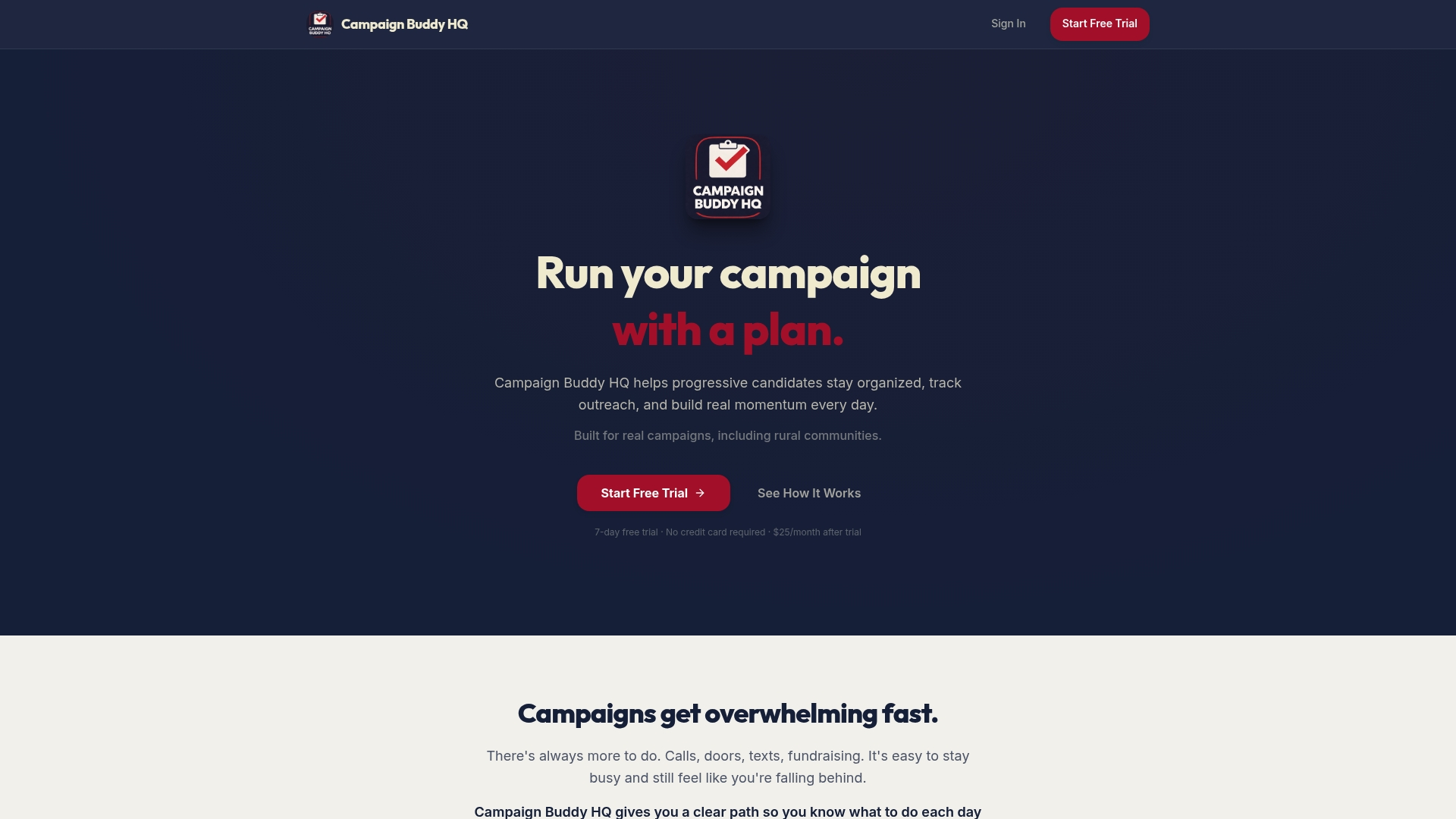
You get supporter tracking, outreach logging across doors, calls, texts, and events, custom tags for behavioral and psychographic segments, workflow automation for lifecycle moves, and progress dashboards that show you which segments are converting. It is designed for real campaign conditions, including rural and low-density communities where field data is harder to collect.
The 7-day free trial requires no credit card. In week one, import your supporter list, create two tags (active engaged and top issue priority), run a 100-record pilot send, and measure your open rate against your baseline. That is a complete segmentation pilot in seven days. After the trial, Campaignbuddyhq runs on a straightforward monthly subscription.
Start your free trial and run your first segmented outreach this week.
Useful sources and further reading
These are the primary sources cited in this article. Each one offers practical depth for teams that want to go further.
- RFM scoring and donor segmentation — DonorPerfect: A practitioner checklist for building RFM-based segments and layering behavioral data on top. Start here for scoring templates.
- Audience segmentation research for campaigns — User Intuition: Covers why qualitative interviews are the lever that turns demographic segments into persuasion tools. Includes interview frameworks.
- Community-based audience analysis — Pulsar Platform: Explains the 2026 shift toward follow-graph and interest-cluster analysis. Useful for social listening methodology.
- Data-driven voter segmentation — Propellant Media: Covers data sources (voter files, behavioral, geographic, third-party), scoring models, and A/B testing guidance for political campaigns.
- Donor segmentation strategy — Anedot: Practical guidance on segment maintenance cadence and the case for starting with 20% of your database.
- Donor lifecycle segmentation — Bloomerang: Covers lapsed donor handling, welcome series automation, and lifecycle segment templates.
- Donor segmentation guide — Kindsight: High-impact segment types (first-time, repeat, monthly, lapsed, major-gift prospect) with retention benchmarks.
- DISC for political campaigns — DISC Assess: How to apply psychometric profiling to staff, volunteer, and supporter communication for more effective field conversations.
- Build a campaign supporter list — Campaignbuddyhq: Step-by-step guidance on assembling and cleaning a supporter list before segmentation begins.
- Fundraising outreach guide — Campaignbuddyhq: Donor lifecycle and RFM examples with messaging templates for fundraising segments.