

Effective campaign team collaboration is defined as coordinated communication, shared workflows, and clear accountability directed toward a single campaign goal. Without it, even well-funded campaigns lose momentum to miscommunication and duplicated effort. The best campaign collaboration practices combine role clarity, repeatable processes, and the right communication norms. Campaignbuddyhq is built specifically to support these practices for political campaigns, advocacy groups, and grassroots organizers who need structure without bureaucracy.
1. Standardize workflows with templates before the campaign starts
Workflow standardization is the single fastest way to cut campaign setup time. Templates reduce setup from days to hours by pre-assigning tasks and mapping dependencies automatically. That time savings go directly into voter outreach, not planning meetings.
Start by building templates for your most common campaign types: door-knocking drives, phone bank events, and digital outreach pushes. Each template should include pre-assigned roles, task sequences, and approval checkpoints. When a new campaign phase begins, your team activates the template rather than rebuilding the plan from scratch.

Gantt charts keep timelines adaptive when deadlines shift. If one task slips, downstream dependencies adjust automatically. That visibility prevents the silent pile-up of delays that kills campaigns in the final week.
Intake gates and approval checkpoints belong in every template. They stop scope creep before it starts by requiring sign-off before a task moves forward. Think of them as traffic lights built into your workflow.
Pro Tip: Build at least three distinct templates: one for field canvassing, one for digital outreach, and one for fundraising events. Reusing a single generic template for every campaign type creates more confusion than starting from scratch.
2. Set communication protocols that match the message
The most common failure in team collaboration is using the wrong communication channel for the message. Overusing synchronous meetings for status updates creates an "always-on" culture that leads to burnout and kills deep work. Campaign teams that default to async communication and escalate to live conversation only when needed move faster and stay sharper.
Set explicit response time expectations for every channel your team uses:
- Slack or group messaging: respond within 4 hours during work hours
- Email: respond within 24 hours
- Phone calls: reserved for urgent blockers only
- Meetings: scheduled only when async communication has stalled
Clear response time expectations reduce anxiety across the team. When everyone knows when to expect a reply, they stop sending follow-up messages every 20 minutes.
Document every decision in a shared, persistent location. A Google Doc, a shared drive folder, or a platform like Campaignbuddyhq all work. The rule is simple: if it was decided in a meeting, it gets written down before the meeting ends.
"Teams should choose communication channels based on message purpose, reducing noise and improving clarity. Matching the channel to the message is not a preference. It is a discipline that separates high-performing teams from reactive ones."
The "observation-impact-request" framework is the most effective structure for giving feedback inside campaign teams. State what you observed, describe the impact it had, and make a specific request. This approach produces respectful, actionable feedback without the defensiveness that derails team dynamics.
3. Run a pre-launch sync and manage launch day in real time
Pre-launch chaos is predictable and preventable. A pre-launch sync 2–3 days before go-live surfaces blockers while there is still time to fix them. Use that meeting to confirm every role, verify every asset, and identify any dependency that has not been resolved.
On launch day, structure matters more than energy. Follow these steps to keep execution tight:
- Assign a single launch lead responsible for escalation decisions and real-time tracking.
- Create a dedicated "war room," physical or virtual, where the core team has live visibility into progress.
- Send structured status updates every 60–90 minutes to keep the full team informed without flooding channels.
- Limit Slack and email during active launch windows. Use direct voice or video for urgent issues.
- Log every issue and resolution in real time so the post-campaign retrospective has accurate data.
The launch lead role is the most underused position in campaign management. Most teams treat launch day as a group effort with no single point of accountability. That structure works fine until something breaks. Assign the role before launch day, not during it.
Pro Tip: Set a "launch day quiet hours" rule for non-essential Slack channels. Noise from unrelated conversations during a live launch is one of the fastest ways to miss a critical alert.
4. Define roles in writing before the kickoff meeting
Role ambiguity is the leading cause of ownership conflicts in campaign teams. Documenting role expectations before kickoff ensures every team member knows what they own and, equally important, what they do not own. Defining roles spontaneously during meetings produces assumptions, not agreements.
A written role definition includes three things: the specific deliverables the person owns, the decisions they can make without approval, and the people they escalate to when a blocker appears. That level of specificity prevents the "I thought you were handling that" conversation that derails campaigns mid-execution.
Retrospectives are the mechanism that turns experience into improvement. Run a project-level retrospective within 48 hours of every campaign's end. The team is still fresh, the details are accurate, and the lessons are specific. Waiting a week means losing the texture of what actually happened.
Quarterly portfolio retrospectives go deeper. They bring all delivery leads together to identify systemic bottlenecks that no single campaign retrospective can surface. A pattern that looks like a one-off problem in one campaign often turns out to be a recurring process failure when viewed across four campaigns.
| Retrospective type | Timing | Primary benefit |
|---|---|---|
| Project-level | Within 48 hours of campaign end | Captures specific lessons while details are fresh |
| Portfolio-level | Quarterly, all delivery leads | Identifies systemic patterns across campaigns |
| Role clarity review | Before each new campaign kickoff | Prevents ownership conflicts before they start |
5. Build communication norms your team actually follows
Communication norms only work when the team builds them together. Norms handed down from a campaign manager get ignored. Norms the team writes together get followed. Run a 30-minute session at the start of each campaign cycle to agree on four things: how the team communicates, how decisions get made, when the team meets, and how blockers get escalated.
Sustaining high-performing team dynamics across multiple campaigns requires keeping core team combinations intact. Teams that stay together skip the "forming and storming" phases and move directly into productive work. That continuity is worth protecting, even when it means turning down a request to reassign a strong performer to a different project.
Workload management is a collaboration issue, not just a scheduling issue. Use a workload planner to see who is at capacity before assigning new tasks. Burnout does not announce itself. It shows up as missed deadlines, short replies, and declining quality. Catching it early through regular check-ins on team health, not just project health, keeps the team functional through a long campaign cycle.
Psychological safety is the condition that makes all other collaboration practices work. When team members feel safe flagging a blocker without fear of blame, problems surface early. When they do not feel safe, problems surface on launch day. Build safety through consistent behavior: thank people for raising issues, never punish transparency, and model the vulnerability you want to see.
- Keep core team combinations together across campaigns to reduce ramp-up time
- Use workload planners to catch overload before it becomes burnout
- Review operating rhythms at the start of each campaign cycle
- Run team health check-ins separately from project status updates
- Reward blocker flagging to build psychological safety over time
For teams managing outreach across multiple channels, centralizing communication logs and task tracking in one platform prevents the information silos that slow decisions. Campaignbuddyhq provides that centralized view for campaign teams running doors, calls, and digital outreach simultaneously.
6. Scale collaboration with shared milestones and deliverables
Scaling a campaign team requires anchoring work to deliverables and shared milestones, not to org charts. Cross-functional teams that organize around outcomes rather than departments move faster and create clearer ownership. When everyone can see the shared milestone, accountability becomes visible rather than assumed.
Shared milestones also solve the coordination problem that grows as teams get larger. A team of five can coordinate through conversation. A team of 25 needs a shared timeline that everyone can see and update. The milestone becomes the meeting point, reducing the number of check-ins required to stay aligned.
Campaign infrastructure built around shared milestones also makes onboarding faster. A new volunteer or staff member can look at the shared timeline, see where the campaign stands, and understand what needs to happen next without a 90-minute orientation meeting. That self-service clarity is one of the most underrated benefits of milestone-based planning.
Pro Tip: Assign a "milestone owner" for each major campaign phase. This person is not responsible for doing all the work. They are responsible for knowing the status and raising the alarm if the milestone is at risk.
Key Takeaways
The most effective campaign team collaboration combines written role clarity, async-first communication, and structured retrospectives to turn individual effort into consistent campaign wins.
| Point | Details |
|---|---|
| Standardize with templates | Pre-built workflow templates cut setup time from days to hours and reduce planning meetings. |
| Match channel to message | Set explicit response times per channel and default to async to prevent burnout. |
| Pre-launch sync saves launches | A sync 2–3 days before go-live surfaces blockers while there is still time to fix them. |
| Write roles before kickoff | Documented role expectations prevent ownership conflicts and speed up onboarding. |
| Retrospectives compound learning | Project-level and quarterly portfolio retrospectives turn single-campaign lessons into systemic improvements. |
What I've learned about collaboration in campaign work
The teams I've seen succeed consistently share one habit: they treat communication as a system, not a personality trait. They do not rely on a naturally organized person to hold everything together. They build the structure so any team member can pick up the thread.
The biggest time waster I've observed is the status meeting that could have been a shared document. Teams that shift to async updates for routine status and save live meetings for real decisions recover hours every week. Those hours go into field work, not conference calls.
Role clarity is the investment that pays off in every campaign phase. Teams that skip the upfront role definition conversation spend twice as long resolving conflicts mid-campaign. Writing it down before kickoff feels slow. Not writing it down feels slower when the campaign is live and two people are arguing over who owns a deliverable.
Templates are the collaboration tool most teams underuse. I've watched campaign teams rebuild the same planning structure from scratch for every election cycle because they never formalized what worked. One afternoon spent building a reusable template saves weeks across a full campaign season.
The retrospective culture is what separates teams that improve from teams that repeat the same mistakes. Running a retrospective within 48 hours of a campaign's end is the single practice I'd recommend to any organizer who wants to get better fast. The lessons are specific, the team is still engaged, and the improvements show up in the next campaign.
— Billy
How Campaignbuddyhq supports your team's collaboration
Campaign teams that want structure without the administrative overhead have a direct path forward with Campaignbuddyhq. The platform is built for political campaigns, advocacy groups, and grassroots organizers who need to plan daily activities, track outreach across doors, calls, and texts, and monitor progress toward campaign goals in one place.
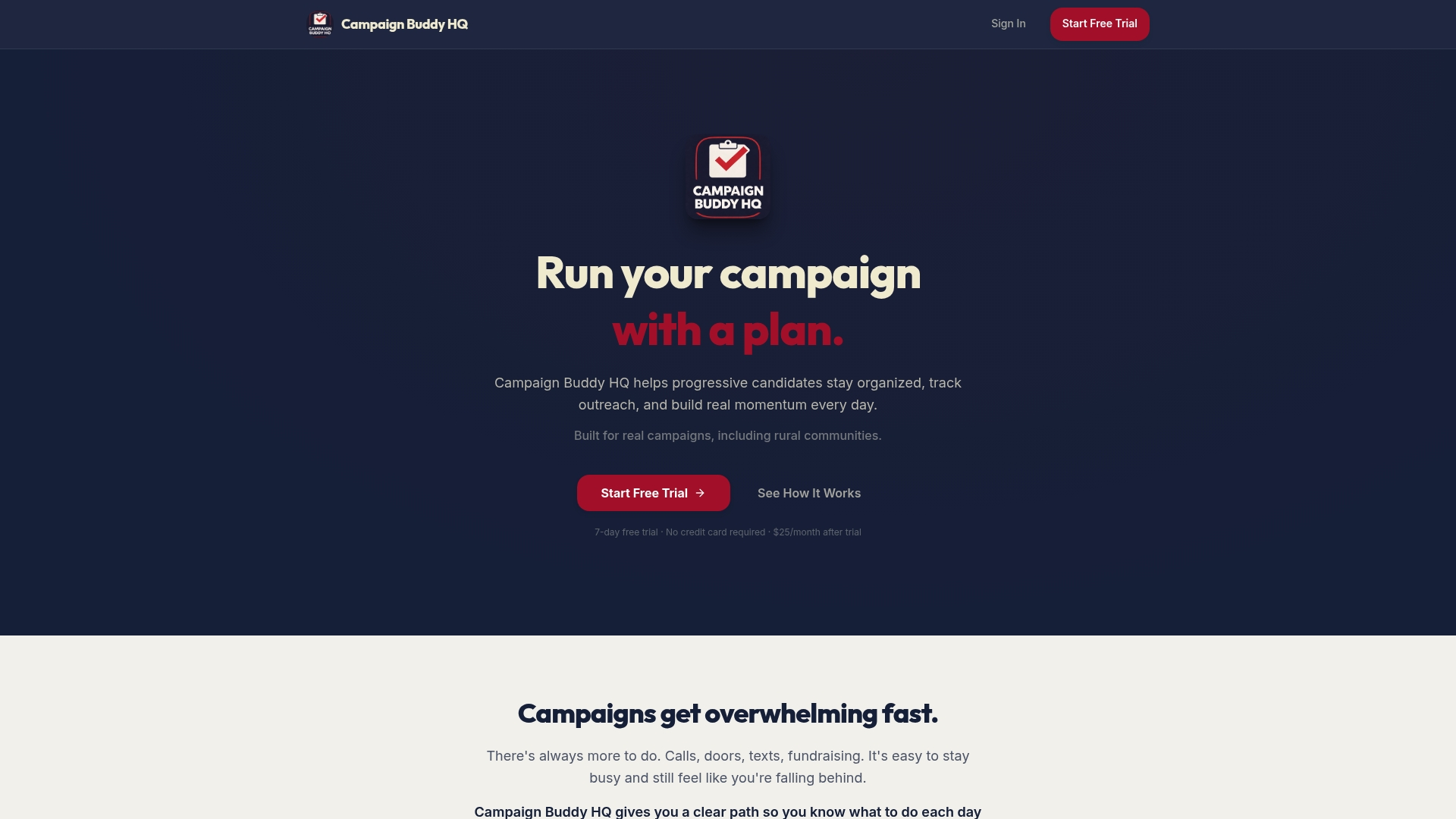
Campaignbuddyhq includes workflow templates, role assignments, and shared timelines that reduce setup time and keep every team member aligned from kickoff to election day. The platform is designed for real-world campaign conditions, including rural and low-density communities where coordination across dispersed teams is the hardest challenge. A free 7-day trial requires no credit card, so your team can test the full platform before committing. Teams that want to improve their outreach organization and collaboration in one move will find Campaignbuddyhq worth the look.
FAQ
What are the most important campaign team collaboration tips?
The most important tips are defining roles in writing before kickoff, setting explicit communication response times, and running retrospectives after every campaign. These three practices address the most common sources of breakdown in campaign teams.
How does async communication improve campaign collaboration?
Async communication reduces the meeting load that causes burnout and protects time for deep work. Teams that respond within set windows per channel stay aligned without the constant interruption of live check-ins.
Why do campaign teams need pre-launch syncs?
A pre-launch sync 2–3 days before go-live surfaces blockers while there is still time to resolve them. Without it, problems that could have been fixed in advance become launch-day emergencies.
How often should campaign teams run retrospectives?
Teams should run a project-level retrospective within 48 hours of each campaign's end and a portfolio-level retrospective quarterly. The combination captures both specific lessons and systemic patterns.
What role does psychological safety play in team collaboration?
Psychological safety is the condition that makes all other collaboration practices work. When team members feel safe raising blockers without fear of blame, problems surface early enough to fix. Teams that lack it hide problems until launch day.