

Campaign collaboration is the process where multiple teams, organizations, or partners work together intentionally to coordinate messaging, share resources, and achieve common political goals more effectively than working alone. Understanding why campaign collaboration matters is the difference between a campaign that stalls at its base and one that breaks into new communities. Collaborative campaigns generate 36% more reach than solo efforts by tapping into complementary audiences. Frameworks like RACI and DACI give campaigns the structural backbone to make that collaboration stick. This article covers the measurable benefits, the operational mechanics, and the practical steps to build genuine partnership into your campaign from day one.
What are the measurable benefits of collaboration in political campaigns?
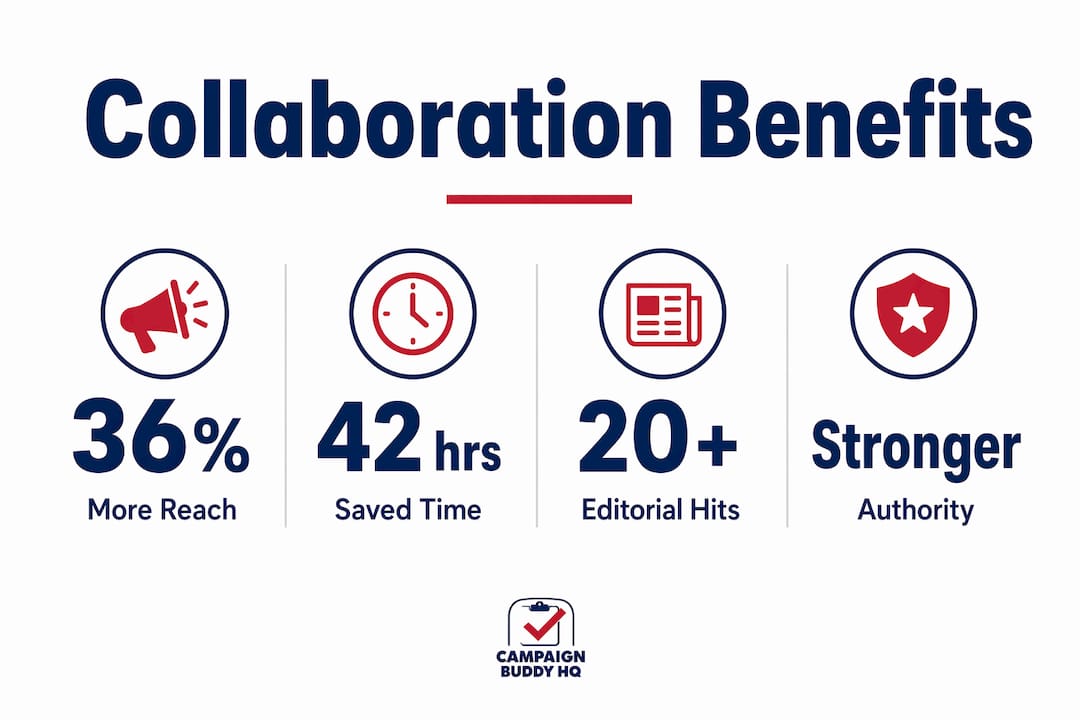
The most direct benefit of campaign collaboration is reach. Collaborative campaigns generate 36% more reach than campaigns run in isolation, according to a 2025 Influencer Marketing Hub study. That number reflects something specific: when partners bring adjacent but non-overlapping audiences, your message lands in rooms you could never enter alone.
Efficiency is the second major gain. Marketing teams spend 42 hours per week on internal communication, according to a Q2 2026 Screendragon survey. That is a full-time job worth of overhead. Structured collaboration with defined roles and shared platforms cuts that overhead by eliminating redundant check-ins and duplicated work.

The third benefit is long-term authority. Campaigns that secure 20–30 editorial placements over time build credibility that no single press release can create. That kind of sustained visibility comes from coordinated outreach across multiple partners, not from one organization pushing alone.
Collaborative vs. solo campaign performance
| Metric | Solo campaign | Collaborative campaign |
|---|---|---|
| Audience reach | Baseline | Up to 36% higher |
| Communication overhead | High (unstructured) | Reduced with defined roles |
| Editorial authority | Short-term spikes | Sustained over 20–30 placements |
| Creative resilience | Dependent on one team | Shared content pipeline |
| Speed to market | Slower (rebuilding context) | Faster with integrated partners |
The pattern across all three metrics is the same. Collaboration does not just add resources. It changes the structure of how a campaign operates, and that structural shift is where the real gains come from.
Pro Tip: Track your collaboration metrics from the start. Log reach, placements, and communication hours before and after bringing in partners. The numbers will tell you exactly where the partnership is paying off.
How does collaboration structurally improve campaign workflow?
Collaboration failures are almost never about personalities. Failures come from structural design flaws, specifically at hand-offs between phases like planning, production, and launch. When no one owns the transition, work gets repeated, context gets lost, and momentum dies.
The fix is not more meetings. Adding communication channels without a centralized platform increases what teams call the "coordination tax," the invisible cost of chasing updates, clarifying decisions already made, and re-explaining context to every new person in the thread. More Slack channels do not solve a hand-off problem.
The solution is defined ownership at every stage. Two frameworks dominate this space:
- RACI (Responsible, Accountable, Consulted, Informed): Assigns a clear owner to every task and specifies who needs to be looped in. Works well for campaigns with multiple internal teams.
- DACI (Driver, Approver, Contributor, Informed): Focuses on decision-making authority. Useful when campaigns involve external partners or coalition members who need clear approval lanes.
Both frameworks do the same core job. They make the invisible visible. When everyone knows who owns what, hand-offs stop being the place where campaigns quietly fall apart. You can learn more about organizing campaign workflows to see how these structures apply in real political settings.
Pro Tip: Run a hand-off audit before your next campaign phase. Map every point where work moves from one person or team to another. If ownership is unclear at any transition, assign it before you launch.
What collaboration models work best for political campaigns?
Political campaigns have two broad options: unified team collaboration and networked partnership collaboration. Each has distinct trade-offs.
A unified team model means all collaborators operate under a shared plan, shared metrics, and shared decision-making authority. This model moves faster because integrated partners rebuild context less often. They already know the goals, the constraints, and the audience. That shared context is what drives speed.
A networked partnership model connects independent organizations around a shared cause without merging operations. This model works well for coalition campaigns where each partner retains its own identity and audience. The risk is siloed execution. Partners who are brought in only at launch, rather than during planning, produce work that feels disconnected because it is.
Choosing the right collaboration model
| Model | Best for | Key risk | Framework fit |
|---|---|---|---|
| Unified team | Single-candidate campaigns | Slower consensus decisions | RACI |
| Networked partnership | Coalition and issue campaigns | Siloed messaging | DACI |
| Hybrid (shared goals, independent execution) | Multi-org grassroots efforts | Inconsistent brand voice | Both |
The most important rule across all models: bring partners in early. Audience complementarity drives the most value when partners' audiences are adjacent but not identical. That means partner selection happens during strategy, not after the messaging is already locked.
Shared narratives are the glue. When every partner tells a slightly different version of the story, voters notice the inconsistency. A shared narrative document, agreed on before any content goes out, prevents that drift. For grassroots campaigns, strategic nonprofit planning resources offer frameworks for aligning diverse stakeholders around a common message.
How does collaboration drive innovation during campaign execution?
Collaboration does not stop at launch. The campaigns that adapt fastest treat collaboration as an ongoing process through testing, iteration, and performance review. Collaboration during testing and iteration phases, not just launch, keeps performance metrics stable as campaigns scale.
Integrated partners push bolder ideas because they share the risk. When a single team owns everything, the instinct is to protect what is working. When partners co-own outcomes, there is more appetite for testing new messages, new formats, and new audiences. That shared accountability is what produces creative breakthroughs.
Creative fatigue is a real operational problem in long campaigns. Pre-approved replacement content, developed collaboratively before it is needed, prevents the stall that happens when the original creative stops performing and no one has a ready alternative. Pre-validated content readiness avoids frequency fatigue and keeps campaigns moving without emergency scrambles.
Pro Tip: Build a content reserve during your planning phase. Develop two or three alternative message sets with your partners before launch. When the primary creative tires, you have tested replacements ready to deploy immediately.
Consistent brand voice is a direct output of genuine collaboration. When partners align on tone, language, and core message from the start, every touchpoint reinforces the same narrative. That consistency builds voter recognition faster than any single high-budget ad.
What practical steps build effective campaign collaboration?
Effective collaboration requires deliberate structure from the first meeting. The following steps give campaign managers a repeatable process for building and maintaining strong partnerships.
- Define shared goals before assigning tasks. Every partner needs to agree on what success looks like before any work begins. Shared metrics prevent the situation where each partner optimizes for its own output rather than the campaign's overall outcome.
- Establish a meeting cadence and stick to it. Weekly syncs for operational updates, bi-weekly reviews for performance data, and quarterly strategy sessions for course corrections. Irregular meetings create information gaps that slow decisions.
- Centralize assets and decisions on one platform. Every partner should see the same version of every document, every creative asset, and every decision log. Scattered files and email threads are where context goes to die.
- Assign a collaboration lead. One person owns the health of the partnership itself, not just the work output. This role monitors hand-offs, flags friction early, and keeps communication flowing between teams.
- Build trust through consistent delivery. Trust in multi-partner collaborations is built on consistent delivery and respect for each contributor's expertise. Show up prepared, meet your commitments, and credit partners publicly.
Letting go of control is the hardest part for most campaign managers. Control over every output feels like quality assurance. In practice, it is a bottleneck. When you trust partners to execute within a shared framework, the campaign moves faster and produces better results. Explore campaign outreach strategies to see how structured processes support collaborative execution at scale.
Key Takeaways
Campaign collaboration produces measurable gains in reach, efficiency, and authority only when it is built on defined ownership, shared goals, and centralized communication from the start.
| Point | Details |
|---|---|
| Reach advantage | Collaborative campaigns generate 36% more reach than solo efforts by accessing complementary audiences. |
| Structural design matters | Most collaboration failures stem from unclear hand-offs, not personality conflicts. Use RACI or DACI to fix them. |
| Bring partners in early | Partners involved during strategy, not just launch, produce more consistent and effective messaging. |
| Centralize communication | Adding channels without a shared platform increases coordination overhead and slows decisions. |
| Collaboration continues past launch | Testing and iteration phases require active collaboration to prevent creative fatigue and maintain performance. |
What I've learned about collaboration failures in campaigns
Most campaign collaboration fails quietly. There is no dramatic falling out. Work just slows down, messages drift apart, and partners start operating in their own lanes without anyone formally deciding to split. By the time the campaign manager notices, the damage is done.
The campaigns I have seen execute collaboration well share one trait: they treat it as a design problem, not a trust problem. They build the structure first, assign ownership explicitly, and create shared visibility into every active decision. Trust follows from that structure. It does not precede it.
The biggest mistake I see is bringing partners in as vendors rather than co-owners. Transactional outsourcing produces transactional results. When a partner is handed a brief and told to execute, they optimize for the brief. When a partner is brought into the strategy, they optimize for the outcome. That difference shows up in the quality of the work and in the speed of execution.
The cultural shift required is real. Campaign managers have to give up the idea that control equals quality. The best collaborative campaigns I have observed run on shared accountability, not centralized approval. That shift is uncomfortable at first. The results make it worth it.
— Billy
How Campaignbuddyhq supports your collaboration efforts
Campaignbuddyhq is built for the exact collaboration challenges political campaigns face every day. The platform centralizes outreach tracking, daily planning, and supporter data so every team member and partner works from the same picture. No more chasing updates across email threads or rebuilding context at every sync. Campaignbuddyhq tracks doors knocked, calls made, texts sent, and registrations logged in one place, giving your whole team live visibility into campaign progress. Whether you are running a single-candidate race or coordinating a multi-org coalition, Campaignbuddyhq gives your collaboration the structure it needs to produce real results. Start your free 7-day trial today, no credit card required.
FAQ
Why does campaign collaboration matter more than solo efforts?
Collaborative campaigns generate 36% more reach than solo campaigns by accessing complementary audiences that a single organization cannot reach alone. That expanded reach translates directly into more voter contacts and greater campaign visibility.
What is the biggest cause of collaboration failure in campaigns?
Collaboration failures almost always come from structural design flaws, specifically unclear hand-offs between campaign phases, not from personality conflicts. Assigning explicit ownership at every transition point prevents most of these failures.
What are RACI and DACI frameworks?
RACI and DACI are role-clarity frameworks that define who owns each task or decision in a collaborative project. RACI works best for task management across internal teams, while DACI is better suited for decision-making in multi-partner or coalition settings.
How do you prevent creative fatigue in a long campaign?
Develop pre-approved replacement content with your partners during the planning phase, before the original creative tires. Having tested alternatives ready prevents the performance stall that happens when campaigns run out of fresh material mid-cycle.
How many editorial placements does a campaign need for lasting authority?
Campaigns that secure 20–30 quality editorial placements over time build sustainable authority. That level of consistent coverage requires coordinated outreach across multiple partners, not a single organization pushing alone.