
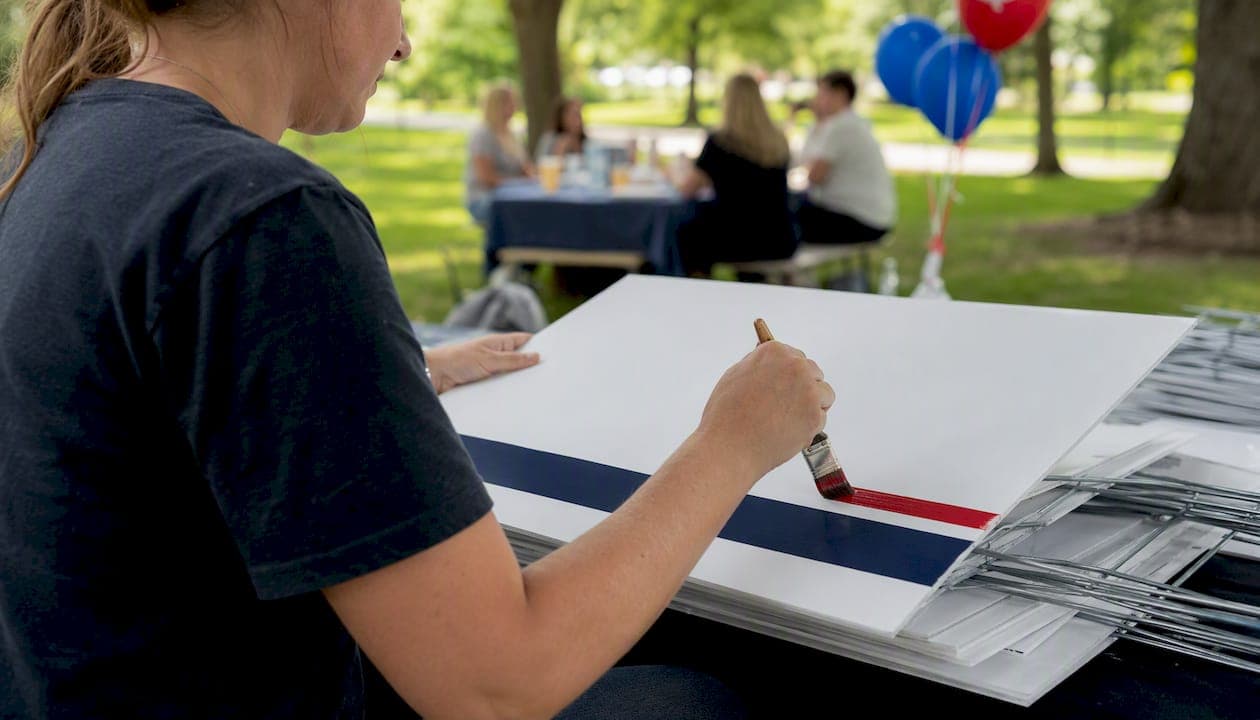
The candidate branding strategies that win races share five elements: a defensible identity statement, five message pillars tested against real voters, a consistent visual system, a growing proof file of earned coverage, and a rollout sequence that hits owned channels before paid ones. Skip any of the five and the brand cracks under the weight of an opposition attack or a bad news cycle. This combination works because candidate branding shapes candidate image; image is what actually drives voter loyalty. A slogan alone does nothing. A logo alone does nothing. It's the whole system, reinforced everywhere a voter encounters the candidate, that changes minds and holds them.
Here's what to complete in the next 72 hours, before you touch a design vendor or a media plan:
- Draft a one-paragraph identity statement (values, persona, top three policy priorities).
- Write five message pillars, each with one proof point.
- Pick three to four priority voter segments from the voter file.
- Audit every existing photo, bio, and social post for tone consistency.
- List every planned earned-media hit for the next 30 days.
- Assign one person to own brand consistency across the whole team.
Key Takeaways
Candidate branding strategies succeed when identity, tested messaging, consistent visuals, and disciplined rollout reinforce each other every week, not just at launch.
| Point | Details |
|---|---|
| Identity drives image | A defensible identity statement, grounded in real record, shapes candidate image, which drives voter loyalty. |
| Segment before you message | Pick three to four priority voter segments and test pillars against each before mass rollout. |
| Test messages before visuals | Run quick message A/B tests first; save larger logo and focus-group testing for validated pillars. |
| Sequence your rollout | Lock owned channels, then earned media, then paid, over an 8 to 12 week timeline. |
| Operationalize with Campaignbuddyhq | Use daily planning and outreach logging to keep field, digital, and volunteer teams aligned on the same brand pillars every week. |
Table of Contents
- Why Candidate Branding Strategies Matter for Electoral Success
- How Do You Define a Candidate's Identity and Positioning?
- Which Voter Segments Should Drive Your Messaging Strategy?
- How Do You Build a Campaign Narrative That Persuades Voters?
- What Visual Choices Actually Shape How Voters See a Candidate?
- What's the Right Way to Roll Out a Consistent Brand?
- How Should You Test Messages and Visuals Before Launch?
- What Does It Cost to Build and Launch a Candidate Brand?
- What KPIs Actually Tell You If Your Brand Is Working?
- How Do You Operationalize Branding in Daily Campaign Workflows?
- What Do Campaigns Consistently Get Wrong About Brand Consistency?
- Put Your Brand Playbook Into Daily Practice
- Sources
Why Candidate Branding Strategies Matter for Electoral Success
Branding isn't decoration on top of a campaign. It's the mechanism that converts a candidate's record into a voter's decision. A 2025 study published in the Journal of Political Marketing found that candidate branding has a significant, positive effect on candidate image, and that image in turn mediates branding's influence on voter loyalty. In plain terms: voters don't vote for your policy platform directly. They vote for the image your branding built in their head, and that image either holds up under an attack ad or it doesn't.
Political-marketing research frames branding as psychological narrative rather than a set of assets. A 2023 analysis in the Journal of Product & Brand Management argues that a durable candidate image requires aligning emotional cues (how the candidate makes people feel) with rational cues (what the candidate has actually done). Miss either half and the brand feels hollow or forgettable.
What consistent branding buys a campaign, concretely:
- Faster name recognition in low-information down-ballot races, where most voters decide in the final two weeks.
- Higher persuasion rates among undecided voters exposed to repeated, consistent visual and verbal cues.
- More resilience against opposition attacks, because a well-established image gives voters a reason to discount unfamiliar claims.
- Better fundraising conversion, since donors respond to the same clarity and consistency that persuades voters.
Statistic Callout: Regional election research on branding and voter behavior found that emotionally consistent, repeated branding outperformed rational, program-heavy messaging for building loyalty among certain electorates, particularly younger and local voters, according to a study on candidate branding and voter loyalty.
How Do You Define a Candidate's Identity and Positioning?
Start with a one-sitting exercise. Fill in this template with your candidate, your consultants, and if possible, one or two trusted volunteers who know the district cold:
Identity statement template: "[Candidate name] is a [core identity, e.g., 'lifelong nurse and mother of three'] who believes [core value] and is running for [office] to [one concrete outcome voters will feel]. Unlike [implicit or explicit contrast], [candidate] has [proof point from record or lived experience]."
That statement becomes the seed for your five message pillars. Each pillar needs four fillable fields:
- Audience: which voter segment this pillar speaks to directly.
- Problem: the specific frustration or fear that segment has.
- Solution: what the candidate will do about it.
- Qualification: why this candidate, specifically, is credible on this issue.
Your elevator pitch is just the strongest pillar, compressed to fifteen seconds. If a volunteer can't repeat it after hearing it twice, it's too long or too abstract.
Pro Tip: Never build a persona that contradicts your candidate's actual voting record, public statements, or personal history. A brand that oversells authenticity, "the outsider" candidate who's spent twenty years in local office, gets torn apart the first time a local reporter runs a fact check. Build the identity from what's true, then find the framing that makes it compelling.
Branding built this way holds up because it's narrative, not decoration. The narrative-psychology research on political branding makes the same point: symbols and slogans only work when they're consistent with a deeper, coherent story the candidate can defend under pressure.
Which Voter Segments Should Drive Your Messaging Strategy?
You need three to four high-priority segments, not twelve. Campaigns that try to speak to everyone equally end up saying nothing memorable to anyone. Recruitment-marketing frameworks offer a useful model here: employer brands build persona-driven segments and an "employee value proposition" before they ever write a job listing, and a Jobvite breakdown of recruitment marketing strategies shows how that same segmentation logic adapts cleanly to voter targeting and audience nurture sequences.
Here's the process:
- Pull your voter file and sort by turnout history, party lean, and geography. Identify clusters where persuasion potential is highest, usually low-propensity voters who lean your direction but don't reliably show up.
- Layer in issue data from any available polling, past surveys, or canvass notes. Look for clusters where a specific pillar (healthcare, housing, jobs) consistently comes up.
- Run 15 to 20 short qualitative interviews with real voters in your target segments. Ask what they've heard about the candidate, what would change their mind, and where they get their news.
- Draft segment profiles with a name, a description, a dominant concern, and the message pillar that best fits.
- Test your pillars against each segment during the next round of canvassing or phone banking, and log which lines get genuine reactions versus polite nods.
Segment testing checklist for field teams:
- Log which message pillar was used on each doorstep or call.
- Note the voter's immediate reaction (positive, neutral, pushback).
- Flag any phrase that consistently triggers confusion or objection.
- Report weekly patterns back to the messaging team, not just anecdotes.
How Do You Build a Campaign Narrative That Persuades Voters?
A persuasive campaign narrative has to answer one question in the voter's head within seconds: "Why does this person running matter to my life?" If your slogan or elevator pitch doesn't answer that, it's noise.
Build a message house with three levels:
| Level | Content | Example |
|---|---|---|
| Core promise | The one thing the candidate stands for above all else | "A campaign built by working families, for working families" |
| Proof points | Two or three specific facts or actions backing the promise | Local school board record, small business ownership, union endorsement |
| Supporter-facing benefit | What a voter or volunteer gets from believing in the promise | Lower property taxes, safer streets, a candidate who answers calls |
Do this:
- Keep the slogan under seven words. Test it out loud, not just on paper.
- Anchor every pillar to something the candidate has actually done or lived.
- Repeat the core promise in every piece of collateral, from yard signs to fundraising emails.
Don't do this:
- Don't borrow a national slogan that has nothing to do with local concerns.
- Don't stack three different promises into one slogan; pick the strongest one.
- Don't let the tagline drift between formal and casual tone across channels.
A quick annotated example: a slogan like "Fighting for Fairness" sounds fine but says nothing specific, any candidate in any race could use it. Compare that to "Twenty Years Fixing Our Roads, Not Our Talking Points," which names a proof point and implies a contrast without attacking anyone by name. The second version does the narrative work the first one skips entirely.
What Visual Choices Actually Shape How Voters See a Candidate?
Voters form impressions of competence, warmth, and energy from visuals faster than they read a single policy line. Design and photography choices carry more weight than campaigns usually budget for. Research on political imagery found that subtle backdrop cues in candidate photography, like props, settings, and framing, can shift perceived ideology and favorability even when the policy message stays identical.
Visual checklist before you approve any design:
- Logo: Simple enough to read at yard-sign distance and at social media thumbnail size. Campaign logo research shows design choices in color, font, and imagery function as symbolic positioning tools tied to constituency expectations, so a logo built for a rural district shouldn't look identical to one built for a dense urban seat.
- Color palette: Two to three colors maximum, consistent across every asset. Avoid colors that clash with your state or local party's dominant branding unless the contrast is deliberate.
- Typography: One display font, one body font. Nothing decorative on policy documents.
- Photography direction: Plan backdrops intentionally, home, workplace, community settings, rather than leaving location choices to whoever's holding the camera that day.
- Imagery consistency: The same visual tone across mailers, social graphics, and yard signs. A polished headshot next to a grainy phone photo undermines both.
Pro Tip: If you're using AI tools to draft social graphics or quick-turn creative, don't publish the raw output. A comparative study of AI-driven and human-edited political campaign design found that human-edited versions of AI-generated designs produced more balanced viewer engagement across the whole graphic, while AI-only outputs concentrated attention unevenly. Use AI to generate options fast, then have a real designer clean up hierarchy and balance before anything ships.
Lock your minimum design spec (logo file formats, color hex codes, font files, headshot guidelines) before you print anything. Reprinting yard signs because nobody standardized the blue is a cost every campaign manager has learned the hard way at least once.
What's the Right Way to Roll Out a Consistent Brand?
Prioritize owned channels first, then earned media, then paid. Your website, social profiles, and campaign materials are the only places where you control every word and pixel; get those locked before you're fielding press calls or buying ads that reference a brand that's still shifting.
Sample 8 to 12 week rollout timeline:
| Week | Milestone |
|---|---|
| 1 to 2 | Finalize identity statement, message pillars, and visual spec |
| 3 to 4 | Launch updated website and social profiles with new brand |
| 5 | Brief press contacts and pitch first round of earned coverage |
| 7 to 8 | Deploy field materials (door hangers, scripts, yard signs) |
| 8 to 10 | Launch first paid creative, digital and/or print |
| 11 | Review consistency across all channels, correct drift |
Brand guidelines checklist every campaign should have on file:
- Logo usage rules (minimum size, clear space, approved backgrounds).
- Color hex codes and font files, shared with every vendor.
- Approved tone-of-voice examples for social posts versus press releases.
- A short "brand don'ts" list (phrases to avoid, imagery that contradicts the identity).
| Role | Approves assets | Trains volunteers | Enforces consistency |
|---|---|---|---|
| Campaign manager | Final sign-off on all major creative | No | Yes, weekly spot checks |
| Communications director | Press materials and messaging | Yes, for spokespeople | Yes, on messaging drift |
| Field director | Door scripts and canvass materials | Yes, for canvassers | Yes, in field reports |
| Digital director | Social graphics and web copy | No | Yes, on posting schedule |
Field materials deserve the same discipline as your website. A well-built candidate promotion plan treats yard signs, door hangers, and scripts as brand touchpoints, not afterthoughts printed the week before the deadline.
How Should You Test Messages and Visuals Before Launch?
Run a message test before a logo test, in almost every case. Wrong words cost you more votes than an imperfect color palette. Save the bigger investment (professional focus groups, extensive logo testing) for once your core message pillars are validated.
Testing playbook:
- Quick-turn message test: Send two or three phrasings of your core promise to a 50 to 100 person email or text list, asking which version they'd be more likely to share or repeat. Directional results in 48 hours.
- A/B creative test: Run two versions of a social ad with identical targeting and budget, differing only in headline or image. Track click-through and share rate over a 5 to 7 day window.
- Small focus group: Gather 8 to 10 voters from a priority segment for a 60 to 90 minute session on message reactions and visual impressions.
- Logo and color test: Show 3 to 4 logo variants to a sample of voters and ask for gut-reaction word associations (trustworthy, energetic, old-fashioned).
Sample metrics table for a quick message test:
| Metric | What it tells you | Minimum sample for directional read |
|---|---|---|
| Recall after one day | Whether the message sticks | 50 respondents |
| Self-reported persuasion shift | Whether the message moves undecided voters | 100 respondents |
| Share/forward intent | Whether supporters will spread it organically | 50 respondents |
Statistic Callout: Directional confidence from a small sample isn't the same as statistical significance. A 50 to 100 person quick test tells you which message is stronger, not a precise vote-share number, so treat these results as a filter to eliminate weak options, not a final verdict. Visual materials tested this way consistently outperform text-only versions on retention and comprehension, according to research on visual communication and message retention, which is exactly why infographics belong in your testing rotation alongside plain-text messages.
What Does It Cost to Build and Launch a Candidate Brand?
A credible local campaign brand can launch in roughly six to eight weeks with a minimal viable budget covering logo design, a basic website, and a first print run of field materials. That's the floor, not the ceiling, but it's enough to have a coherent brand before your first big earned-media hit or debate.
Sample cost buckets:
| Category | Low range | Medium range | High range |
|---|---|---|---|
| Logo and brand identity design | Freelancer, one designer | Small agency package | Full brand agency with testing |
| Website | Template builder | Custom template with copywriting | Fully custom build with CMS |
| Print materials (signs, mailers) | Local print shop, single run | Multiple staged runs | Full-district saturation run |
| Paid digital creative | DIY social ads | Contracted digital strategist | Full paid media agency |
Budgeting pro tips:
- Buy your design system once and reuse every asset across mailers, signs, and social graphics rather than commissioning new creative for each channel.
- Negotiate volume pricing with printers by committing to a full campaign print schedule upfront instead of ordering as needs arise.
- Stage your rollout in phases so paid creative and larger print runs get funded once early fundraising numbers come in, not all at once before you know your budget ceiling.
What KPIs Actually Tell You If Your Brand Is Working?
Three numbers matter every week: unaided name recognition, favorability rating, and message recall. If all three are flat or declining two months into active outreach, your brand isn't landing and you need to pivot, not just push harder on the same materials.
KPI checklist with measurement methods:
- Unaided name recognition: Ask "who is running for [office]?" in phone surveys or canvass conversations, log volunteer answers.
- Favorability rating: Track through polling or a simple 1 to 5 scale question in supporter and voter surveys.
- Message recall: Ask voters what they remember hearing about the candidate; compare against your five pillars.
- Persuasion movement: Compare pre and post exposure survey results among the same voter segment.
Decision thresholds:
- If favorability stalls for three consecutive weeks despite active outreach, revisit your core message pillar, not your logo.
- If message recall is high but favorability is flat, the brand is memorable but not persuasive; the narrative needs stronger emotional proof points.
- If both metrics are moving in the right direction, keep the current plan and scale spending on what's working.
Statistic Callout: Campaigns that lean on emotionally consistent branding rather than program-heavy messaging see stronger loyalty gains among younger and local voters, per research on candidate branding and voter loyalty in regional elections, which makes message recall among under-40 voters a metric worth tracking separately from your general population numbers.
Example dashboard fields for weekly review: favorability trend line, unaided recall percentage, top three social posts by engagement, earned media mentions logged this week, volunteer-reported doorstep reactions by segment.
How Do You Operationalize Branding in Daily Campaign Workflows?
The minimal daily workflow: every volunteer shift, every social post, and every canvass script gets checked against the same five message pillars before it goes out. That's the whole discipline. Most campaigns don't fail because they lack a brand, they fail because the brand lives in a slide deck nobody opens after week two.
Sample weekly workflow:
- Monday: Digital team reviews the week's planned posts against brand guidelines.
- Tuesday: Field director briefs canvassers on which pillar to lead with this week.
- Wednesday: Communications director logs earned-media pitches sent and tracks responses.
- Thursday: Analytics review of the prior week's KPI dashboard, flag any drift.
- Friday: Team sync on what messaging landed and what needs adjusting for next week.
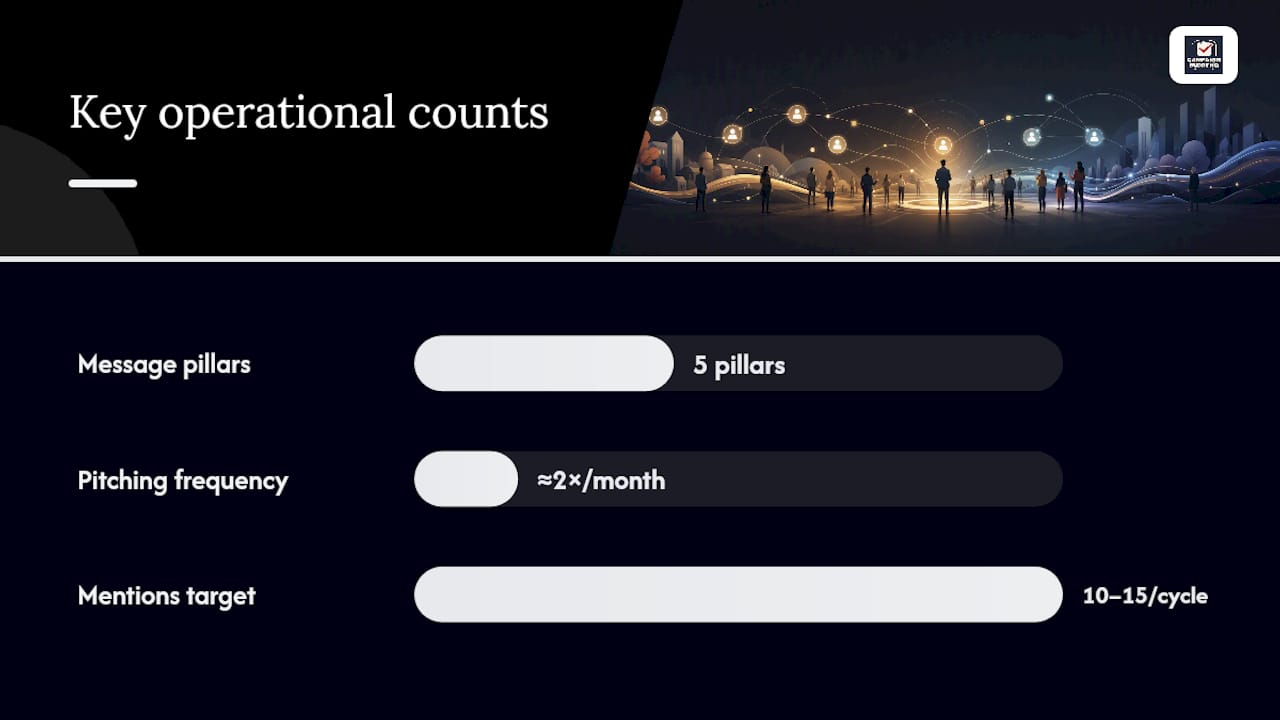
Earned media deserves its own discipline inside this workflow. Deliberate press operations, pitching local reporters with district-specific angles roughly twice a month, build the proof file that keeps a candidate's public profile accurate and substantive rather than thin. Practitioner guidance on active press operations suggests aiming for 10 to 15 quality mentions over a campaign cycle to make sure any summary of the candidate, whether from a reporter, a voter guide, or an AI tool, reflects real depth rather than a generic outline.
This is where a tool built for campaign operations earns its keep. Campaignbuddyhq's daily and weekly planning features, outreach logging across doors, calls, texts, and registrations, and campaign phase tracking give teams one place to keep the brand pillars attached to the actual outreach work, instead of scattered across a shared drive nobody checks. Supporter tracking and progress visualization also make it easier to see whether a given week's messaging is generating the expected doorstep reactions and volunteer sign-ups if the brand is landing. For campaigns building a supporter list or working through essential outreach checklists, this is exactly where brand strategy and field execution meet.
What Do Campaigns Consistently Get Wrong About Brand Consistency?
The most common mistake I see is treating brand work as a one-time deliverable instead of a weekly discipline. A campaign spends three weeks nailing down identity, pillars, and visuals, celebrates the launch, and then lets the brand quietly drift for the next four months because nobody's job is to check it. By the time a reporter or an opponent notices the inconsistency, usually somewhere around week ten, the damage to credibility is already done.
The small change that produces outsized results isn't more design spend or a slicker logo. It's a single weekly fifteen-minute check where someone compares that week's social posts, canvass scripts, and press materials against the five message pillars. Campaigns that do this consistently rarely need a mid-cycle rebrand. Campaigns that skip it almost always do, usually right when they can least afford the distraction.
Put Your Brand Playbook Into Daily Practice
Building the brand is half the job. Keeping it consistent across doors knocked, calls made, texts sent, and volunteers briefed every single day is the part that actually determines whether voters see one coherent candidate or five slightly different versions depending on who they talked to. Campaignbuddyhq exists for that second half.
The platform's daily and weekly planning tools let you attach your message pillars directly to outreach activities, so every canvasser and phone-banker is working from the same script without a manager re-briefing the team every morning. Outreach logging tracks doors, calls, texts, and registrations against your campaign phases, which means you can spot brand drift in the field data before it shows up in a bad poll. If you're running a rural or low-density district where volunteer coordination is harder to centralize, the workflows are built with exactly that scenario in mind.
Start a 7-day free trial of Campaign Buddy HQ, no credit card required, and pilot your brand playbook with your actual field team before your next canvassing weekend.
Sources
- The Effect of Candidate Branding and Election Socio-Economics on Voter Loyalty (journal article)
- Visual communication and message retention (research repository)
- What draws voters to 'brandates' and why: Political branding as narrative
- What’s in a Campaign Logo? Exploring differences in candidate self-presentation through campaign logos