
Phone banking is defined as a direct voter contact method where trained volunteers call targeted voters to identify support, persuade undecided voters, or mobilize turnout on election day. Done right, it delivers measurable results: volunteer phone banking boosts voter turnout by up to 3.8 percentage points at an estimated $26 cost per vote. That cost-per-vote figure makes phone banking one of the most efficient tools in any campaign's outreach arsenal. Modern digital platforms let volunteers connect with over 10 times more voters per hour than manual dialing, while protecting volunteer privacy. Whether you're running a statewide race or a local school board campaign, this phone banking guide for campaigns gives you the structure to execute calls that actually move voters.
What does a phone banking campaign require to get started?
Every effective telephone outreach operation starts with four core assets: a targeted voter list, a clear script, a reliable dialing platform, and trained volunteers. Miss any one of these, and your contact rate drops before your first shift begins.
Voter contact lists are the foundation. Pull lists from your state's voter file, filtered by party registration, voting history, and geography. Calling unregistered or out-of-district voters wastes volunteer time and inflates your cost per contact. Pair your list with a CRM that tracks every interaction so no voter gets called twice with the same message.

Scripts and dialers work together. Your dialing platform should integrate directly with your voter database so call dispositions update in real time. Campaignbuddyhq is built for exactly this workflow, letting organizers log calls, track outreach progress, and monitor volunteer productivity from a single dashboard. Platforms that mask volunteer phone numbers also protect your callers from unwanted callbacks, which matters for volunteer retention.
Recruiting the right volunteers is as important as the technology. Volunteers who understand the campaign's goals make better calls. A clear volunteer recruitment process that sets expectations upfront reduces no-shows and improves shift consistency.
Here is a quick reference for the core setup requirements:
| Component | What you need | Why it matters |
|---|---|---|
| Voter contact list | Filtered voter file by district and history | Targets only persuadable or low-turnout voters |
| Call script | Goal-specific with branching responses | Keeps volunteers on message and captures data |
| Dialing platform | CRM-integrated, number-masking capable | Protects volunteers and prevents duplicate contacts |
| Volunteers | Recruited, briefed, and goal-aware | Determines call quality and shift output |
| Timing plan | Peak windows scheduled in advance | Maximizes live contact rates per shift |
Pro Tip: Choose a dialing platform that masks volunteer phone numbers. Volunteers who receive callbacks on personal numbers often quit after the first shift, and replacing trained callers mid-campaign is expensive.
How do you run a phone banking shift effectively?
A well-run shift follows a repeatable structure. Improvised sessions produce inconsistent results. The sequence below applies whether your team is calling from a campaign office or logging in remotely.
-
Set a shift goal before anyone picks up the phone. Express the goal in concrete numbers: "We need 80 completed voter ID contacts tonight." Goals tied to the overall campaign target give volunteers a reason to push through the hard calls.
-
Run a 10–15 minute pre-shift briefing. Briefing volunteers with a pre-shift review that includes role-playing and goal setting significantly improves call quality and volunteer morale. Pair a veteran caller with each new volunteer for the first 20 minutes of the shift.
-
Assign call lists and confirm platform access. Every volunteer should be logged in and pulling calls within five minutes of the briefing ending. Delays at this stage kill momentum.
-
Monitor calls in real time. A shift manager should track live metrics: calls attempted, contacts made, and dispositions logged. If contact rates drop below expectations, adjust the call list or check for technical issues immediately.
-
Hold a five-minute debrief at the end of every shift. Ask volunteers what objections they heard most. That feedback directly improves your script for the next session.
-
Log all data before volunteers leave. Incomplete data entry after a shift creates gaps in your voter file that compound over time.
Pro Tip: Team phone canvass events are highly effective for onboarding new volunteers. Put first-time callers in a room or video call with experienced volunteers so they can hear real conversations and ask questions between calls.
What types of phone banking scripts work best for each call goal?
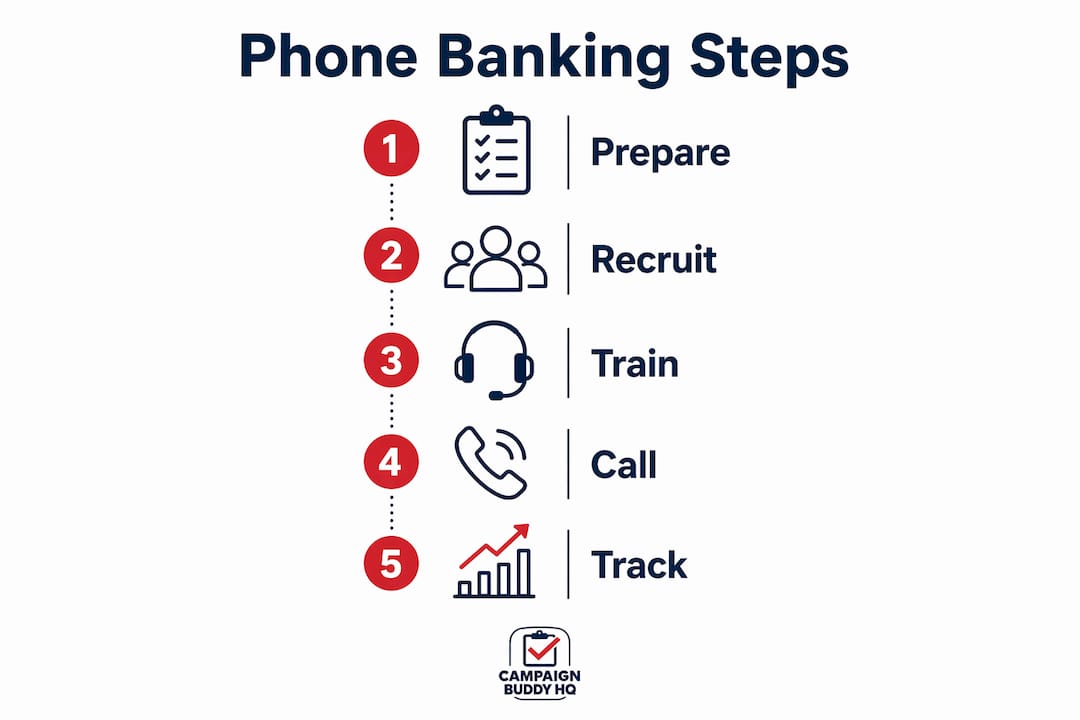
Phone banking scripts fall into four categories, and using the wrong script for your call goal is one of the most common mistakes campaigns make. Effective scripts contain a direct ask, a clear opening, response branches, and a polite close tailored to the call's purpose.
Voter ID calls
Voter ID scripts identify where a voter stands on your candidate or issue. The opening is brief: introduce yourself, name the candidate, and ask a simple support question on a 1–5 scale. The goal is data, not persuasion. Keep these calls under 90 seconds.
Persuasion calls
Persuasion scripts target voters who rated themselves a 2 or 3 on your ID scale. These calls run longer because the volunteer needs to listen, respond to concerns, and connect the voter to a specific issue. Avoid scripted rebuttals that sound robotic. Train volunteers to acknowledge the voter's concern before pivoting to the candidate's position.
Get-Out-the-Vote calls
GOTV scripts run in the final 72 hours before election day. The ask is concrete: confirm the voter's polling location, ask if they have a plan to vote, and offer to answer questions. Do not use GOTV calls for persuasion. Voters who receive a GOTV call when they expected a persuasion call feel misled, and that damages your campaign's credibility.
Fundraising calls
Fundraising scripts require the most careful construction. Lead with a specific campaign need, not a generic appeal. "We need $500 to run ads in your district this week" outperforms "We need your support." Always include a low-dollar ask option so volunteers can close a gift even when the voter declines the primary amount.
A detailed call script guide helps volunteers navigate branching responses without losing the conversation's natural flow. Build your response branches for the three most common objections you hear in the field, then update them after each shift debrief.
What are the best practices for phone banking compliance and performance?
Phone banking effectiveness depends on timing, coordination, and legal compliance. Ignoring any of these three areas costs you contacts, volunteers, or both.
Call timing is not optional. Optimal contact rates occur on weekday evenings between 5:00 PM and 9:00 PM, with Saturday afternoons as a secondary peak. Calling outside these windows produces lower answer rates and more hostile interactions.
Coordinate calls with your texting and digital outreach. Siloed outreach produces duplicate contacts and voter irritation. A voter who receives a text, a call, and a door knock with three different messages on the same day is less likely to support your candidate, not more. Use a unified voter database that updates across all channels in real time.
TCPA compliance is non-negotiable. The Telephone Consumer Protection Act restricts automated calls and texts to cell phones without prior consent. Consult your campaign's legal counsel before using auto-dialers on mobile numbers. Violations carry per-call fines that can exceed the value of the contacts you made.
Here are the core performance metrics every phone banking operation should track daily:
- Contact rate: Completed conversations divided by total dials. A healthy contact rate varies by list quality, but track it shift over shift to spot list decay.
- Disposition accuracy: The percentage of calls logged with a complete response. Incomplete dispositions corrupt your voter file.
- Volunteer productivity: Contacts per volunteer per hour. Use this to identify your strongest callers and pair them with newer volunteers.
- Script adherence: Spot-check calls or listen to recordings to confirm volunteers are following the script and capturing data correctly.
Campaignbuddyhq's outreach tracking features let organizers monitor all of these metrics without building a separate spreadsheet system. You can organize outreach activities and track daily progress toward campaign goals from one place.
Can smaller campaigns succeed with phone banking?
Smaller campaigns often assume phone banking requires a large budget or a professional call center. That assumption is wrong. Local campaigns benefit from phone banking precisely because their voter universes are smaller, meaning even a few hundred targeted calls can shift a close race.
A city council race with 2,000 likely voters needs a fundamentally different approach than a congressional campaign. You do not need 50 volunteers calling for six weeks. You need 10 committed volunteers calling the right 400 voters at the right time.
Phone banking for local elections works because the margin for victory is often measured in dozens of votes, not thousands. A single well-run calling session can account for the entire margin of victory in a tight ward race.
Common myths that hold smaller campaigns back:
- "We can't afford the technology." Entry-level calling platforms cost less than a single campaign mailer. Many offer free tiers for small volunteer teams.
- "Voters don't answer calls anymore." Contact rates are lower than a decade ago, but a live conversation with a motivated volunteer still outperforms any digital ad for voter persuasion.
- "We don't have enough volunteers." A team of five volunteers calling two nights a week can complete 300–400 contacts in a month. That is enough to matter in most local races.
Pro Tip: Prioritize relationship over call volume. A volunteer who has a genuine three-minute conversation with a neighbor will move that voter more than five volunteers who rush through scripted 45-second calls. Train for quality, then scale.
For smaller campaigns, the canvassing strategies that work door to door translate directly to phone banking. The same principles of targeted lists, clear asks, and consistent data capture apply across both methods.
Key Takeaways
Phone banking works when campaigns combine targeted lists, trained volunteers, and real-time data tracking to turn every call into a measurable step toward election day.
| Point | Details |
|---|---|
| Start with the right list | Filter your voter file by district, history, and support level before the first shift. |
| Brief volunteers every shift | A 10–15 minute pre-shift review with role-playing improves call quality and morale. |
| Match scripts to call goals | Use voter ID, persuasion, GOTV, or fundraising scripts based on where voters are in the cycle. |
| Call during peak windows | Weekday evenings 5:00 PM to 9:00 PM and Saturday afternoons produce the highest contact rates. |
| Track data in real time | Unified voter databases prevent duplicate outreach and keep messaging consistent across channels. |
Why I think most campaigns underuse their best phone banking asset
Most campaign organizers focus their energy on the technology: the dialer, the CRM, the contact list. Those tools matter. But the biggest performance gap I see is in how campaigns treat the 10 minutes before a shift starts.
Campaigns that run a real pre-shift briefing, with actual role-playing and a clear goal number, consistently outperform campaigns that hand volunteers a script and say "good luck." The difference is not subtle. Volunteers who role-play one objection before their first call handle real objections with confidence. Volunteers who skip that step often freeze or hang up early.
The second thing campaigns consistently undervalue is the debrief. Five minutes at the end of a shift, asking what objections volunteers heard, produces script improvements that compound over weeks. A campaign that updates its script every three shifts based on real voter feedback is running a fundamentally different operation than one that uses the same script from kickoff to election day.
Phone banking as an activist guide often focuses on volume: calls made, doors knocked, texts sent. The campaigns that win treat it differently. They treat every call as a data point and every volunteer as a source of field intelligence. That mindset shift, more than any platform or list, is what separates campaigns that move voters from campaigns that just make noise.
— Billy
How Campaignbuddyhq supports your phone banking operation
Running a phone banking program across multiple volunteers, shifts, and call goals requires more than a spreadsheet. Campaignbuddyhq gives campaign organizers a single platform to plan daily outreach, log calls and contacts, track volunteer productivity, and monitor progress toward campaign goals in real time.
The platform is built for real-world campaign conditions, including rural and low-density communities where every contact counts. Campaignbuddyhq integrates outreach logging across calls, texts, and door knocks so your voter data stays consistent and your team avoids duplicate contacts. A free 7-day trial requires no credit card. If you are ready to run a tighter, more organized phone banking operation, start with Campaignbuddyhq and see how much cleaner your outreach data becomes after the first week.
FAQ
What is phone banking in a political campaign?
Phone banking is a voter contact method where campaign volunteers call targeted voters to identify support levels, persuade undecided voters, or mobilize turnout before election day. It is one of the most cost-efficient direct outreach tactics available to campaigns.
When is the best time to make campaign phone banking calls?
Weekday evenings between 5:00 PM and 9:00 PM produce the highest contact rates, with Saturday afternoons as a reliable secondary window. Avoid calling before 9:00 AM or after 9:00 PM in the voter's local time zone.
How many volunteers do you need to run phone banking?
Even five committed volunteers calling two evenings per week can complete 300–400 voter contacts per month. Local campaigns with small voter universes can run effective phone banking programs with a very small team.
How do you keep phone banking volunteers motivated?
Pre-shift briefings with clear goals, role-playing, and real-time feedback significantly improve both call quality and volunteer morale. Pairing new volunteers with experienced callers during their first shift reduces early dropout.
What is the difference between a voter ID call and a GOTV call?
A voter ID call identifies where a voter stands on your candidate, typically using a 1–5 support scale. A GOTV call, run in the final 72 hours before election day, confirms the voter's plan to vote and provides polling location information without attempting persuasion.