

A political call script is a structured conversation framework that gives campaign volunteers the words, branches, and data fields they need to connect with voters and move them toward action. Phone banking works. Volunteer-led calls can increase voter turnout by up to 3.8% at roughly $26 per vote acquired. That kind of return depends entirely on the quality of the script behind each call. This political call script guide covers every component you need, from opening lines to data capture fields, so your volunteers make every conversation count.
What are the critical components of a political call script?
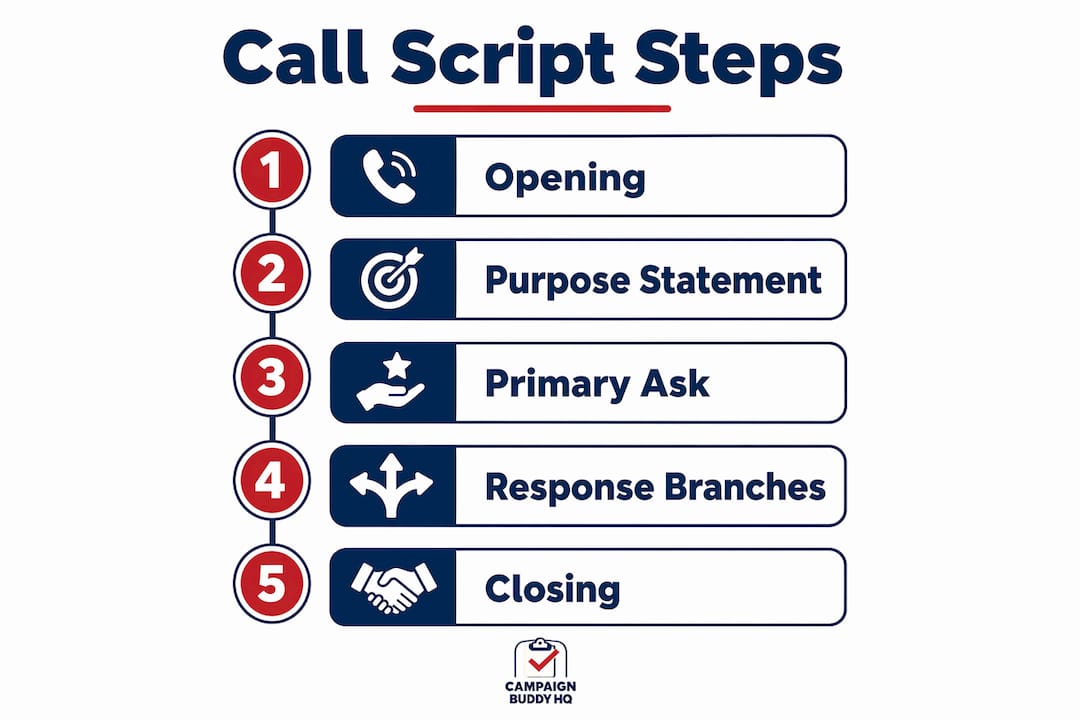
Every effective political call script contains five core components: the opening, the purpose statement, the primary ask or questions, response branches, and the close. Miss any one of these, and your volunteers will either lose the voter or fail to capture useful data.
The opening
The first five seconds determine whether a voter stays on the line or hangs up. Natural introductions that state the volunteer's name and the campaign outperform robotic openers every time. Avoid phrases that sound like a robocall. "Hi, this is Maria calling as a volunteer for the Johnson for Senate campaign" lands far better than "You have been contacted by the Johnson campaign."

The purpose statement
After the greeting, state why you are calling in one sentence. Voters decide quickly whether the call is worth their time. A clear purpose statement respects that decision and sets the tone for the rest of the conversation.
The primary ask and response branches
The ask changes based on call type. Voter ID calls ask which candidate the voter supports. Persuasion calls present a key message and probe for concerns. Get-out-the-vote (GOTV) calls confirm voting plans. Each answer a voter gives should lead to a specific response branch. A voter who says they are undecided needs a different path than one who is already committed.
The close
Closing statements carry more weight than most campaigns realize. GOTV calls should close by confirming the voter's specific plan to vote, including when and how. Persuasion calls should close with a direct commitment ask. A weak close wastes everything that came before it.
Pro Tip: Build data capture fields directly into the script layout. Every branch should end with a field for the volunteer to fill in, whether that is support level, voting plan, or a callback note. If the field is not in the script, volunteers will skip it.
How do you choose the right call script style?
Campaigns must choose between linear scripts and dynamic branching scripts based on call objective and volunteer experience. The wrong choice creates friction for volunteers and frustration for voters.
Linear scripts follow a single path from start to finish. They work best for simple voter ID calls where the goal is to record a support level and move on. New volunteers handle linear scripts with minimal training. The tradeoff is rigidity. If a voter goes off script, a linear format gives the volunteer nowhere to go.
Dynamic branching scripts adapt based on voter responses. A voter who expresses concern about healthcare gets routed to a healthcare message. A voter who says they already voted gets a quick thank-you and a close. Modern phone banking software automates this branching logic so volunteers focus on the conversation rather than flipping through pages.
| Call type | Best script style | Reason |
|---|---|---|
| Voter ID | Linear | Simple goal, fast calls, minimal training needed |
| Persuasion | Dynamic branching | Voter responses vary; message must adapt |
| GOTV | Linear or light branching | Clear ask, but voting plan details vary |
| Volunteer recruitment | Dynamic branching | Objections and availability differ widely |
Pro Tip: Match script complexity to your volunteer pool. A branching script with eight paths overwhelms a first-time volunteer. Start with three branches maximum, then expand as your team gains confidence.
How to write a political call script step by step
Writing a call script from scratch feels daunting, but the process is straightforward when you work through it in order. A script is a framework, not a monologue. Build it to guide the conversation, not control it.
-
Define your call goal. Decide whether this call is for voter ID, persuasion, or GOTV before you write a single word. Every other decision flows from this. A persuasion script for a school board race looks nothing like a GOTV script for a Senate campaign.
-
Identify your target voter segment. A script for low-propensity voters in a rural district needs different language than one for high-propensity suburban voters. Pull your voter outreach data and write to the actual audience, not a generic voter.
-
Draft a natural opening. Write the greeting as if a real person is speaking, not reading. Include the volunteer's name, the candidate or campaign name, and a brief reason for calling. Read it aloud. If it sounds stiff, rewrite it.
-
Write the primary ask. State the ask clearly and early. Voters do not want to sit through two minutes of background before they understand why you called. One sentence for the ask is enough.
-
Build your response branches. Map the three to five most common voter responses. For each one, write a short reply and a follow-up question or close. Label each branch clearly so volunteers can find them fast during a live call.
-
Add data capture fields. After each branch, include a labeled field for the volunteer to record the outcome. Support level, voting plan, best callback time, and issue priority are the most useful fields for most campaigns. Calls that produce no data waste campaign resources.
-
Write the close. Match the close to the call type. GOTV closes confirm voting plan details. Persuasion closes ask for a commitment. Both should end with a genuine thank-you that leaves the voter feeling respected.
-
Test before you deploy. Run the script through a role-play session with two or three volunteers. Note where they stumble, where the language sounds unnatural, and where branches are missing. Revise before your first calling session.
What are the most common challenges in political phone banking?
Phone banking challenges fall into two categories: volunteer problems and script problems. Both are fixable, but you have to diagnose which one you are dealing with before you can fix it.
-
Robotic tone. Volunteers who read word for word sound like automated systems. Train them to use the script as a reference, not a teleprompter. Encourage them to glance at the next line, then look up and speak naturally.
-
Handling objections. A voter who says "I'm not interested" is not necessarily a lost cause. Scripts should include a brief, respectful response to common objections, such as "I understand. Could I leave you with just one thought before I go?" Graceful objection handling keeps the door open.
-
Missing data. Calls that capture no voter data waste campaign resources and reduce your ability to target future outreach. Scripts must direct volunteers to record something, even if the voter declines to engage fully.
-
Off-message calls. A script written for a primary audience should not be used in a general election without revision. Align every script to the current campaign phase and the specific message your candidate is running on right now.
-
Local context gaps. Campaign calls tailored to local context perform better than generic outreach, especially in local races. Reference a local issue, a community name, or a recent event to signal that this is not a mass-produced call.
Pro Tip: Run a 15-minute role-play session before every calling shift. Pair experienced volunteers with new ones. Role-playing builds muscle memory and reduces the anxiety that makes volunteers sound robotic on real calls.
How do scripts help you capture better voter data?
Data capture is the second job of every call script, right behind voter engagement. A call that ends without recorded data is a missed opportunity, regardless of how well the conversation went.
Useful data points to build into every script include:
- Support level (strong support, lean support, undecided, lean oppose, strong oppose)
- Voting plan (has a plan, needs a plan, already voted)
- Top issue priority (one or two issues the voter mentioned)
- Contact preference (call, text, mail, or no contact)
- Callback flag (voter requested more information or a follow-up)
Field directors emphasize that scripting for data capture is not optional. Every branch in your script should end with a clear instruction for the volunteer to record a specific field. Vague instructions like "note the outcome" produce inconsistent data that is hard to use for targeting.
Quality data from scripted calls directly shapes how your campaign allocates resources. A district where 60% of contacted voters are undecided gets more persuasion calls and canvassing hours. A district where 80% are already committed gets GOTV resources closer to election day. That kind of targeting is only possible when your scripts produce clean, consistent data. Campaignbuddyhq tracks all of this in one place, connecting your call outcomes to your broader campaign reporting so nothing gets lost between shifts.
Key Takeaways
A political call script works only when it combines a natural opening, a clear ask, response branches, and a data capture field in every path.
| Point | Details |
|---|---|
| Script structure matters | Every script needs five parts: opening, purpose, ask, branches, and close. |
| Match style to call type | Use linear scripts for voter ID and branching scripts for persuasion calls. |
| Data capture is non-negotiable | Every branch must end with a field for volunteers to record voter information. |
| Train before every shift | Role-playing reduces robotic tone and prepares volunteers for objections. |
| Local context improves results | Scripts referencing local issues and community names outperform generic outreach. |
What I have learned from years of watching scripts succeed and fail
Scripts fail for one reason more than any other: campaigns write them for the campaign, not for the volunteer using them. I have watched experienced field directors hand volunteers a two-page script with twelve branches and then wonder why call quality collapsed after the first hour. Cognitive load is real. A volunteer managing a live conversation, a script, and a data entry form simultaneously cannot also navigate a decision tree with no clear labels.
The scripts I have seen work best are the ones that read like a conversation a real person would actually have. They use contractions. They leave room for the volunteer to pause and listen. They do not try to cover every possible voter response in one document. The best field teams I have worked with treat their scripts as living documents, revising after every major calling session based on volunteer feedback. That iterative approach is what separates campaigns that build real voter intelligence from ones that just log call counts.
The other lesson worth stating plainly: volunteer training matters as much as script quality. A great script in the hands of an untrained volunteer produces mediocre calls. A good script in the hands of a well-prepared volunteer produces real conversations. Invest in both, and your data quality will reflect it.
— Billy
How Campaignbuddyhq supports your phone banking operation
Campaignbuddyhq is built for campaign teams that need more than a spreadsheet to manage their outreach. The platform gives you tools to plan daily call sessions, log volunteer activity, and track voter contact outcomes all in one place.
Campaign staff can build call workflows, set goals by phase, and monitor progress toward outreach targets in real time. Volunteers get a clear picture of what they need to do each shift, and managers get the data they need to make resource decisions without chasing down call logs. Campaignbuddyhq offers a free 7-day trial with no credit card required, so your team can test the full platform before committing. If you are ready to run a more organized phone banking operation, start there.
FAQ
What is a political call script?
A political call script is a structured conversation guide that gives volunteers the language, branches, and data fields they need to conduct effective voter outreach calls.
How long should a political call script be?
Most effective scripts run 90 seconds to two minutes for a completed call. Scripts that run longer see higher hang-up rates and lower data capture quality.
What is the difference between a voter ID script and a GOTV script?
A voter ID script asks which candidate the voter supports and records a support level. A GOTV script confirms the voter's specific plan to vote, including when, where, and how.
How do you train volunteers to use a call script?
Run role-playing sessions before every calling shift. Pair new volunteers with experienced callers and practice common objections so volunteers can respond naturally rather than reading word for word.
How often should you update your call script?
Revise your script after every major calling session or when your campaign message shifts. Scripts aligned to the current campaign phase and local context consistently outperform outdated templates.