

Digital advocacy is defined as the use of technology to organize, communicate, and mobilize support for a political or social cause. The role of technology in advocacy has shifted from a nice-to-have to a core operational requirement for any campaign that wants to reach people at scale. Platforms like Campaignbuddyhq, AI-driven outreach tools, and social media channels now form the backbone of modern political campaigns. Advocates who understand how to use these tools ethically and strategically hold a measurable advantage over those who rely on traditional methods alone.
How does technology mobilize support for advocacy causes?
Technology mobilizes support by removing the geographic and logistical barriers that once limited grassroots campaigns. A volunteer in a rural county can now send targeted text messages, log outreach results, and coordinate with a statewide team in real time. That kind of reach was impossible without digital infrastructure.
The core digital tools advocates use today include:
- Social media platforms (Facebook, Instagram, X) for mass message distribution and community building
- Email and SMS campaigns for direct, personalized outreach to supporter lists
- Online petitions for rapid signature gathering and public pressure
- Virtual events and webinars for donor cultivation and volunteer training
- AI-driven content tools for drafting messages, generating visuals, and analyzing audience response
- Campaign management platforms like Campaignbuddyhq for tracking doors knocked, calls made, and registrations completed
The impact of technology in advocacy becomes clearest at scale. Signpost served over 20 million people in 30 countries since 2015, providing legal and aid information through AI-driven localized services. That scale demonstrates what digital tools can do when deployed with clear intent and proper infrastructure.
AI now handles many of the repetitive tasks that once consumed advocate hours. Drafting outreach scripts, scheduling posts, and segmenting supporter lists are all tasks AI can complete in minutes. This frees advocates to focus on relationship building and strategic decisions, which are the parts of campaigning that require human judgment.

Pro Tip: Automation speeds up outreach, but your message must still sound like a person wrote it. Review every AI-generated draft before it goes out. Supporters notice when communication feels mechanical, and trust is hard to rebuild once it erodes.
What are the benefits and challenges of technology in advocacy?
Technology for social change delivers clear advantages, but it also introduces risks that advocates must manage deliberately. Understanding both sides is what separates campaigns that use technology well from those that get burned by it.
Benefits
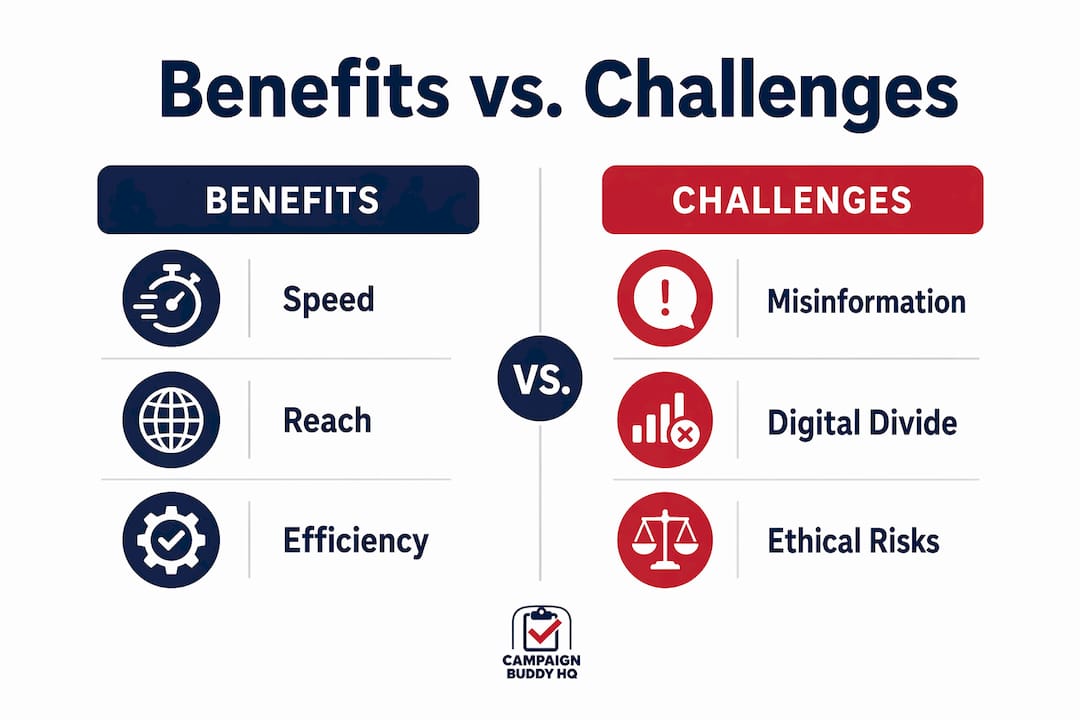
Speed is the most immediate benefit. A campaign can respond to a breaking news event with a coordinated message across email, social media, and SMS within hours. Precision targeting lets advocates reach specific voter segments based on geography, past engagement, or issue interest. Data-driven insights from outreach logs tell campaign managers which messages convert and which fall flat. Campaignbuddyhq captures this kind of outreach data automatically, giving teams a live picture of their progress toward campaign goals.
Challenges
The risks are real and underreported. Civil society must balance co-opting, countering, and innovating to manage the risks that come with new technologies. Surveillance is a genuine threat for advocates working on sensitive issues. Echo chambers form when algorithms serve content only to people who already agree, limiting genuine persuasion. Misinformation spreads faster through digital channels than corrections ever do.
| Benefit | Challenge |
|---|---|
| Reach millions of supporters quickly | Misinformation spreads faster than corrections |
| Precision targeting by geography or issue | Surveillance risks for sensitive campaigns |
| Data-driven insights from outreach logs | Digital divide excludes low-income communities |
| AI reduces time spent on repetitive tasks | AI outputs can contain errors or bias |
| Low cost per contact compared to direct mail | Echo chambers limit persuasion beyond base |
The digital divide deserves specific attention. Campaigns that rely entirely on digital outreach risk leaving behind communities with limited internet access. Rural and low-income supporters often need phone calls and door knocking alongside digital contact. Campaignbuddyhq is built with this reality in mind, supporting outreach tracking for doors, calls, and texts in low-density communities.
Ethical AI use requires human review, privacy protection, and bias mitigation at every stage. These are not optional safeguards. They are the difference between technology that builds credibility and technology that destroys it.
Pro Tip: Set a rule that no AI-generated content goes out without a human reading it first. This single practice catches most errors before they become public problems.
How is AI shaping grassroots advocacy in 2026?
Generative AI has changed what a small advocacy team can accomplish. A two-person operation can now produce the content volume that once required a full communications department. The key is knowing which tasks AI handles well and which ones still need a human.
AI programs enable fast extraction of key issues from complex planning documents for civic action. What once took a policy analyst weeks to summarize can now be processed in minutes. That speed matters enormously when a city council vote is three days away and your team needs to understand a 200-page environmental impact report.
More than 1,500 social entrepreneurs use AI in over 130 countries to scale their social impact. That number reflects a genuine shift in how grassroots organizations operate globally. The AMPLIFY: Citizens platform condensed 1,400+ workshop papers from youth into actionable policy recommendations using AI clustering techniques. That kind of synthesis would have taken months without AI assistance.
Current AI applications in grassroots advocacy include:
- Document analysis: Summarizing legislation, zoning proposals, and policy briefs for non-expert audiences
- Content drafting: Writing first-draft emails, social posts, and talking points for human review
- Multi-language outreach: Translating and culturally adapting messages for diverse communities
- Scenario modeling: Projecting how different outreach strategies might perform before committing resources
- Outreach visuals: Generating graphics and short-form video scripts for social media campaigns
The risk of AI inaccuracy is real. AI tools hallucinate facts, misread context, and reflect the biases in their training data. Every AI output needs a human check before it reaches supporters or decision-makers. The AI toolkit for government affairs has become more sophisticated, but the verification step remains non-negotiable.
Practical steps for integrating technology responsibly
Responsible technology adoption follows a clear sequence. Advocates who skip the planning stage end up with tools that don't fit their campaign and data they can't use.
-
Audit your campaign needs first. List the tasks that consume the most time. Outreach logging, message drafting, and supporter tracking are common bottlenecks. Match tools to those specific problems rather than adopting technology for its own sake.
-
Vet tools for privacy and data security. Ask vendors directly how they store supporter data and whether they share it with third parties. Campaigns collect sensitive information. Protecting it is a legal and ethical obligation.
-
Build human-in-the-loop workflows. Successful campaigns use AI for initial data processing but rely on human verification for accuracy and safety. Design your workflow so AI handles the first pass and a staff member reviews before anything goes public.
-
Train your team before launch. Digital literacy gaps cause more campaign technology failures than bad software does. Run practice sessions before a tool goes live. Staff who understand why a tool exists use it more consistently.
-
Evaluate results on a set schedule. Review outreach data weekly. If a channel is not producing contacts or conversions, reallocate the time. Technology should serve the campaign's goals, not the other way around.
Transparency with supporters also matters. When you use AI to draft content, the message should still reflect your campaign's actual values and voice. Supporters who feel deceived by automated communication disengage permanently. The role of digital outreach in political campaigns depends on trust as much as it depends on reach.
Pro Tip: Run a quarterly technology audit. Ask your team which tools they actually use and which ones sit idle. Cut what isn't working and reinvest that time in the tools that produce results.
Key Takeaways
Technology amplifies advocacy only when advocates combine the speed of digital tools with the judgment and accountability that human oversight provides.
| Point | Details |
|---|---|
| Digital tools expand reach | Platforms and AI outreach let small teams contact thousands of supporters efficiently. |
| AI requires human oversight | Every AI-generated output needs a human review before it reaches supporters or officials. |
| Ethical use is non-negotiable | Privacy protection, bias mitigation, and transparency protect campaign credibility. |
| Data drives better decisions | Outreach tracking tools like Campaignbuddyhq show what works and where to focus effort. |
| Digital divide demands balance | Combine digital outreach with phone and door-to-door contact to reach all communities. |
Technology is a tool, not a substitute for conviction
I've watched campaigns adopt every new platform the moment it launches, convinced that the right app will solve their organizing problems. It rarely does. The campaigns that use technology well are the ones that already know what they are trying to accomplish. The tool just helps them do it faster.
The most honest thing I can say about AI in advocacy is this: it is genuinely useful for about 40% of what campaigns spend time on. Document review, first-draft content, and outreach scheduling are all places where AI saves real hours. But the other 60%, which includes building trust with a skeptical voter, reading a room at a town hall, and deciding when to push and when to hold back, still requires a person who cares about the outcome.
The automation in campaigns conversation often skips over the ethical weight that advocates carry. When you use AI to generate messages at scale, you are making a choice about how you represent your community. That choice deserves more deliberate thought than most campaign teams give it.
My advice is to adopt technology skeptically and evaluate it honestly. If a tool saves your team ten hours a week and the output quality holds up, keep it. If it creates more review work than it saves, cut it. The goal is a campaign that wins and maintains the trust of the people it serves. Technology is one way to get there. It is not the only way, and it is never the whole answer.
— Billy
Campaignbuddyhq: built for advocates who need results
Political advocates need tools that match the pace and complexity of real campaigns. Campaignbuddyhq is a campaign management platform built specifically for issue advocacy groups, progressive candidates, and grassroots organizers who need to track outreach, manage workflows, and build momentum across every phase of a campaign.
The platform logs doors knocked, calls made, texts sent, and registrations completed, giving your team a clear picture of daily and weekly progress. It works for campaigns in dense urban districts and rural low-density communities alike. Campaignbuddyhq offers a free 7-day trial with no credit card required, so your team can test it against your actual campaign needs before committing.
FAQ
What is the role of technology in advocacy?
Technology in advocacy refers to the use of digital tools, AI platforms, and communication channels to organize supporters, deliver messages, and mobilize action at scale. It enables campaigns to reach broader audiences faster and with greater precision than traditional methods allow.
How does AI help grassroots advocacy groups?
AI helps grassroots groups by summarizing complex policy documents quickly, drafting outreach content, and processing large volumes of supporter input into usable insights. The AMPLIFY: Citizens platform used AI to condense over 1,400 youth workshop papers into policy recommendations.
What are the biggest risks of using technology in advocacy?
The biggest risks include misinformation spread through digital channels, surveillance of activists working on sensitive issues, and AI outputs that contain errors or reflect bias. Human review of all AI-generated content is the most effective safeguard.
How can advocates use technology without losing authenticity?
Advocates maintain authenticity by treating AI as a drafting assistant rather than a final author. Every automated message should reflect the campaign's actual values and pass a human review before distribution.
What features should advocates look for in a campaign management platform?
Advocates should prioritize outreach tracking across multiple contact methods, daily and weekly planning tools, supporter logging, and progress monitoring toward campaign goals. Campaignbuddyhq covers all of these functions in a single platform built for real-world campaign conditions.