

Every winning campaign runs through four operational phases: Building the Foundation, Engaging Supporters, Engaging Voters (Persuasion), and Winning / GOTV. Some teams add a fifth, post-election Optimization phase to capture lessons before the next cycle.
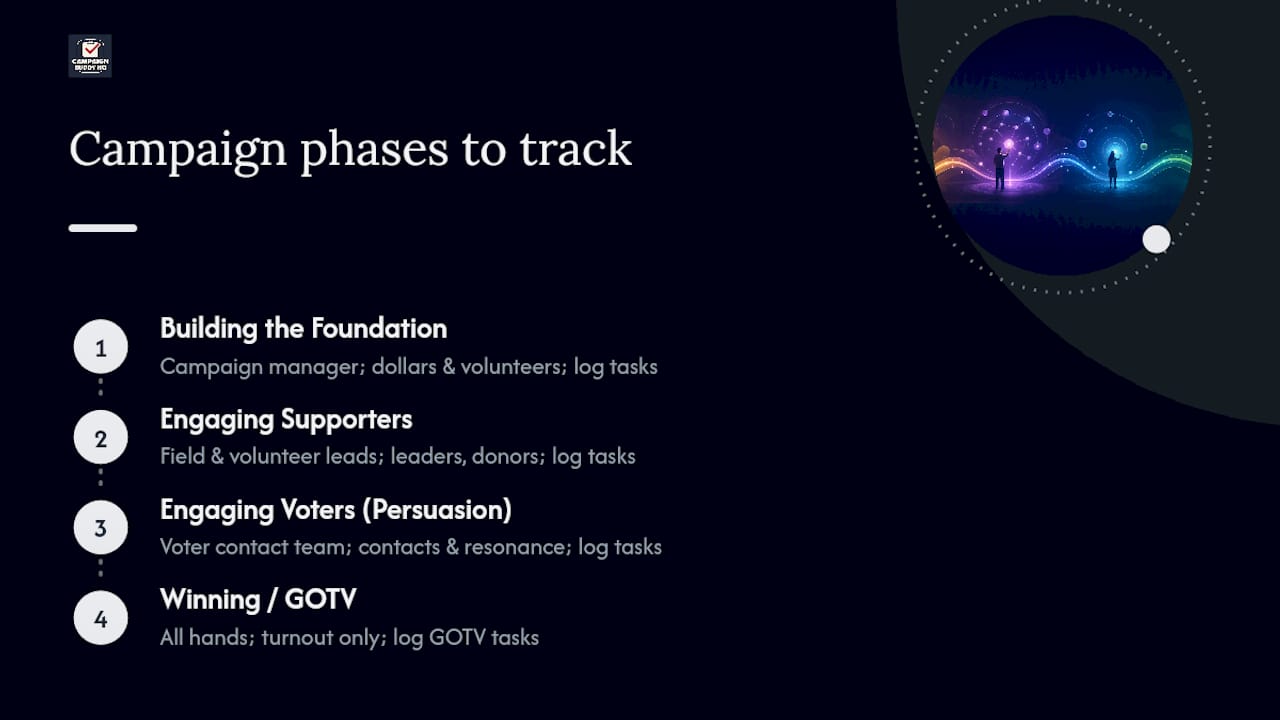
Each phase has one owner, one primary metric, and a distinct set of daily tasks to log in your campaign-management software. Foundation is run by the campaign manager and measured in dollars raised and volunteers recruited. Engaging Supporters is owned by field and volunteer leads, tracked by leader recruitment and donor counts. Persuasion belongs to your voter contact team, measured in contacts made and message resonance. GOTV is an all hands phase measured purely in turnout.
This four-phase structure comes from the Engagement Campaign model developed for grassroots organizing, and it maps cleanly onto how Campaign Buddy HQ structures phase templates for progressive campaigns.
Key Takeaways
Phase-based planning works because it ties every task, budget dollar, and staff hour to a specific milestone instead of one long undifferentiated push toward Election Day.
| Point | Details |
|---|---|
| Use four core phases | Track Building the Foundation, Engaging Supporters, Persuasion, and GOTV as distinct labels in your SaaS. |
| Set a milestone test per phase | Run a small stress test before scaling volume, like a dress-rehearsal phone bank before full canvass launch. |
| Log outputs and outcomes weekly | Track doors, calls, and texts alongside pledges and persuasion score shifts, not just contact counts. |
| Phase your budget and staff | Shift resources by stage rather than spreading spend evenly, with GOTV often needing the largest short-term push. |
| Run phases inside Campaign Buddy HQ | Use built-in phase templates, outreach logging forms, and milestone alerts instead of spreadsheets. |
Table of Contents
- Why Phase-Based Planning Beats Running One Long Sprint
- What Are the Operational Phases and Their Milestones?
- How Do You Turn Phases Into Weekly Tasks?
- How Do You Set Measurable Money, Message, and Mobilization Goals?
- What Should Your Phase Dashboards Actually Show?
- What Mistakes Derail Phase-Based Campaigns?
- How Do You Train Teams and Test Milestones by Phase?
- How Should Data and Voter Feedback Shape Each Phase?
- How Should You Budget and Allocate Resources by Phase?
- A Note From the Campaign Buddy HQ Team
- Where Campaign Buddy HQ Fits Into Your Phase Plan
- Where to Go Next for Templates and Deeper Guidance
- Frequently Asked Questions
- Sources
Why Phase-Based Planning Beats Running One Long Sprint
Campaigns that treat Election Day as one continuous sprint burn out staff by August and run out of budget by October. Phasing prevents that. It forces you to decide, in advance, when creative shifts from narrative to logistics, when spending ramps, and which KPI actually matters this month. The campaign life cycle framework built around distinct pre-launch, persuasion, and GOTV stages exists precisely because budget and staff capacity behave differently in each one.
Tracked inside a SaaS tool, phases give you:
- Clearer budget phasing instead of one flat annual number
- Task assignments that map to who owns which metric
- Milestone dates that catch capacity problems before they become crises
- A tagging system that keeps scope creep visible instead of buried
Pro Tip: Set your first milestone date 30 to 45 days out. A short runway forces an early gut check on whether your fundraising and volunteer numbers are on pace, while there's still time to adjust.
What Are the Operational Phases and Their Milestones?
Here's the phase-by-phase breakdown you can copy directly into your campaign-management software as templates.
1. Building the Foundation
Purpose: Lock in infrastructure, message, and seed money before public-facing work starts. Milestone: Confirm a base budget target and a tested core message early in the phase.
Tasks to log:
- Draft and test core message with focus groups or small donor calls
- Recruit an initial set of volunteer leaders
- Build donor prospect list and set fundraising targets
- Set up voter file and CRM tagging structure
- Secure office space, tech stack, and compliance filings
- Log founding donor calls (contact count, pledge amount, follow-up date)
Sample KPIs: seed money raised, core leaders recruited, message-testing sample size.
2. Engaging Supporters
Purpose: Expand the human capital, donors, volunteers, and precinct leaders, that later phases depend on. The Engaging Supporters phase exists because early investment in people creates the capacity for exponential growth in outreach volume once persuasion begins.

Milestone: Reach a target number of recruited volunteer leaders and recurring donors early in the phase.
Tasks to log:
- Host house parties and volunteer recruitment events
- Make leader-recruitment calls (contact type, owner, success flag)
- Run small-dollar fundraising asks via text and email
- Train new volunteer leaders on scripts and tools
- Log weekly donor calls and pledge follow-ups
- Build supporter segmentation (likely voter, strong supporter, undecided)
Sample KPIs: new leaders recruited, recurring donor count, volunteer hours logged.
3. Engaging Voters / Persuasion
Purpose: Move undecided voters with direct contact and consistent messaging.
Milestone: Complete a significant portion of the target voter universe with at least one contact during the phase.
Tasks to log:
- Door-knocking shifts (doors logged, contact result, follow-up flag)
- Phone bank calls (contact count, script version, response code)
- Text canvassing batches (sent, replied, opted out)
- Persuasion mail and digital ad tracking
- Weekly message-resonance surveys
- Update voter file with new persuasion scores
Sample KPIs: doors knocked, contact rate, persuasion score shift.
4. Winning / GOTV
Purpose: Convert identified supporters into votes. Creative here should be stripped to essentials, date, name, polling location, since GOTV messaging performs best when it drops storytelling for logistics.

Milestone: By Election Day minus 3, confirm turnout plans for every identified supporter.
Tasks to log:
- Poll-location reminder calls and texts
- Ride-to-polls coordination (requests, drivers assigned)
- Election Day shift check-ins (volunteer count, location, hours)
- Absentee/early-vote confirmation calls
- Final-day door knocks for unconfirmed likely voters
Sample KPIs: confirmed turnout contacts, early-vote conversion, Election Day shift coverage.
How Do You Turn Phases Into Weekly Tasks?
Break each phase into repeatable weekly sprints, then reverse the calendar from your final deadline. A basic four-week workback for the Persuasion phase looks like this:
- Week 1: Set voter contact targets, assign precincts, brief scripts
- Week 2: Run first canvass and phone bank wave, log every contact
- Week 3: Review contact data, adjust script based on resistance points
- Week 4: Second wave targeting undecided voters flagged in week 2
Field, phone/text, and fundraising teams each need their own weekly cadence, but the logging fields stay consistent: contact type, result, pledge amount (if applicable), follow-up action, and leader score.
Build handoff triggers so results move automatically to the next step:
- A "yes" pledge triggers a fundraising follow-up call
- An "undecided" contact triggers a persuasion mail flag
- A "confirmed voter" tag routes straight into the GOTV contact list
How Do You Set Measurable Money, Message, and Mobilization Goals?
Every phase needs three goal types tied to a milestone date: money (fundraising pace), message (resonance or awareness), and mobilization (volunteers and contacts). The Engagement Campaign model recommends attaching a strategic milestone test to each goal to prove capacity early, rather than discovering a shortfall in October.
| KPI Name | Definition | Where to Log It |
|---|---|---|
| Supporter ID | Voters marked "likely" or "strong" in your CRM | Voter file tag field |
| Weekly doors | Doors knocked and logged that week | Field outreach log |
| Fundraising pace | Dollars raised against weekly target | Finance dashboard |
| Message resonance | Survey or call feedback score on core message | Persuasion tracking module |
Set interim check-ins every two weeks rather than waiting for the phase-end milestone. Some frameworks separate outputs (calls made, doors knocked) from outcomes (pledges secured, minds changed), and tracking both weekly is what lets a team course-correct before a shortfall becomes a crisis.
What Should Your Phase Dashboards Actually Show?
You don't need a complicated reporting stack. A phase pipeline view, a milestone burn-up chart, a weekly outreach funnel, and a finance pacing chart cover almost everything a manager needs to spot trouble early.
Use a consistent tagging scheme across every task: phase (Foundation, Supporters, Persuasion, GOTV), audience segment, and priority level. That combination lets you filter a week's work down to exactly what matters, like every high-priority Persuasion task assigned to a specific field team.
Weekly snap reports work best as a single page: phase status, this week's numbers against targets, and next week's top three priorities. Campaign management best practices consistently point to this kind of continuous tracking loop as the difference between a campaign that adjusts in real time and one that finds out too late.
Pro Tip: Screenshot your dashboard every Monday morning and drop it in your team channel. A visual pace-check catches a stalled phase faster than any spreadsheet review.
Roughly one in three campaign teams skip the retrospective step entirely, treating wrap-up as pure administrative cleanup instead of the input for next cycle's phase templates.
What Mistakes Derail Phase-Based Campaigns?
The most common mistake is treating the whole campaign as one continuous sprint, never phasing budget or staff capacity to match what each stage actually needs. The second most common: letting phases bleed into each other without adjusting task tags, so a Persuasion-phase door list quietly becomes a GOTV list with nobody noticing the shift.
Quick fixes:
- Overlap confusion: keep phase tags distinct in your SaaS even when activities overlap in practice
- Scope creep: review every new task request against its assigned phase before adding it
- Ignoring optimization: schedule the retrospective meeting before the campaign ends, not after
Pro Tip: When a phase milestone slips by more than a week, don't quietly extend the deadline. Re-phase the budget and staff hours attached to it, or the next phase inherits the shortfall.
How Do You Train Teams and Test Milestones by Phase?
Training should match the phase, not happen once at kickoff. Foundation-phase training covers message discipline and CRM setup. Engaging Supporters training focuses on recruitment scripts and donor conversation skills. Persuasion training drills canvass and phone scripts against real objections. GOTV training is almost entirely logistics: shift check-ins, ride coordination, and polling-location scripts.
Strategic milestone tests work best as a small, deliberate stress test rather than a passive check-in. Before moving from Foundation to Engaging Supporters, run a test event, a house party or a call night, and measure whether your volunteer-to-leader conversion rate holds up at slightly higher volume. If it doesn't, you've caught a capacity gap while it's still cheap to fix.
The same logic applies moving into Persuasion. Run a one-night phone bank at full script before committing the whole team to six weeks of the same approach. If contact rates or message resonance come in weak, you adjust the script before burning through your voter universe on a flawed message.
GOTV milestone tests are the least forgiving. There's no time to iterate three days before an election, so the test has to happen earlier, typically during a full-scale dress rehearsal in the final two weeks, covering ride coordination, shift staffing, and text-reminder sequencing under real volume.
Log every milestone test result in your campaign-management tool the same way you log regular outreach: contact count, success flag, and a note on what needs adjusting before the next phase begins.
How Should Data and Voter Feedback Shape Each Phase?
Data should flow in both directions inside every phase, not just get collected for a final report. In Foundation, message-testing feedback should directly reshape your talking points before you scale distribution. In Engaging Supporters, donor and volunteer response rates tell you which recruitment channels are actually converting, so you can shift effort away from underperforming ones early.
Persuasion is where feedback loops matter most. Every canvass shift and phone bank should feed a persuasion score back into the voter file, and that score should update in near real time, not at the end of the week. If a script is generating pushback on a specific point, that needs to surface within days, not after the whole universe has been contacted with a message that isn't working.
GOTV feedback loops are shorter and higher stakes. Turnout data from early voting locations should adjust the final week's door and call targets daily, shifting resources toward precincts with lower early turnout. A campaign that ignores this and sticks to a static final-week plan wastes volunteer hours on precincts that already turned out and under-resources the ones that need a final push.
The common thread: build your tagging and CRM fields so that feedback from this week's contacts automatically informs next week's target list. That's a workflow decision, not a technology one, but it only works if your team logs consistently enough for the data to mean something.
How Should You Budget and Allocate Resources by Phase?
Resource allocation should shift in both amount and type as you move through phases. Foundation needs relatively little cash but a lot of founder and manager time; it's the phase where a wrong hire or a bad message decision costs the most downstream. Budget here goes toward tools, initial staff, and seed fundraising infrastructure rather than paid outreach.
Engaging Supporters needs a moderate budget increase focused on volunteer recruitment events, small-dollar fundraising tools, and leader training materials. This is also where staffing shifts from a small core team to a growing volunteer leadership structure, so budget for training time, not just event costs.
Persuasion is typically where budget accelerates fastest, covering paid canvassers or expanded volunteer shifts, phone and text tools at scale, and persuasion mail or digital ads. Staff capacity needs to be phased up before this point, not during it, since hiring and training take longer than the phase itself allows once it's underway.
GOTV often demands the single largest short-term spend of the entire cycle, concentrated into the final one to two weeks: ride coordination, Election Day staffing, and high-frequency reminder outreach. Planning budget phasing backward from Election Day rather than spreading spend evenly across the calendar is what keeps campaigns from running short exactly when they need the most resources.
A Note From the Campaign Buddy HQ Team
We built our phase templates around the four-stage model because campaigns kept asking for exactly this: a way to stop guessing which week to ramp fundraising or when to start GOTV shifts. One rural campaign using our leader-recruitment tracking during Engaging Supporters doubled its volunteer base before Persuasion even started, simply by making leader recruitment a visible, logged metric instead of an informal goal.
Where Campaign Buddy HQ Fits Into Your Phase Plan
Campaign Buddy HQ is the alternative to running your phases across scattered spreadsheets and group texts: one place where Foundation, Engaging Supporters, Persuasion, and GOTV each get their own template, task scheduler, and logging form, so nothing falls through the cracks between phases.
Phase templates come pre-built with the milestone structure covered above, so you're not building a tracking system from scratch. Outreach logging forms capture doors, calls, and texts with the exact fields, contact result, owner, follow-up date, that this article walks through phase by phase. Dashboards give you the milestone burn-up and outreach funnel views without needing a separate reporting tool, and milestone alerts flag when a phase is falling behind pace early enough to fix it.
Campaign Buddy HQ was built with rural and low-density campaigns in mind, where a small team needs software that does the coordination work a larger campaign would hire staff for. Every plan starts with a 7-day free trial, no credit card required, so you can load your current phase and test the workflow before committing. Start your free trial and get your first phase template built out this week.
Where to Go Next for Templates and Deeper Guidance
A few places worth bookmarking as you build out your phase plan:
- Master every campaign phase for maximum voter impact for a deeper phase-by-phase breakdown
- Political Advocacy Workflow Process: A Campaign Manager's Guide for staff delegation templates
- Get Out the Vote: What It Means and How It Works for GOTV-specific operations
- Amplify Overlooked Cold Case Victims: 2026 Guide for coalition-building timelines from a community advocacy angle
Frequently Asked Questions
What are the main types of advocacy campaign phases? Most campaigns run four operational phases: Building the Foundation, Engaging Supporters, Engaging Voters (Persuasion), and Winning/GOTV. Some teams add a fifth Optimization phase after the election to capture lessons for next cycle.
Why do experts recommend adding an Engaging Supporters phase? Adding a dedicated phase for recruiting donors, volunteers, and precinct leaders before persuasion begins builds the human capital that later phases depend on. Campaigns that skip this step often hit a wall once outreach needs to scale.
How long should each campaign phase last? It varies by race size and election date, but a common structure runs Foundation for the first month, Engaging Supporters for roughly two months, Persuasion through most of the middle stretch, and GOTV concentrated in the final two weeks.
What KPIs should I track in each phase? Track one metric each for money, message, and mobilization per phase: fundraising pace and leader recruitment early on, contact rate and message resonance during persuasion, and confirmed turnout contacts during GOTV.
Can phases overlap in practice? Yes, activities often bleed together, but keep the phase tags distinct inside your campaign-management software anyway. That separation is what lets you assign tasks, track KPIs, and catch scope creep before it becomes a budget problem.
Sources
- Campaigning to Engage and Win (New Organizing Institute) — Manual cover (influencewatch copy)
- Advocacy Campaign Planner - POP17
- The Political Campaign Life Cycle | Surge Tactic
- Monday