

The nine highest-leverage advocacy event promotion ideas, in order of impact: attendee one-click shareables with unique referral links; speaker and sponsor advocacy triggered at program milestones; email cadence targeting warm lists; SMS for rapid mobilization; omnichannel partner pushes; referral incentives; petition-to-registration conversion ladders; paid social retargeting; and an optimized landing page with a friction-free registration flow.
One-line operational plan: Open registration → launch email drip + attendee share assets → activate speakers and partners at milestones → layer SMS in the final two weeks → run retargeting ads for non-registrants → measure referral registrations daily in your campaign tool.
Industry guidance confirms that starting early with a slow-drip cadence, then ramping hard in the final week, consistently outperforms last-minute blasts. Email remains the highest-converting owned channel when you work warm lists, and Attendee advocacy benchmarks show 15–30% share participation rates when personalized assets are delivered at the moment of registration. Campaignbuddyhq is built to wire these steps together so nothing falls through the cracks.
- One-click shareables with referral links
- Speaker and sponsor milestone triggers
- Segmented email sequences (warm lists first)
- SMS last-minute mobilization
- Omnichannel partner co-promotion
- Referral incentives tied to registration
- Petition → registration conversion ladder
- Paid social retargeting for non-registrants
- Optimized landing page and simple registration flow
Table of Contents
- When should you start promoting an advocacy event?
- Which channels actually work for advocacy event promotion?
- What creative assets make supporters actually share your event?
- How do you sequence asks to convert engagement into attendance?
- What should you measure and how do you log it in your campaign tool?
- What does a realistic budget and staffing plan look like?
- Copyable promotion checklist and 8-week sample schedule
- Ready-to-use email, SMS, and social templates
- How to keep momentum going after the event ends
- Campaignbuddyhq makes this plan executable from day one
- Key Takeaways
- A campaign manager's honest take on what actually works
- Further reading and sources
When should you start promoting an advocacy event?
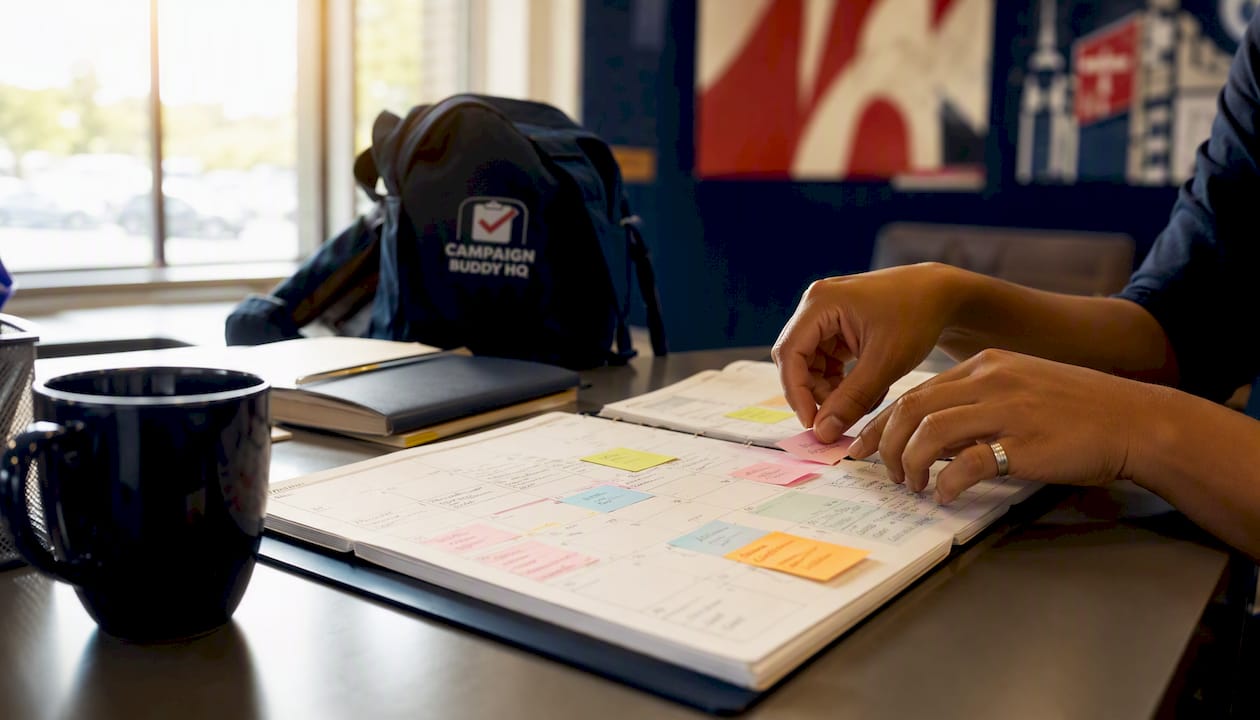
Start the day registration opens. Industry cadence guidance is clear: a slow drip that ramps sharply in the final two to three weeks outperforms any single loud announcement. For most advocacy events, an eight-week window is the right frame.
| Week | Milestone | Key Actions | Owner |
|---|---|---|---|
| 8 | Registration opens | Launch landing page, send save-the-date, post organic social | Campaign manager |
| 7 | Early-bird window | First email to warm list, attendee share assets live | Digital lead |
| 6 | Speaker confirmations | Trigger speaker advocacy kits, post speaker announcements | Advocacy ops |
| 5 | Agenda published | Email segment with session highlights, partner kit activation | Digital lead |
| 4 | Early-bird close | Urgency email, SMS to engaged non-registrants | Digital lead |
| 3 | Mid-push | Retargeting ads go live, referral leaderboard update | Data/attribution owner |
| 2 | Final ramp-up | Daily social posts, SMS reminders, partner re-push | All |
| 1 | Event week | Countdown emails, last-chance SMS, volunteer briefings | Campaign manager |
Pro Tip: Wire each milestone above to a campaign software trigger in Campaignbuddyhq so share prompts and reminder sequences fire automatically when a program phase changes. Manual follow-up at scale is where cadence breaks down.
A political advocacy workflow guide maps these milestones directly to campaign phases, making it straightforward to assign owners and set automated nudges without rebuilding the schedule from scratch each cycle.
Which channels actually work for advocacy event promotion?
The short answer: email first, SMS for urgency, peer sharing for reach, partners for niche audiences, and paid ads to catch everyone else. Most registrations happen after four to five touches, so layering channels is not optional.
| Channel | Best Use | Timing |
|---|---|---|
| Warm list conversion, segmented reminders | Weeks 8–1, increasing frequency | |
| SMS | Rapid mobilization, last-minute push | Weeks 2–1 |
| Peer/attendee sharing | Referral registrations, organic reach | Triggered at registration |
| Partners/speakers | Niche network reach | Milestone-triggered |
| Paid social/retargeting | Non-registrant conversion | Weeks 3–1 |
Email is your highest-converting owned channel. Segment by past engagement, personalize the CTA to the registrant's issue area, and always tie links to UTM parameters for clean attribution.
SMS has very high open and read rates and reaches supporters within minutes of delivery. Keep messages under 160 characters, include a short link, and always lead with the action. Reserve SMS for the final two weeks and event-day reminders so you don't burn goodwill.
Peer-to-peer sharing is where the math gets interesting. When you give attendees a personalized asset and a one-click path, Share participation rates run 15–30% when personalized assets are delivered at the moment of registration, and those referrals convert at a lower cost per registration than paid ads because the trust is already there.
Partners and speakers are essentially free media for niche audiences. Provide a ready-to-use kit with pre-written copy, sized graphics, and a tracked link. Trigger the kit at the moment of acceptance or agenda publication, when enthusiasm peaks.
For smaller budgets, email and organic social deliver the best return. Add paid retargeting only after organic channels are running, and use lookalike audiences built from your registrant list to keep cost per click reasonable.
What creative assets make supporters actually share your event?
The asset that gets shared is the one that makes the sharer look good. Your event brand rides along; it does not lead.
- "I'm attending" cards: personalized with the supporter's name, photo, and a unique referral link. Deliver immediately after registration confirmation.
- "I'm speaking" banners: session title, speaker headshot, and event date. Trigger at speaker acceptance to capture peak enthusiasm.
- Pre-written captions: one for LinkedIn, one for X/Twitter, one for Facebook. Remove blank-page friction entirely.
- Short video clips and quote cards: pull a compelling session quote or impact stat and format it for vertical and square crops.
- Post-event photo drops: branded, captioned, delivered within minutes of capture. These drive next-year registrations.
Pro Tip: Build a 60-second share path: registration confirmation → personalized graphic auto-generated from registration data → pre-filled caption → one-click post. Every extra step cuts share rates. Keep the path under three taps.
Deliver assets over email, SMS, and in-app. For image specs, 1080×1080px works for most social platforms; add alt text for accessibility. At scale, generate assets automatically from registration data rather than building them one by one.
How do you sequence asks to convert engagement into attendance?
Use an action ladder. Start with low-effort, high-volume actions and move toward higher-commitment asks only after supporters are warmed up.
- Share prompt fires at registration confirmation (lowest friction, highest volume).
- Petition or public pledge opens the issue to your full list and social channels to build visible momentum.
- Segmented email invites petition signers to register for the event (they are already warm).
- Targeted constituent ask routes specific supporters to contact their decision-maker (highest commitment, reserved for engaged advocates).
- Volunteer or speaker sign-up for the most committed segment.
The most common mistake is skipping steps two and three and going straight from a cold list to a high-commitment ask. Cold audiences need a low-friction on-ramp first.
Pro Tip: Map each step to a metric before launch. Share → click rate. Click → registration rate. Registration → referral rate. If a step's conversion drops below your baseline, fix that step before pushing more volume through the top.
Building campaign momentum with data walks through how to use petition engagement as a warm-up signal before moving supporters into a targeted event registration ask.
What should you measure and how do you log it in your campaign tool?
Track these six metrics, and separate momentum from impact in your dashboards.
- Share participation rate: percentage of registrants who shared an asset.
- Referral registrations: registrations attributed to a specific advocate's link.
- Cost per acquisition: total paid spend divided by paid-channel registrations.
- Attendance rate: registrants who actually showed up.
- Constituent contacts: decision-maker contacts generated by the event.
- Follow-through rate: share of petition signers who completed the next step.
Attribution without UTMs is guesswork. Use a consistent naming convention: utm_source=email&utm_medium=drip&utm_campaign=event-2026&utm_content=week4. For referral links, append a unique advocate ID so registrations trace back to the individual sharer.
| Field to Log | Why It Matters |
|---|---|
| Channel | Tells you which source drove the registration |
| Owner | Accountability for follow-up |
| Timestamp | Cadence analysis and trigger audits |
| Asset ID | Identifies which creative drove shares |
| Referral code | Attributes word-of-mouth registrations |
Log outreach in Campaignbuddyhq using the activity tracking fields for calls, texts, and registrations. Keep constituent meeting counts and qualitative stories in a separate dashboard column from raw sign-up totals. Volume tells you momentum; constituent contacts tell you impact.
What does a realistic budget and staffing plan look like?
For a small to mid-size advocacy event, four roles cover the work: campaign manager (overall coordination), digital lead (email and SMS), advocacy ops (shareables and partner kits), and data owner (attribution and reporting).
| Cost Bucket | Notes |
|---|---|
| Asset production | Graphic templates, video clips, photo editing |
| Platform and tool fees | Campaign software subscription, SMS delivery costs |
| Paid ads | Social retargeting, Google display for non-registrants |
| Partner and speaker kits | Print or digital collateral |
| Staff hours | Largest cost for most small teams |
For smaller budgets, email and organic social with peer sharing cover most of the reach without ad spend. Add paid retargeting only in the final three weeks when your registrant list is large enough to build a useful lookalike audience. SMS delivery costs are low per message but add up at scale; budget for it separately from email.
Minimum effective staffing for a 200-person event: one digital lead managing sequences, one advocacy ops person building and distributing assets, and a campaign manager reviewing attribution weekly.
Copyable promotion checklist and 8-week sample schedule
Use this checklist directly in Campaignbuddyhq's planning view. Assign an owner to each item before week eight begins.
- Build and test the event landing page and registration flow.
- Set up UTM parameters and referral link structure.
- Create attendee and speaker share asset templates.
- Load email sequences into your campaign tool (confirmation, drip, urgency).
- Draft SMS templates and confirm opt-in compliance.
- Build partner and speaker kits with pre-written copy and tracked links.
- Configure retargeting audiences in your paid ad platform.
- Assign owners and set automated triggers for each milestone.
| Week | Task | Owner | Automation Trigger |
|---|---|---|---|
| 8 | Launch landing page, send save-the-date | Campaign manager | Registration opens |
| 7 | Email warm list, deploy attendee share assets | Digital lead | Registration confirmation |
| 6 | Activate speaker kits | Advocacy ops | Speaker acceptance logged |
| 5 | Partner co-promotion email, agenda post | Digital lead | Agenda published |
| 4 | Early-bird close urgency email | Digital lead | Date-based trigger |
| 3 | Launch retargeting ads, update referral leaderboard | Data owner | Non-registrant segment |
| 2 | Daily social posts, SMS to engaged non-registrants | Digital lead | Scheduled |
| 1 | Countdown emails, last-chance SMS, volunteer brief | Campaign manager | 7 days before event |
For coordinating multi-channel outreach across a small team, logging each task completion in your campaign tool keeps everyone aligned without daily standups.
Ready-to-use email, SMS, and social templates
Registration confirmation email (with share prompt)
Subject: You're in — now bring a friend
Thanks for registering for [Event Name]. You're joining [X] advocates working on [Issue]. Share your spot and help us reach our goal of [Y] attendees: [Personalized referral link]
Segmented reminder email (non-registrants, week 2)
Subject: [First name], seats are filling fast
[Event Name] is [X] days away. [Speaker Name] will be discussing [Topic] — and we saved you a spot. Register before [Date]: [Registration link]
SMS last-minute reminder
[Org name]: [Event] is tomorrow at [Time], [Location]. Confirm your spot: [Short link]. Reply STOP to opt out.
LinkedIn "I'm attending" post
Excited to join [Event Name] on [Date] to advocate for [Issue]. If you work on [Topic], come find me. Register: [Link] #[Hashtag]
Speaker promotion post (X/Twitter)
I'm speaking at [Event Name] on [Date] about [Topic]. Join me: [Link] #[Hashtag]
Pro Tip: For SMS, always include opt-out language ("Reply STOP to opt out") and send only to contacts who have given explicit prior consent. TCPA compliance is not optional — consult legal counsel for your specific program before launching any text campaign.
How to keep momentum going after the event ends
Post-event engagement is where most advocacy teams leave impact on the table. The supporters who attended are your warmest list, and the window to act on that warmth is short.
Send a thank-you email within 24 hours. Include attendance numbers, a key impact stat from the event, and one clear next step (sign a petition, contact a legislator, register for the next event). Supporters who get a specific, timely follow-up are far more likely to take that next step than those who receive a generic recap a week later.
Share event photos and video clips on social within 48 hours. Tag speakers and attendees where possible. Post-event content extends the event's reach to people who did not attend and plants the seed for next year's registration.
Report back on outcomes. When a decision-maker responds, a bill advances, or a policy changes, tell your advocates. That feedback loop is the single strongest predictor of whether someone will act again. Segment your post-event list by engagement level and resurface them for the next campaign with context on what they already care about.
Campaignbuddyhq makes this plan executable from day one
Pulling off an omnichannel advocacy event promotion plan without a system to track it is where most campaigns stall. Campaignbuddyhq maps directly to every phase above: campaign phases hold your eight-week schedule, outreach logging captures every email sent, door knocked, and text delivered, and the referral attribution dashboard shows which advocates drove registrations so you can recognize and re-engage them.
The practical difference: instead of managing a spreadsheet of share assets, UTM links, and owner assignments across three tools, your team logs everything in one place. Milestone triggers fire share prompts automatically when a program state changes. Attribution is built in, not bolted on after the fact.
Start your free 7-day trial at Campaignbuddyhq — no credit card required. Drop the eight-week checklist above into your first campaign phase and assign owners before your next planning call.
Key Takeaways
The single most effective advocacy event promotion strategy combines a slow-drip email cadence, attendee one-click shareables with referral links, and SMS mobilization in the final two weeks, all logged and attributed in campaign software.
| Point | Details |
|---|---|
| Start eight weeks out | Open registration and launch your drip the same day; late starts compress your cadence. |
| Email and peer sharing first | Email converts warm lists best; attendee shareables drive significant share participation at low cost. |
| SMS in the final two weeks | High read rates make SMS the right tool for urgency, not awareness. |
| Measure referral registrations | Attribution without UTMs and referral codes leaves ROI unprovable. |
| Campaignbuddyhq for execution | Use campaign phases, outreach logging, and milestone triggers to automate the eight-week plan. |
A campaign manager's honest take on what actually works
The conventional wisdom says "be everywhere." In practice, that advice burns out small teams fast. What actually moves registrations is doing two or three channels well rather than eight channels poorly.
The single asset that consistently outperforms everything else is the personalized share card delivered at the moment of registration. Not a week later. Not in a follow-up email. At the confirmation screen, when the supporter's enthusiasm is at its peak. That one touchpoint, wired correctly, generates referral registrations that no paid ad budget can replicate at the same cost.
The staffing shortcut most teams miss: assign one person to own attribution from day one. Not as an afterthought at the end of the campaign. If nobody owns UTM naming conventions and referral code setup before week eight, you will spend the post-event debrief arguing about which channel drove what, with no data to settle it.
Further reading and sources
- Advocacy events and associations (Muster) — cadence and ramp-up guidance
- Event marketing strategy framework (Attendir) — email conversion and channel prioritization
- What is attendee advocacy? (Attendir) — share participation benchmarks and attribution metrics
- Speaker advocacy for events (Sessionboard) — milestone-triggered sharing and speaker kit design
- Advocacy campaign overview (Givebutter) — SMS mobilization and read-rate context
- Event promotion guide (Bizzabo) — omnichannel sequencing and multi-touch strategy
- How to promote your event (Custom Ink) — low-budget, high-ROI channel recommendations
- How to run a nonprofit advocacy campaign (Soapbox Engage) — petition-to-action sequencing and impact metrics
- What is advocacy campaigning? (Campaignbuddyhq) — foundational strategy context
- Automation in advocacy (Campaignbuddyhq) — milestone triggers and workflow automation
Compliance note: SMS outreach in the United States is governed by the Telephone Consumer Protection Act (TCPA). Consult qualified legal counsel before launching any text program to confirm your opt-in practices, message content, and frequency comply with current FCC rules and any applicable state law.