

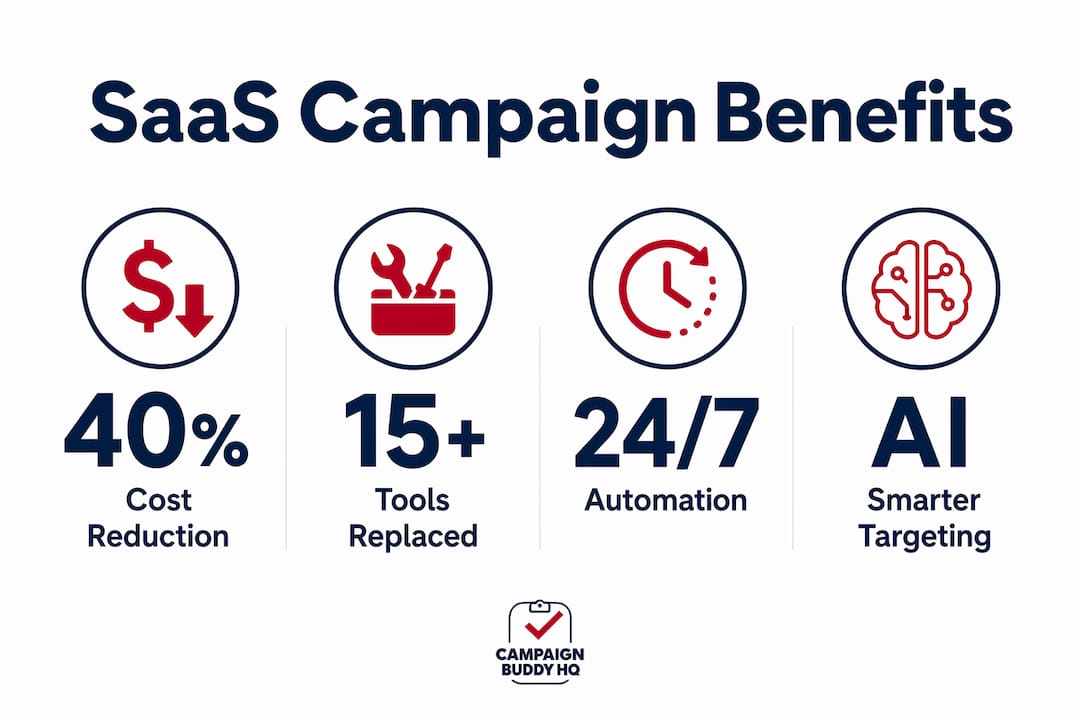
SaaS, or Software as a Service, is defined as cloud-based software delivered over the internet that replaces locally installed tools with always-on, subscription-based platforms. For political campaigns, the answer to why use SaaS for campaigns comes down to one core advantage: integrated, AI-driven management that replaces scattered spreadsheets, disconnected phone lists, and manual tracking with a single coordinated system. Platforms like Campaignbuddyhq and TigerTail are built specifically to handle the outreach volume, data demands, and tight timelines that campaigns face. AI-integrated SaaS tools reduce acquisition costs by 20–40%, which means more doors knocked and more calls made per dollar spent. That kind of efficiency is not a luxury for a campaign. It is a competitive requirement.
Why use SaaS for campaigns instead of traditional methods?
Traditional campaign management relies on a patchwork of tools: spreadsheets for voter lists, separate email platforms, manual call logs, and disconnected ad accounts. The result is data fragmentation, duplicated effort, and no clear picture of what is actually working.

SaaS platforms replace that patchwork with a unified stack. A single platform can handle CRM data, email automation, outreach logging, and reporting in one place. That means your field organizer, digital director, and candidate are all looking at the same numbers in real time.
The cost difference is significant. AI-powered orchestration platforms cut campaign asset creation from weeks to hours. A landing page that used to take a week of back-and-forth between a designer and a developer now takes an afternoon. That speed compounds across an entire campaign cycle.
The real cost advantage
The benefits of SaaS for marketing go beyond convenience. When your ad spend, CRM data, and outreach logs feed into one system, you stop paying for audiences you have already converted. You stop running ads to people who already volunteered. That kind of waste is invisible in a fragmented setup but obvious once you have integrated data.
Pro Tip: Before switching platforms, audit your current tool count. If you are using more than 15 separate tools, you are almost certainly losing data between them and paying for redundant features.
Consider the difference between a campaign running Google Ads with no CRM connection versus one with full pipeline attribution. The disconnected campaign optimizes for form fills. The connected campaign optimizes for actual volunteer signups and donor conversions. Those are very different outcomes, and the data infrastructure is what separates them.
What SaaS features actually support campaign workflows?
Political campaigns have specific operational needs that generic marketing software does not address. The SaaS advantages for campaigns come from platforms built around those specific workflows.
The most critical features for campaign teams include:
- Centralized supporter database: A CRM that stores voter contact history, volunteer status, donation records, and outreach notes in one place. Campaignbuddyhq's supporter tracking tools are designed specifically for this use case, including rural and low-density community scenarios where contact lists are harder to maintain.
- Multi-channel coordination: Managing door knocking, phone banking, text outreach, and email from a single dashboard. Real-time monitoring and task automation keep every team member accountable and on the same schedule.
- Outreach logging: Tracking doors knocked, calls made, texts sent, and registrations completed so you can measure daily and weekly progress against campaign goals.
- Real-time reporting: Dashboards that show which precincts are on track, which volunteers need follow-up, and where outreach is falling short before it becomes a problem.
SaaS teams experiment rapidly, requiring fast A/B testing capabilities that traditional tools cannot match. For a campaign, that means testing two different voter contact scripts and knowing within 48 hours which one drives more commitments.
The automation piece matters most for small campaign teams. When your system automatically sends a follow-up text after a door knock, schedules the next volunteer shift reminder, and flags supporters who have gone cold, your organizers spend their time on strategy instead of data entry.
How does AI and data integration sharpen campaign targeting?
AI does not replace campaign judgment. It amplifies it. The SaaS solutions for campaign management that deliver the best results are the ones that feed real behavioral data back into their targeting algorithms.
Here is how that works in practice. When a supporter attends a rally, that event attendance data gets imported into your ad platform. The algorithm learns what a high-intent supporter looks like and finds more people who match that profile. Without that data import, the algorithm is guessing. Campaigns fail without technical infrastructure to feed conversion data back from CRM to ad platforms, causing algorithms to optimize for vanity metrics instead of real outcomes.
Lead scoring is the other major AI advantage. Instead of treating every name on a voter list equally, a SaaS platform with AI scoring ranks contacts by their likelihood to volunteer, donate, or show up on election day. Your best organizers spend their time on the top 20% of that list, not the bottom 80%.
Pro Tip: Import offline conversion events, such as volunteer signups at events and in-person donor meetings, into your ad platform at least once a week. That data is what trains the algorithm to find your best prospects.
The data feedback loop is what separates campaigns that improve over time from campaigns that repeat the same outreach patterns regardless of results. Pipeline-based attribution and CRM integration are the technical backbone of that loop. Without them, you are flying blind even if your individual tools are excellent.
How to implement SaaS in your campaign without wasting budget
Adoption strategy matters as much as tool selection. The most common mistake campaigns make is layering automation on top of insufficient data. The result is an algorithm that optimizes for the wrong thing at scale.
Follow this sequence to avoid that outcome:
- Start manual. Run your first outreach push with manual targeting and manual bidding. This builds a clean dataset of actual conversions before any automation touches it.
- Integrate your CRM first. Connect your supporter database to your ad platforms and outreach tools before you add any automation layer. Data plumbing first, automation second.
- Reach the learning threshold. Automated bidding requires 30+ conversions per month per campaign unit before it operates effectively. Launching automation before that threshold wastes budget on algorithm guessing.
- Limit your stack. High-growth organizations focus on 8–15 core integrated tools rather than 90 or more. Every tool you add beyond that range creates a new data gap.
- Audit and consolidate. After your first campaign phase, identify which tools are producing data that feeds other tools. Cut the ones that are isolated.
SaaS vs. traditional campaign tools: a direct comparison
| Factor | SaaS Platform | Traditional Methods |
|---|---|---|
| Data centralization | Single integrated database | Fragmented across spreadsheets and tools |
| Outreach tracking | Automated, real-time logging | Manual entry, often delayed |
| Targeting accuracy | AI-driven, behavior-based scoring | Broad list-based outreach |
| Asset creation speed | Hours with automation | Days to weeks |
| Reporting | Live dashboards | Periodic manual reports |
| Cost per conversion | Lower with optimized spend | Higher due to waste and duplication |
The comparison above shows why choosing SaaS for advertising is not just a technology preference. It is an operational decision that affects how many voters you reach and how much each contact costs.
Key takeaways
SaaS platforms give political campaigns a measurable edge by replacing fragmented tools with integrated, data-driven systems that reduce cost and improve outreach quality.
| Point | Details |
|---|---|
| Cost reduction is real | AI-integrated SaaS tools reduce acquisition costs by 20–40% through optimized targeting. |
| Data integration drives results | CRM and ad platform integration feeds algorithms real conversion data, not vanity metrics. |
| Start manual, then automate | Build a clean conversion dataset before activating automated bidding to avoid wasted spend. |
| Limit your tool stack | Focus on 8–15 integrated tools to prevent data fragmentation and operational bloat. |
| Campaign-specific features matter | Outreach logging, supporter tracking, and real-time reporting are non-negotiable for field teams. |
What campaigns get wrong about SaaS adoption
I have watched campaigns invest in SaaS platforms and still underperform, and the reason is almost always the same. They treat the software as the solution instead of treating the data infrastructure as the solution.
The tool is only as good as what you feed it. A campaign that imports clean, offline conversion data every week will outperform a campaign with a fancier platform but no data discipline. I have seen well-funded campaigns run Google Ads for months and optimize for form fills because nobody connected the CRM. They generated hundreds of leads that never converted to volunteers or donors. The algorithm kept finding more people just like them.
The campaigns that get the most out of SaaS are the ones that assign someone, even a part-time volunteer, to own the data pipeline. That person makes sure event attendance gets imported, that volunteer signups sync to the ad platform, and that the CRM is updated after every outreach push. That discipline is unglamorous. It is also what separates a 2% conversion rate from a 6% one.
My honest advice: do not evaluate SaaS platforms by their feature lists. Evaluate them by how easily they connect to the tools you already use and how clearly they surface data you can act on. Campaignbuddyhq earns its place in a campaign stack because it was built for the specific workflows field organizers actually run, not adapted from a generic marketing template.
— Billy
How Campaignbuddyhq puts these advantages to work
Campaignbuddyhq is built specifically for the campaign workflows described in this article, from daily outreach planning to supporter tracking and campaign reporting dashboards that show real progress toward your goals.
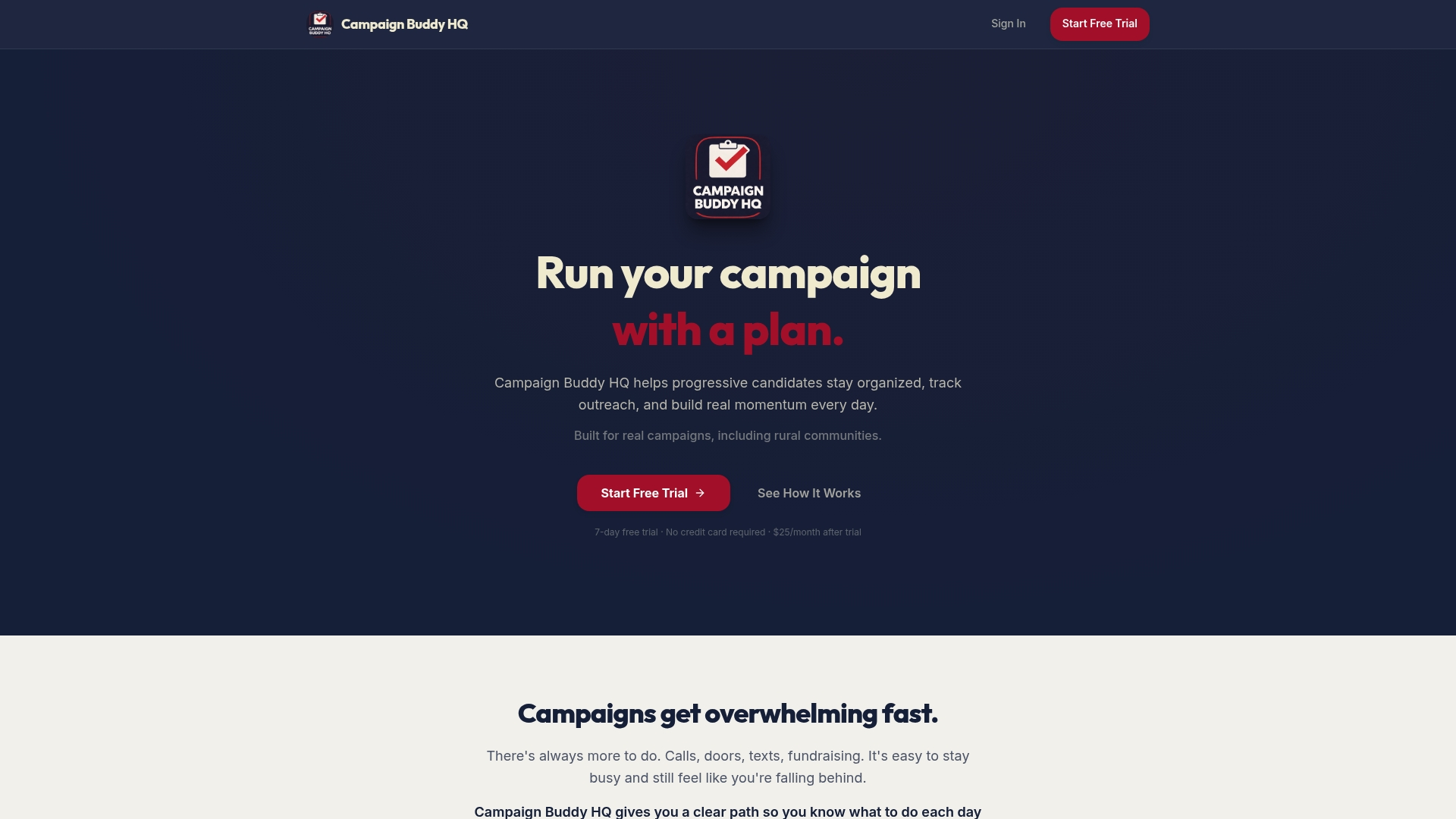
The platform handles CRM integration, outreach logging across doors, calls, and texts, and real-time progress monitoring in one place. It is designed for grassroots and traditional campaigns, including those operating in rural and low-density communities where contact management is hardest. For campaigns that want to understand automation in campaign management before committing, the Campaignbuddyhq blog covers practical implementation in depth. Start a free 7-day trial at campaignbuddyhq.com with no credit card required and see how integrated outreach management changes your daily operations.
FAQ
What is SaaS in the context of political campaigns?
SaaS, or Software as a Service, refers to cloud-based platforms that campaign teams access online to manage outreach, track supporters, and run reporting without installing local software. Platforms like Campaignbuddyhq are purpose-built for campaign workflows including door knocking, phone banking, and volunteer coordination.
How does SaaS reduce campaign costs?
AI-integrated SaaS tools reduce customer acquisition costs by 20–40% by targeting high-intent prospects and automating conversion sequences that would otherwise require manual effort. The savings come from reduced wasted ad spend and faster asset creation.
Do small campaigns benefit from SaaS solutions?
Small campaigns benefit most from SaaS because they have the least capacity for manual data management. A single platform that handles outreach logging, supporter tracking, and reporting replaces several staff hours of administrative work per week.
What is the biggest mistake campaigns make with SaaS tools?
The most common mistake is activating automated bidding before collecting enough conversion data. Automated ad products require at least 30 conversions per month per campaign unit to operate effectively. Launching automation too early causes algorithms to optimize for the wrong signals.
How many SaaS tools should a campaign use?
High-performing organizations focus on 8–15 core integrated tools rather than building sprawling stacks of 90 or more. For most campaigns, a CRM, an outreach tracking platform, an email tool, and an ad management integration cover the core needs without creating data gaps between systems.