
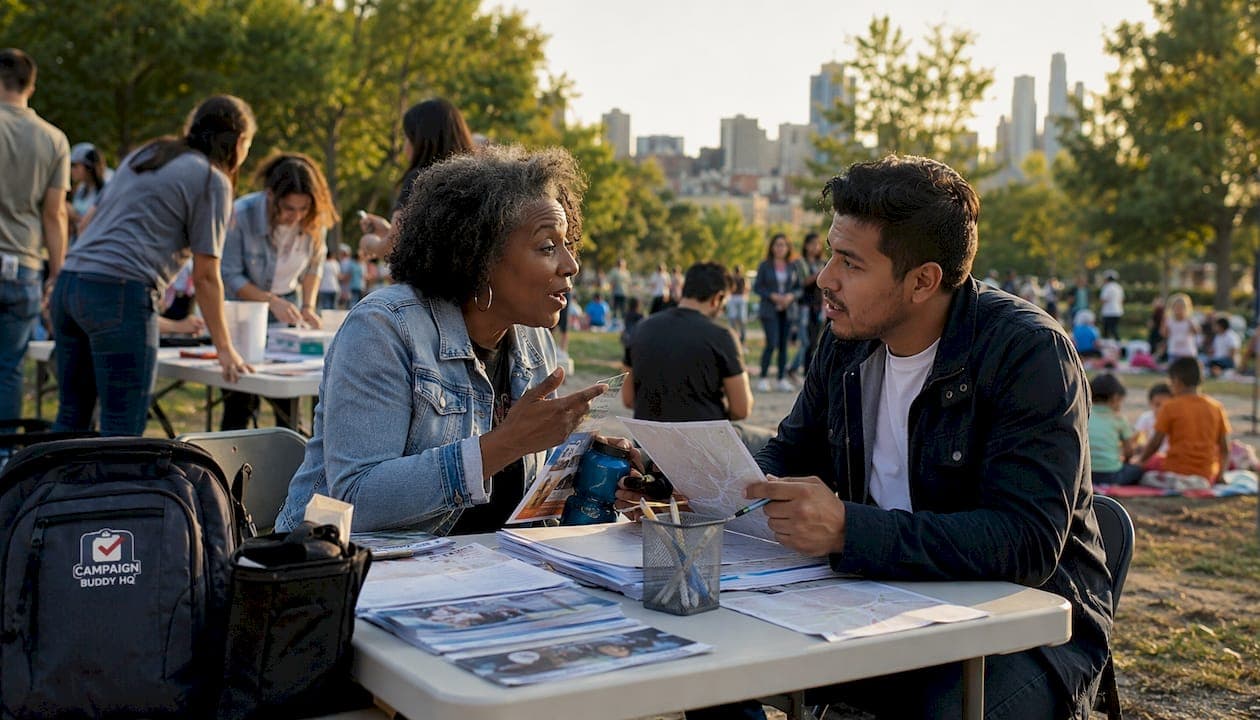
What is "get out the vote" and why does it matter?
"Get out the vote" (GOTV) refers to any organized effort to increase voter turnout, whether by helping people register, reminding them to show up on Election Day, or solving the practical barriers that keep registered voters home. Ballotpedia defines GOTV as a concerted effort to register voters and increase turnout, covering both nonpartisan drives that boost participation broadly and partisan campaigns that target likely supporters of a specific candidate or cause.
The stakes are real. Elections at every level, from local school boards to U.S. Senate races, have been decided by margins that a single well-run GOTV push could have flipped. The NAACP underscored this urgency in 2026 by announcing a $20 million GOTV campaign targeting 6.5 million Black voters across 14 states and 33 congressional districts ahead of the midterms. That kind of investment signals how seriously major organizations treat voter mobilization as a democratic necessity, not an afterthought.
GOTV is not about persuading people to change their minds on candidates or issues. It is about converting intention into action: getting someone who already plans to vote to actually follow through.
- GOTV covers both voter registration and Election Day turnout efforts
- Efforts can be nonpartisan (increase overall participation) or partisan (mobilize supporters)
- The goal is turnout, not persuasion
- Legal rules differ significantly depending on who runs the campaign and how
How do the different types of GOTV efforts work?
Two distinct categories define most GOTV work, and mixing them up creates both strategic and legal problems.
Nonpartisan, non-election-specific efforts focus on increasing overall civic participation without favoring any candidate or party. Nonprofits, community organizations, and civic groups typically run these. Activities include voter registration tables at community events, multilingual voter education materials, and general reminders to vote. Because these efforts do not advocate for a particular outcome, they face fewer legal restrictions and can be conducted by a wider range of organizations, including 501(c)(3) nonprofits.
Election-specific, partisan efforts are run by political campaigns, party committees, and political action committees (PACs). The goal here is targeted: identify your supporters, confirm they are registered, and make sure they vote. These campaigns use voter file data to prioritize contacts and focus resources on people most likely to support their candidate. The legal framework governing these efforts is stricter, particularly around coordination, disclosure, and funding sources.
- Voter registration drives (nonpartisan) aim to expand the electorate broadly
- Turnout drives (partisan) focus on mobilizing identified supporters before and on Election Day
- Nonpartisan groups can conduct GOTV without endorsing candidates
- Partisan campaigns must follow FEC and state-level rules on spending and coordination
Understanding which category your effort falls into shapes every decision that follows, from messaging to budget to legal compliance.
What activities make up a GOTV campaign?
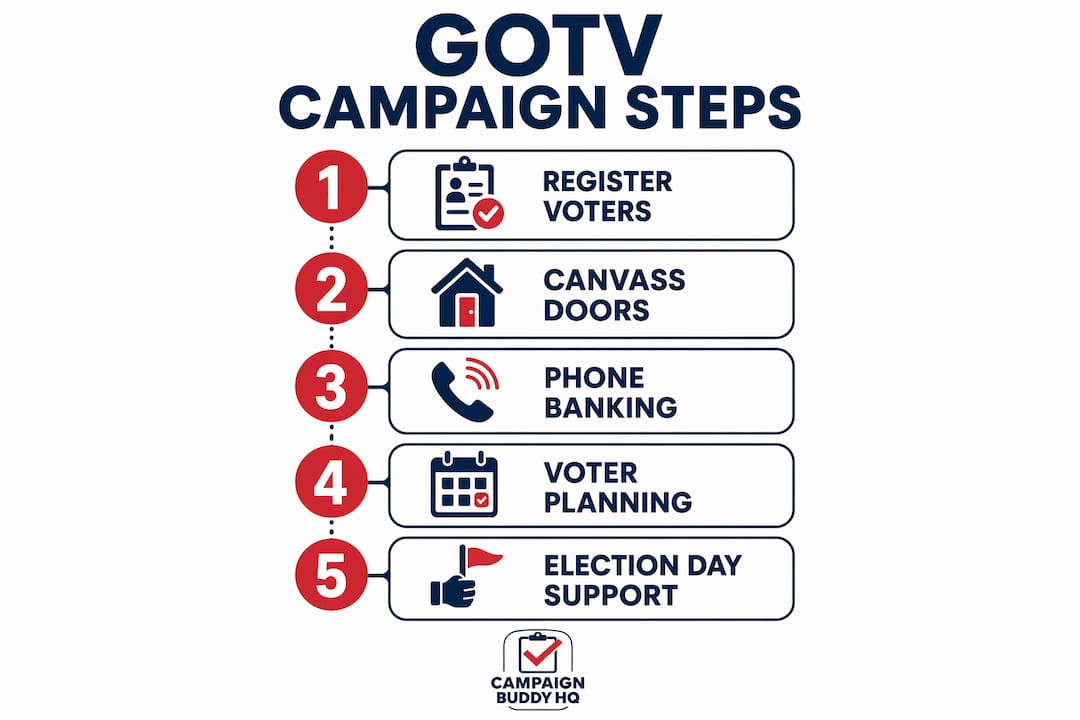
The core of any voter mobilization effort comes down to a handful of proven tactics, each with different costs, reach, and effectiveness.
Door-to-door canvassing remains the gold standard. A volunteer knocking on a door and having a real conversation with a voter consistently outperforms every other method. Phone banking with genuine, conversational calls (not scripts read robotically) runs a close second. Text messaging works well for reminders and logistics, especially for younger voters. Voter education efforts, such as distributing polling place information or explaining ID requirements, remove friction that keeps people home. Transportation assistance to polling places addresses one of the most concrete barriers, particularly in rural areas and low-income communities.
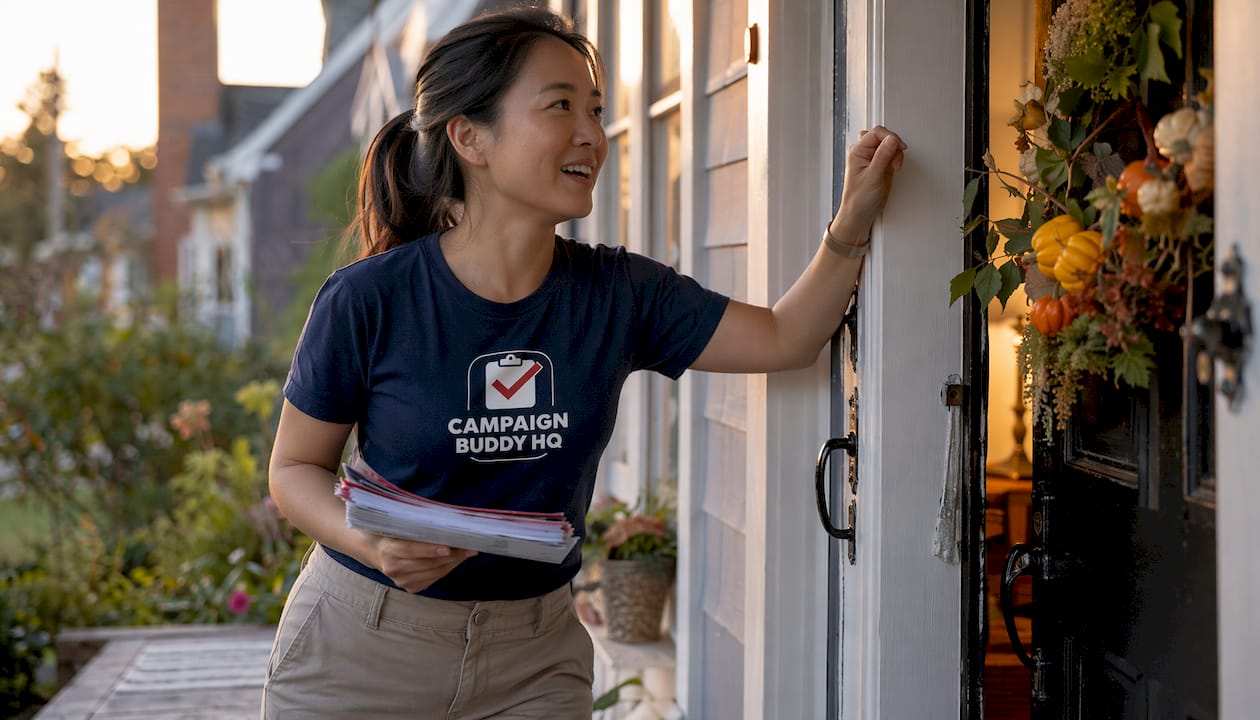
What does not work: mass emails and robocalls. Research from Yale's Institution for Social and Policy Studies confirms that impersonal methods like robocalls and bulk email are "chronically ineffective and inefficient" at mobilizing voters. The dynamic back-and-forth of a real conversation is what moves people.
Pro Tip: Help voters make a specific plan: ask them what time they will vote, how they will get there, and where their polling place is. Voters who articulate a concrete plan are significantly more likely to follow through than those who simply say they intend to vote.
Timing matters too. The most effective GOTV contacts happen in the final 72–96 hours before Election Day, with a follow-up reminder on Election Day morning. Contacting voters too early loses impact; too late and you run out of time to reach everyone on your list.
What are the legal rules for running a GOTV drive?
Federal and state law draws sharp lines around who can do what in voter mobilization, and the penalties for crossing those lines are serious.
For corporations and labor organizations, the FEC restricts GOTV activities to communications directed at their own employees, members, and shareholders. Broader public voter drives by corporations are heavily regulated and often prohibited in partisan contexts.
For 501(c)(3) nonprofits, the IRS bars any activity that directly or indirectly supports or opposes a candidate for public office. Nonpartisan voter registration and turnout drives are permitted, but the moment messaging favors one party or candidate, the organization risks losing its tax-exempt status.
For political campaigns and PACs, GOTV spending must be properly disclosed to the FEC. Coordination between outside groups and campaigns triggers additional rules. State laws add another layer, with some states requiring registration of paid canvassers or restricting when and where voter registration drives can operate.
- Nonpartisan nonprofits may conduct voter registration and GOTV drives without endorsing candidates
- Corporations and unions face strict limits on who they can contact and how
- Political campaigns must disclose GOTV expenditures to the FEC
- State laws vary widely on canvasser registration, voter assistance, and solicitation rules
- 501(c)(3) organizations that cross into partisan activity risk IRS penalties
The safest approach for any organization is to consult legal counsel before launching a drive and to document that all activities are conducted in a nonpartisan manner. A civic engagement guide for organizers can also help frame your program within appropriate legal boundaries from the start.
What do experts say actually works in modern GOTV campaigns?
The research consensus is clear: personal contact wins. Yale's ISPS field experiment findings show that door-to-door canvassing is the most consistently effective and efficient method of voter mobilization, with authentic phone calls approaching the same level of effectiveness. The key variable is not the channel but the quality of the interaction.
One personal contact equals roughly seven door hangers in voter turnout effect. Volume without quality is wasted effort.
The NAACP's 2026 campaign illustrates what serious resource commitment looks like at scale: $20 million invested, 20,000 volunteers recruited, and a multi-state infrastructure built to sustain mobilization across an entire election cycle. That model treats GOTV as a long-term engine, not a last-minute sprint.
One persistent myth is that GOTV is really just about voter registration. Registration matters, but it is the beginning, not the end. The real work is converting motivation into turnout by helping voters work through the logistics of actually casting their ballot. Campaigns that stop at registration leave votes on the table.
For current outreach trends in 2026, the shift toward relational organizing, where volunteers contact people in their own social networks rather than strangers, is producing measurable gains over traditional cold canvassing.
How has GOTV evolved over American history?
GOTV as a formal practice traces back to the early 20th century, when labor unions and political machines used precinct-level organizing to turn out their members on Election Day. The tactics were blunt: ward captains knew every voter on their block and showed up personally.
The civil rights movement transformed GOTV into something larger. Organizations like the NAACP and the Student Nonviolent Coordinating Committee (SNCC) ran voter registration drives across the South in the 1960s, facing violent resistance to efforts that were, at their core, about basic democratic access. The Voting Rights Act of 1965 created federal protections that made large-scale nonpartisan GOTV work legally viable for the first time.
The 1990s brought professionalization. Academic researchers, particularly Donald P. Green and Alan S. Gerber at Yale, began running controlled field experiments to test which tactics actually moved voters. Their book Get Out the Vote!: A Guide for Candidates and Campaigns (2004) gave campaigns an evidence base to work from rather than relying on folklore. Digital tools arrived next, first email lists, then social media, then sophisticated voter file databases that let campaigns target contacts with far more precision than any ward captain could manage.
Does GOTV actually change election outcomes?
Yes, and the evidence is not ambiguous. Well-executed canvassing campaigns consistently produce measurable increases in turnout among contacted voters. The effect is modest per contact but compounds across thousands of interactions. In close races, that compounding effect is often the difference.
The impact is not uniform, though. Turnout effects are strongest among low-propensity voters, people who are registered but vote inconsistently. High-propensity voters who reliably show up every cycle do not need a knock on the door. Campaigns that target their GOTV resources toward low-propensity supporters get far more return per dollar than those who spend time reminding reliable voters to do what they were already going to do.
Nonpartisan GOTV drives show similar patterns. Broad registration and turnout campaigns in underrepresented communities have historically shifted the composition of the electorate in ways that persist beyond a single election cycle.
Who runs GOTV campaigns in the United States?
The ecosystem is wide. Political parties run coordinated GOTV programs in every competitive state, pooling resources across candidates on the same ticket. Individual campaigns layer their own efforts on top of party infrastructure. PACs and super PACs fund independent expenditure programs that include voter mobilization components, though coordination with campaigns is prohibited.
On the nonpartisan side, the League of Women Voters has run voter registration and education drives for over a century. The NAACP operates one of the largest sustained mobilization programs in the country. Rock the Vote focuses on young voters. Mi Familia Vota targets Latino communities. Faith-based organizations, labor unions, and college campus groups all run their own programs, often in coalition with each other.
State and local governments also play a role, through automatic voter registration, vote-by-mail programs, and early voting expansions that reduce the logistical barriers GOTV campaigns work to overcome.
What challenges and controversies surround GOTV work?
Voter suppression is the most direct challenge. Restrictive voter ID laws, polling place closures, aggressive voter roll purges, and limits on early voting all raise the cost of voting and reduce the effectiveness of GOTV drives. Civil rights organizations argue these measures disproportionately affect Black, Latino, Indigenous, and low-income voters, which is precisely why groups like the NAACP frame GOTV as a rights defense effort, not just a campaign tactic.
Partisan accusations fly in both directions. Critics of aggressive GOTV programs sometimes claim they manufacture turnout among uninformed voters. Defenders counter that higher participation strengthens democratic legitimacy regardless of outcome. The debate rarely resolves, but the legal framework is clear: nonpartisan voter education and registration are protected civic activities.
Misinformation is a growing problem. False information about polling dates, ID requirements, and eligibility circulates on social media before every major election, and GOTV campaigns increasingly have to spend resources correcting it before they can focus on turnout.
What tools and technologies power modern GOTV efforts?
Voter file databases sit at the center of modern GOTV. Platforms that aggregate public voter registration data, past turnout history, and consumer data allow campaigns to score every voter by likelihood of supporting their candidate and likelihood of actually voting. That scoring drives every resource allocation decision.
Canvassing apps let field organizers assign turf, track completed doors in real time, and sync contact results back to the central database instantly. Phone banking has moved largely to browser-based dialers that queue calls automatically and log outcomes without manual data entry. Peer-to-peer texting platforms allow volunteers to send personalized messages at scale, with each text appearing to come from an individual rather than a mass sender.
For campaigns managing voter contact workflows, the ability to log doors, calls, and texts in one place and track progress toward daily goals is what separates organized campaigns from chaotic ones. Campaignbuddyhq is built specifically for this: tracking outreach activity across canvassing, phone, and text channels, with daily planning tools that keep volunteers focused and campaign managers informed. A step-by-step canvassing guide can help teams translate that infrastructure into field-ready execution.
Social media targeting, email automation, and digital advertising round out the toolkit, though their effectiveness for direct turnout mobilization remains far below that of personal contact. They work best for awareness and logistics, not for the final push that gets a voter to the polls.
Key Takeaways
GOTV campaigns succeed when personal contact, concrete voter planning, and legal compliance work together across a well-organized field operation.
| Point | Details |
|---|---|
| GOTV definition | Organized efforts to increase voter turnout through registration, reminders, and logistical support. |
| Two main types | Nonpartisan drives boost overall participation; partisan campaigns mobilize identified supporters. |
| Personal contact wins | One face-to-face or conversational contact equals roughly seven door hangers in turnout effect. |
| Legal compliance is required | FEC and IRS rules restrict how corporations, nonprofits, and campaigns may conduct voter drives. |
| Registration is not enough | True GOTV converts motivation into action by helping voters plan the exact when, where, and how of voting. |