
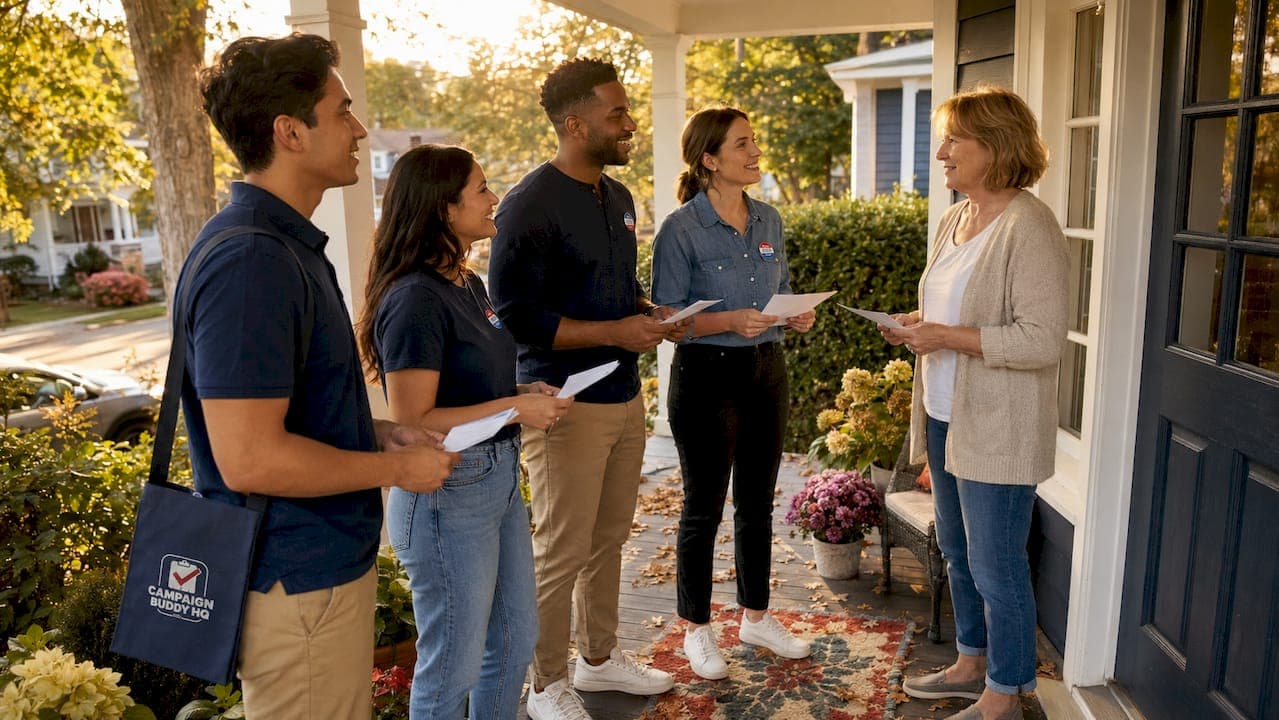
Canvassing is defined as the direct, face-to-face or phone-based outreach method campaigns use to identify supporters, persuade undecided voters, and drive turnout on Election Day. It is the foundation of every serious ground game, from local school board races to statewide campaigns. Foot canvassing increases voter turnout by 8–10% compared to baseline, making it the single most effective voter contact method available to campaigns. Phone banking, by comparison, produces roughly a 2.6% lift. Those numbers tell you exactly where to put your volunteers.
What is canvassing and how does it work in practice?
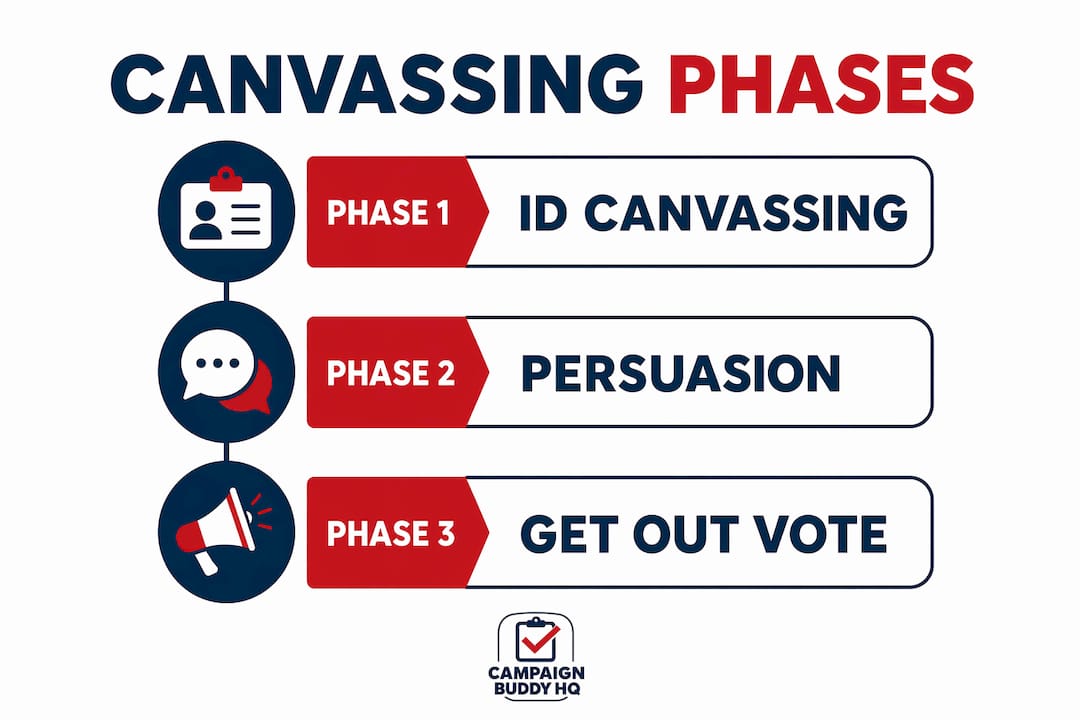
Canvassing is organized into three distinct phases, each with a different goal and a different script. Understanding the phases is what separates a campaign that builds momentum from one that burns out its volunteers on the wrong conversations.
Phase 1: ID canvassing. Canvassers knock doors or make calls to identify where voters stand. The goal is not persuasion. It is data collection. Canvassers ask a simple support question, record the answer, and move on. This phase happens earliest in the campaign calendar.
Phase 2: Persuasion canvassing. Once the campaign knows who is undecided, canvassers return with a message tailored to move those voters. Scripts are longer, conversations are deeper, and canvassers are trained to handle objections. This phase runs through the middle of the campaign.
Phase 3: Get Out the Vote (GOTV). Campaigns shift to GOTV roughly 14 days before Election Day. The script changes entirely. Canvassers no longer try to persuade. They remind confirmed supporters to vote, offer information on polling locations, and create a social commitment to show up.
A typical canvassing workflow runs like this: the campaign pulls a walk list from its voter database, assigns turf to each volunteer, briefs the team on the script, and deploys them to the field. After each shift, canvassers log their results. Recording conversation outcomes is as important as the conversations themselves. Without clean data entry, the campaign cannot retarget, cannot prioritize, and cannot measure progress.
Pro Tip: Never let volunteers leave a shift without entering their results. A door knocked without a recorded outcome is a door knocked twice.
Does canvassing actually move voters? The evidence
The evidence for canvassing is stronger than most campaign managers realize. Foot canvassing outperforms phone banking by a wide margin on turnout, and the effect compounds when voters receive multiple contacts.
"Campaign visibility through canvassing improves voter perception of candidate viability by 4 to 13 percentage points depending on context and party. That shift in perceived viability is not just a polling number. It changes whether volunteers join, whether donors give, and whether soft supporters bother to vote."
That viability effect is the part most campaigns miss. Canvassing is not only about flipping individual voters. It signals to the entire community that a campaign is real, organized, and worth supporting. A candidate who shows up at doors looks like a candidate who can win.
Local canvassers mobilize more effectively than canvassers brought in from outside the district. The reason is social capital. A neighbor asking you to vote carries more weight than a stranger with a clipboard. Campaigns that recruit volunteers from within the target community see stronger results than those that bus in outside help, even when the outside volunteers are more experienced. That finding should shape every volunteer recruitment decision you make.
Community events and local presence reinforce this effect. Local nonprofit events and visible community engagement build the same social trust that makes canvassing conversations land harder. Canvassing does not happen in a vacuum. It works best when the campaign already has roots in the neighborhood.
What legal rules govern political canvassing in the U.S.?
Political canvassing enjoys First Amendment protection, but that protection has real limits. Campaigns that ignore local ordinances create legal exposure and damage their public image.
The core legal framework breaks down into four areas:
- Property rights. Political speech does not override trespassing laws. Canvassers must leave when asked. Gated communities and private apartment complexes can legally restrict access. Ignoring a "No Trespassing" sign is not protected political activity.
- Noise and time ordinances. Many municipalities set quiet hours, typically before 9:00 AM or after 8:00 PM. Knocking doors outside those windows can result in complaints, citations, and bad press.
- Polling place buffers. Most states prohibit campaigning within a set distance of polling locations on Election Day. That buffer is typically 100 feet, but it varies by state. Violating it is a criminal offense in many jurisdictions.
- Phone outreach regulations. Calling cell phones with automated dialers without prior consent violates the Telephone Consumer Protection Act (TCPA). Live calls to cell phones face fewer restrictions, but campaigns must maintain do-not-call compliance.
Many activists assume canvassing allows unrestricted access to any door they choose. That assumption is wrong and costly. Respecting property rights is not just a legal obligation. It is a basic standard of effective canvassing, because a canvasser who creates conflict at the door destroys the conversation before it starts.
Pro Tip: Brief every volunteer on local quiet hours and trespassing rules before their first shift. A five-minute legal orientation prevents 90% of field incidents.
What techniques make canvassing more effective?
The gap between a mediocre canvassing program and a great one comes down to execution. The following practices separate campaigns that move numbers from campaigns that just knock doors.
- Recruit from within the community. Local canvassers bring social legitimacy that no script can replicate. Prioritize volunteers who live in the turf they are canvassing. For tips on building that volunteer base, the guide on volunteer recruitment strategies covers the full process.
- Use a clear, respectful script. Scripts should be short, conversational, and focused on one ask. Canvassers who go off-script or talk too long lose the voter's attention. Practice the script in training until it sounds natural, not rehearsed.
- Time your phases correctly. Switching from persuasion to GOTV too late wastes resources on voters who have already made up their minds. The step-by-step canvassing guide from Campaignbuddyhq walks through phase timing in detail.
- Enter data immediately after each shift. Campaigns that neglect data entry lose the ability to retarget efficiently. Use a canvassing app or platform that lets volunteers log results in the field, not the next morning.
- Debrief your team after every shift. A 10-minute debrief surfaces problems with scripts, turf, or voter reactions before they become patterns. It also keeps volunteers engaged and feeling heard.
| Canvassing phase | Primary goal | Timing |
|---|---|---|
| ID canvassing | Identify supporter levels | Early campaign |
| Persuasion canvassing | Move undecided voters | Mid-campaign |
| GOTV canvassing | Confirm turnout commitment | Final 14 days |
Technology matters here too. Canvassing apps that sync with voter databases let volunteers pull walk lists, record results, and flag issues in real time. That data flows back to the campaign instantly, so field directors can adjust turf assignments and targeting without waiting for end-of-day reports. For a broader look at how outreach methods are evolving, the 2026 campaign outreach trends piece covers what is changing and what is not.
Key Takeaways
Canvassing is the most effective voter contact method available, and its impact depends entirely on disciplined execution across all three phases.
| Point | Details |
|---|---|
| Foot canvassing leads all methods | Door-to-door contact increases turnout by 8–10%, far above phone banking's 2.6%. |
| Phase timing is non-negotiable | Shift to GOTV scripts and walk lists 14 days before Election Day to avoid wasted outreach. |
| Data entry is half the job | Recording conversation outcomes enables targeted follow-up and efficient resource use. |
| Local canvassers outperform outsiders | Shared community identity boosts social influence and voter mobilization rates. |
| Viability signaling matters | Canvassing raises perceived candidate strength by 4–13 points, driving volunteer and donor engagement. |
Why canvassing is misunderstood by most campaigns
Most campaigns treat canvassing as a persuasion operation. That framing is too narrow, and it leads to poor resource decisions.
The real power of a strong canvassing program is what it signals to the broader electorate. When voters see organized volunteers in their neighborhood, they update their belief about whether a candidate can win. That belief shift recruits more volunteers, loosens donor wallets, and moves soft supporters off the fence. Campaigns that focus only on converting individual voters miss this multiplier entirely.
The second thing campaigns consistently undervalue is data quality. I have seen well-funded operations knock tens of thousands of doors and come away with voter files full of incomplete entries. That data is nearly useless for GOTV targeting. The canvassing conversation is the input. The data record is the output. Both matter equally.
The third misconception is about who should be knocking. Campaigns default to whoever is available, often importing volunteers from other districts or states. The research is clear that local canvassers outperform outsiders. A smaller team of neighborhood volunteers will move more votes than a larger team of strangers. Build your volunteer base locally first, even if it takes longer.
Canvassing is not glamorous work. It is repetitive, weather-dependent, and physically demanding. But no other voter contact method comes close to its impact when it is done with discipline, good data, and the right people.
— Billy
How Campaignbuddyhq supports your canvassing program
Running a canvassing program without a system to track it is like knocking doors without a walk list. Campaignbuddyhq is built for exactly this problem.
Campaignbuddyhq gives campaign managers a single platform to log doors knocked, calls made, and supporter contacts, all organized by campaign phase. Volunteers can record field results in real time, and field directors see progress toward daily and weekly goals without chasing spreadsheets. The platform is built for grassroots campaigns, including those working in rural and low-density communities where every contact counts. A free 7-day trial requires no credit card. See what Campaignbuddyhq can do for your next canvassing push.
Pairing your canvassing program with the right tools also means thinking about how digital outreach complements field work. Social media video strategies for nonprofits offer a practical way to reinforce your canvassing message between door knocks.
FAQ
What is the canvassing definition in politics?
Canvassing is the organized practice of contacting voters directly, through door-to-door visits or phone calls, to identify supporters, persuade undecided voters, and increase turnout. It is the core method of grassroots voter mobilization.
How does door-to-door canvassing differ from phone banking?
Door-to-door canvassing increases voter turnout by 8–10%, compared to phone banking's roughly 2.6% lift. Face-to-face contact creates stronger social commitment and allows canvassers to read and respond to voter reactions in real time.
When should a campaign switch from persuasion to GOTV canvassing?
Campaigns should transition to GOTV scripts and walk lists approximately 14 days before Election Day. Switching too late wastes volunteer time on voters who have already decided how they will vote.
Are local canvassers really more effective than outside volunteers?
Local canvassers outperform outside volunteers because shared community identity strengthens social influence on voter behavior. Recruiting volunteers who live in the turf they canvass produces measurably better mobilization results.
What legal rules must canvassers follow?
Canvassers must respect private property rights, comply with local quiet-hour ordinances, and stay outside polling place buffer zones on Election Day. First Amendment protections apply to public spaces but do not override trespassing laws or harassment statutes.