

A workable advocacy campaign plan needs six things: a situation analysis; one to three SMART+C objectives; a target and power map; a chosen strategy with matched tactics; a time-bound action plan with owners and budget; and a monitoring rhythm. Treat it as a living document you revisit, not a static file. A tight two-page plan you actually follow beats a forty-page plan that sits in a drawer. The fillable checklist and templates below cover every piece.
TL;DR:
- A thorough situation analysis is essential and should be completed first to ensure that objectives, tactics, and targets align with the actual problem.
- Focus on one to three SMART+C objectives per campaign to maintain clarity and increase the likelihood of success, with clear indicators for progress.
- Build a power map to identify decision-makers, influencers, and gatekeepers, then choose messengers whose credibility and access match each target.
- Use a mix of advocacy strategies, such as mass mobilization, elite negotiation, networks, or expert testimony, and tailor tactics to each chosen path.
- Continuously monitor activity outputs, interim outcomes, and policy milestones weekly and monthly, adjusting tactics to stay on track or pivot if necessary.
Table of Contents
- What Goes Into Advocacy Campaign Planning First?
- How Do You Write SMART+C Objectives for Advocacy?
- Who Do You Need to Reach, and Who Will They Listen To?
- Which Advocacy Strategy Fits Your Situation?
- How Do You Build an Advocacy Action Plan With a Timeline?
- How Do You Craft Messages That Actually Move People?
- How Do You Track Progress and Know When to Change Course?
- How Campaign Buddy HQ Helps You Run This Plan
- What Risks Should You Plan For Before You Launch?
- What Legal and Ethical Lines Should Advocacy Campaigns Respect?
- How Do You Fund and Resource an Advocacy Campaign?
- How Do You Keep Volunteers and Supporters Engaged?
- Author Perspective: Three Priorities and a Common Pitfall
- Ready to Put This Plan Into Action?
- Where to Go for More Advocacy Planning Guidance
- Sources
- FAQ
What Goes Into Advocacy Campaign Planning First?
Advocacy campaign planning starts with a situation analysis, and most teams rush this step or skip it entirely. That's a mistake, because everything downstream, your objectives, your targets, your tactics, depends on getting the problem definition right.
Write the problem and its root causes in two or three sentences. Not five paragraphs. If you can't state the problem that tightly, you don't understand it well enough yet to build a campaign around it.
From there, gather three kinds of evidence:
- Policy and legal context. What law, regulation, or budget decision governs this issue right now, and who controls it?
- Local data or case examples. A specific story or number that makes the problem concrete for a decision-maker who has never lived it.
- Stakeholder positions. Who has already said something public on this, and what did they say?
Then scan for your window of opportunity. Bills in committee, scheduled hearings, budget cycles, an anniversary, a news story that just made your issue relevant, these are the moments when a decision-maker is actually paying attention. A well-argued campaign launched at the wrong moment gets ignored. A mediocre campaign launched at the right moment gets a meeting.
Your deliverable here is a one-page situation snapshot: the problem, the evidence, and the opening you're aiming for. Comprehensive advocacy planning frameworks consistently start with this exact sequence, situation analysis before goals, because strategic advocacy planning guidance from NCD Alliance shows that objectives built before the analysis tend to drift from what's actually achievable.
How Do You Write SMART+C Objectives for Advocacy?
An effective advocacy goal follows the SMART+C framework: Specific, Measurable, Achievable, Relevant, Timed, and Challenging. That last letter is what separates advocacy objectives from generic business goals, according to the Community Tool Box's advocacy planning guide. Your objective should stretch your coalition, not just describe a comfortable outcome.
Here's what that looks like in practice: instead of "improve school meal policy," write "get the district school board to adopt universal free breakfast by the upcoming budget vote, with several board members publicly co-sponsoring the measure."
Pro Tip: Limit yourself to one to three objectives per campaign cycle. Every additional objective splits your coalition's attention and your limited volunteer hours, and research on advocacy practice finds that narrowing focus to a single manageable objective raises the odds of actually winning it.
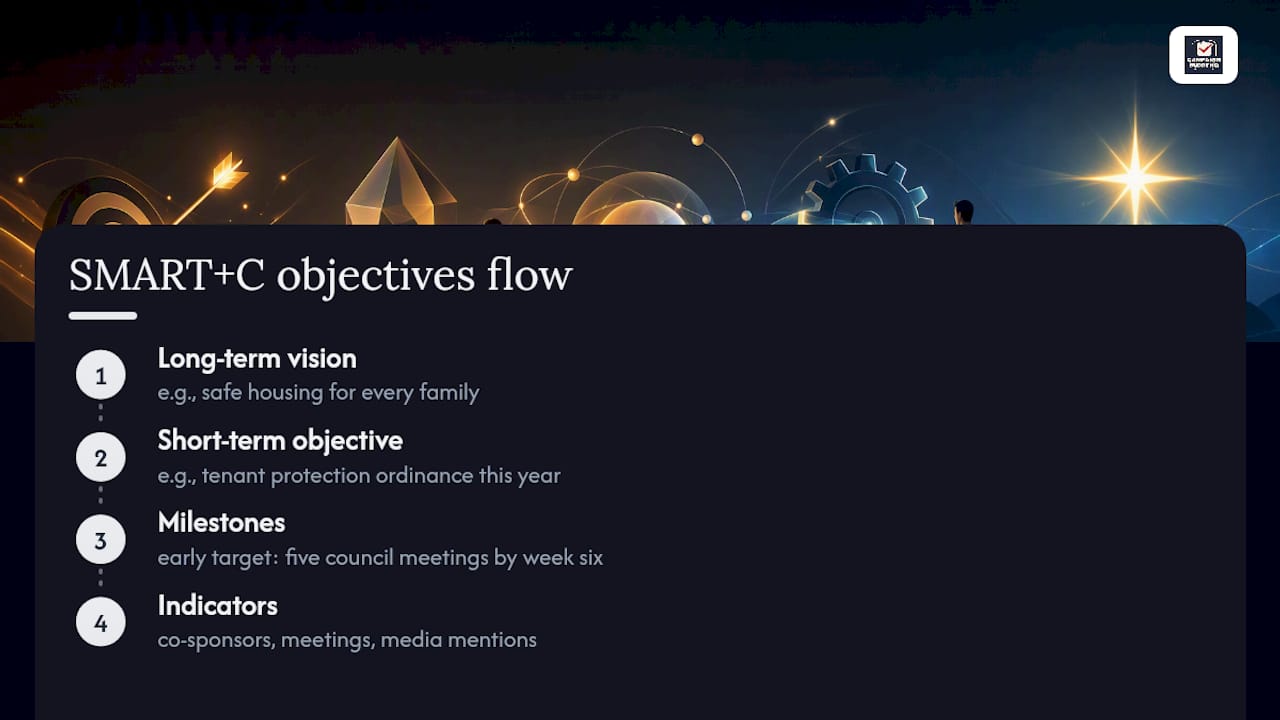
Objectives work as stepping stones. Your long-term vision (safe housing for every family in the county) breaks into a short-term objective (a tenant protection ordinance passed this year) that itself breaks into milestones.
SMART+C splits big visions into short, intermediate, and long-term objectives that you can actually measure, according to Community Tool Box.
Pick indicators tied to each objective: co-sponsors signed on, meetings secured, media mentions, and set an early milestone, like "five city council meetings booked by week six," so you know within a month whether you're on pace.
Who Do You Need to Reach, and Who Will They Listen To?
Build a simple 2x2 matrix: influence on one axis, support for your position on the other. That gives you four boxes, high influence and supportive, high influence and opposed, low influence and supportive, low influence and opposed, and each box tells you a different move.
Inside that matrix, separate three roles that people often lump together:
- Decision-makers, the people who can actually say yes: a legislator, a board chair, an agency director.
- Influencers, people the decision-maker trusts or fears losing support from, staff, donors, respected constituents.
- Gatekeepers, the people who control access to the decision-maker: schedulers, committee chairs, chiefs of staff.
Once you know who you're targeting, choose your messenger deliberately. Credibility often matters as much as the message itself, and power mapping guidance from the Open University recommends matching the messenger's identity and access to the specific target, not just picking whoever is most passionate. A retired veteran talking to a Veterans Affairs committee lands differently than a college intern reading the same script.
Power mapping should also track routines and social proximity, not just formal titles. A decision-maker's neighbor, softball teammate, or church acquaintance can sometimes open a door that a formal office visit never will.
Which Advocacy Strategy Fits Your Situation?
Effective advocacy strategies generally fall into four paths, and the research on what works in advocating for change suggests mixing tactics across paths often outperforms sticking to just one.
Mass mobilization works when your issue has broad public sympathy and you need visible numbers, think rallies, petition drives, viral moments. Elite negotiation fits when the decision sits with a handful of insiders and you have (or can build) a seat at the table. Emergent networks suit fast-moving, decentralized issues where no single organization owns the campaign. Expert-community strategy works when the fight is over technical credibility, think regulatory comment periods or scientific testimony.
Once you've picked a lead strategy, match tactics to it:
- Targeted constituent contact. Calls and letters from actual constituents move legislators; field experiments show even small numbers can shift votes.
- Grassroots lobbying through district office visits and town halls.
- Coalition-building across organizations with overlapping interests.
- Policy briefings for staff who actually write the memos decision-makers read.
- Media placements, op-eds and local news pitches timed to your window.
- Public events that create visible, photographable momentum.
- Social media momentum tactics, showcasing early supporters and officials responding, which experiments show increases both participation and legitimacy.
- Written comment campaigns during formal regulatory periods.
- Direct legislator meetings, ideally paired with a constituent from their district.
- Storytelling campaigns that pair data with a specific, named case.
Targeted conflict, publicly pressuring a specific official, can work, but manage it carefully. It can provoke an overreaction that opens a negotiation window, though it risks alienating potential allies who prefer quieter approaches.
How Do You Build an Advocacy Action Plan With a Timeline?
Break each objective into quarterly milestones, then monthly targets, then weekly tasks. A "so that" chain helps here: "we will hold three town halls so that we build fifty new supporter contacts so that we can turn out testimony at the September hearing." Each link should be a milestone you can actually check off.
Contingency planning belongs in this step too. If a hearing gets postponed, if a key ally drops out, if the bill dies in committee, decide now what your backup path looks like instead of scrambling later.
Here's the fillable checklist to copy into your own plan document:
| Field | What to fill in |
|---|---|
| Activity | The specific task (e.g., "Host town hall in District 4") |
| Objective linked | Which of your 1–3 objectives this supports |
| Owner | Named person, not "the team" |
| Deadline | Specific date |
| Budget | Dollar amount allocated |
| Success indicator | The number or event that proves it worked |
| Status | Not started / in progress / done / blocked |
Advocacy Plan Quick Reference
| Plan Element | Core Question It Answers |
|---|---|
| Situation analysis | What's the problem and when is our window? |
| SMART+C objectives | What, specifically, are we trying to win? |
| Power map | Who decides, and who do they listen to? |
| Strategy and tactics | How do we move them? |
| Action plan | Who does what, by when, with what money? |
| Monitoring rhythm | How do we know if it's working? |
Structured steps like these, problem analysis, objectives, activity planning, and monitoring, consistently improve the focus and feasibility of advocacy plans according to Transparency International's step-by-step advocacy guide. Teams running multiple outreach activities on this kind of timeline often benefit from a structured workflow process that keeps daily tasks tied back to the weekly milestones instead of drifting into busywork.
How Do You Craft Messages That Actually Move People?
Every ask should compress into one sentence: "We're asking the county board to allocate $2 million to the tenant legal defense fund in the FY27 budget." Attach one to three supporting talking points, no more, each backed by a fact or a story from your situation snapshot.
Pre-test the message before you scale it. Run it past five people outside your coalition and watch where they get confused or defensive; that's the line you need to rewrite. A guide to designing effective surveys offers a useful structure for gathering that kind of feedback systematically instead of relying on a few hallway conversations.
- Match the messenger to the audience: a local business owner for an economic argument, an affected resident for a moral one, a coalition leader for a political one.
- Sequence your channels: reach sympathetic insiders first, then use their public response to amplify toward harder targets.
- Use earned media and owned channels (email, social) for early wins, paid channels only when you need reach fast and have the budget.
How Do You Track Progress and Know When to Change Course?
Track three tiers of indicators: outputs (meetings held, calls made), interim outcomes (co-sponsors gained, media mentions, favorable statements from targets), and policy movement markers (bill advances to committee, amendment language changes). The INTRAC advocacy toolkit stresses defining these interim milestones precisely because final policy change often takes far longer than a campaign's initial timeline assumes.
- Weekly: review activity numbers against your action plan checklist.
- Monthly: check interim outcomes and adjust messaging if targets aren't responding.
- Quarterly: full strategy review, is your chosen path (mobilization, negotiation, network, expert) still the right one?
When a tactic stalls for two review cycles in a row, document why and reassign that budget line rather than letting it limp along. Practitioner guidance consistently frames the advocacy plan as a cycle built for pivots, not a document you write once and defend forever. A monitoring guide for campaign managers walks through setting up this kind of review rhythm in more detail.
How Campaign Buddy HQ Helps You Run This Plan
The checklist above only works if someone actually updates it every week, and that's where most plans quietly die. Campaign Buddy HQ turns the action plan table into daily and weekly views your team logs into instead of a spreadsheet nobody opens.
- Daily and weekly planning screens mirror the milestone breakdown from your action plan.
- Outreach logging tracks doors, calls, texts, and registrations against the objective each activity supports.
- Supporter tracking keeps your power map's allies and targets in one searchable record instead of scattered notes.
- Campaign phases let you mark progress through stages of your campaign, such as moving from situation analysis to active mobilization.
A weekly task like "call 40 constituents in District 4" gets logged as it happens, so your Monday check in becomes a real number instead of a guess, and your outreach tracking approach stays consistent even across a rural, low-connectivity district.
What Risks Should You Plan For Before You Launch?
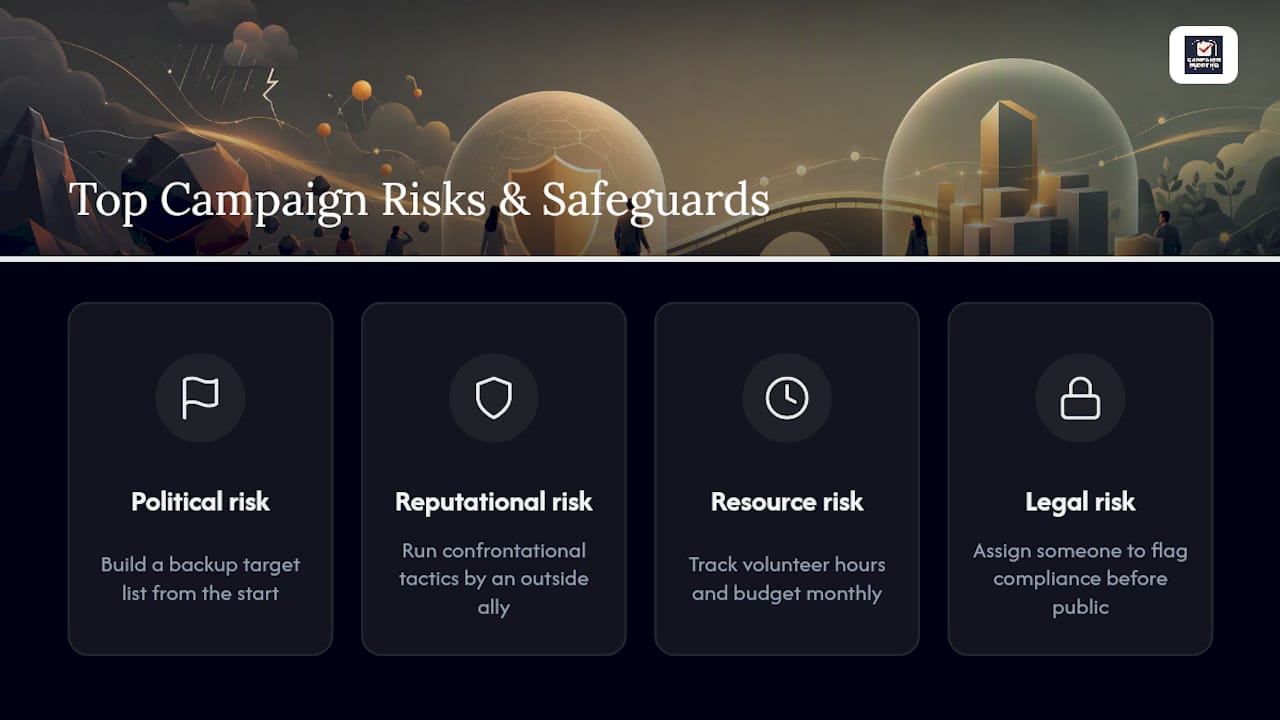
Every advocacy campaign carries risk, and naming it up front beats discovering it mid campaign. Political risk tops the list: a sympathetic official loses reelection, a bill sponsor withdraws, or your issue gets crowded out by a bigger news cycle. Build a backup target list from the start so one lost relationship doesn't stall the whole plan.
Reputational risk matters too. A tactic that reads as aggressive to one audience can read as principled to another, and a single miscalculated public statement can cost you a coalition partner. Run any confrontational tactic past at least one ally outside your immediate team before you deploy it.
Resource risk shows up when volunteer burnout or a funding gap hits mid campaign. Track volunteer hours and budget burn rate monthly, not just at the end, so you catch the shortfall while you can still adjust.
Legal risk deserves its own line, especially for tactics involving public assembly, campaign finance rules, or lobbying disclosure requirements that vary by jurisdiction. Assign someone, even a volunteer with a legal background, to flag anything that needs a compliance check before it goes public.
For each major risk, write one sentence: the trigger, the early warning sign, and the fallback action. That single line, repeated for your top three or four risks, does more real protection than a lengthy risk narrative nobody rereads once the campaign gets busy.
What Legal and Ethical Lines Should Advocacy Campaigns Respect?
Advocacy and lobbying rules differ by jurisdiction and by organization type, and 501(c)(3) nonprofits in the United States face real limits on lobbying activity that a 501(c)(4) or a political campaign committee does not. Know which category your organization falls under before you plan tactics, since the wrong classification can jeopardize funding or tax status.
Disclosure requirements around who is paying for what communication apply in many states and at the federal level for certain activities. If your campaign involves paid advertising or coordinated spending, confirm the applicable disclosure rules with someone qualified rather than assuming your state's rules mirror another's.
Ethically, the core rule is simple: represent the people affected by your issue honestly, and never fabricate a statistic, a quote, or a case example to strengthen your ask. A campaign's credibility is its only durable asset, and one exposed exaggeration can undo months of coalition-building. When in doubt about a specific legal question, a qualified attorney familiar with your state's advocacy and lobbying rules is worth the consultation.
How Do You Fund and Resource an Advocacy Campaign?
Fundraising for advocacy campaigns usually blends a few sources rather than relying on one. Small individual donations from your existing supporter base build a resilient base that isn't tied to any single funder's priorities. Foundation grants can fund a specific campaign phase, but many carry restrictions on lobbying activity, so read the grant terms before you count that money toward direct legislative contact.
In-kind resources often get overlooked and matter just as much as cash. Meeting space donated by a partner organization, printing donated by a local business, or a coalition member's existing email list can offset real budget line items.
Build your resource ask around the same action plan checklist you already created: each activity has a budget field, so your fundraising target is simply the sum of those line items plus a reasonable buffer for the unexpected. That gives potential donors a concrete number tied to a concrete outcome, "$3,000 funds our three planned town halls," rather than a vague appeal for general support. Specific asks consistently outperform vague ones, the same principle that makes SMART+C objectives work applies directly to fundraising asks.
How Do You Keep Volunteers and Supporters Engaged?
Volunteers stay engaged when their work connects visibly to a result, and they drop off fast when tasks feel disconnected from any outcome. Assign specific, bounded tasks, "make 30 calls from this list by Thursday," rather than open-ended asks like "help with outreach," and report back what those 30 calls produced.
Recognition matters more than most campaigns budget for. A short weekly update naming who hit their targets, paired with the campaign's cumulative numbers, keeps supporters aware they're part of something moving forward rather than shouting into a void.
Build a tiered engagement ladder: a one-time petition signer moves to a phone bank shift, which moves to a team lead role. Most supporters won't climb that ladder, but the few who do become your most valuable organizers, and a ladder gives them a visible next step instead of leaving them stuck at whatever task they started with.
Momentum tactics help retention too. Showing volunteers early wins, an official responding, a co-sponsor signing on, keeps energy up during the long middle stretch of a campaign when visible progress otherwise stalls.
Author Perspective: Three Priorities and a Common Pitfall
If you take one thing from this guide, take this: focus your objectives, test your messages before you scale them, and measure signals every week, not just at the end. Those three habits separate campaigns that adapt from campaigns that just hope.
The pitfall I see most often is the opposite of ambition, it's diffusion. Teams write six objectives instead of two, or they skip monitoring because "we'll know if it's working." You won't. Build the review rhythm in from week one, and treat every template here as a draft to bend to your own campaign, not a form to fill out once and forget.
— Billy
Ready to Put This Plan Into Action?
Campaign Buddy HQ turns the templates in this guide into a daily working system instead of a document that gets written once and never opened again. Every checklist field above—activity, owner, deadline, budget, success indicator—maps directly to digital tools designed to support daily and weekly planning, outreach logging, supporter tracking, and campaign phase management tailored for a variety of campaign conditions, including rural and low-density districts.
You can start with the 7-day free trial, no credit card required, and test it against this week's action plan before committing to anything. The templates in this article work fine on paper or in a spreadsheet too, so nothing here locks you in. But if your team keeps losing track of who owns what by week three, moving the checklist into Campaign Buddy HQ is the fastest way to fix that.
Where to Go for More Advocacy Planning Guidance
- Community Tool Box covers the full advocacy planning cycle with worksheets on SMART+C objectives.
- AdvocacyLabs/FutureEd breaks down which tactics research actually validates through field experiments.
- NCD Alliance's practical guide offers a stepwise framework used across global health advocacy campaigns.
- Transparency International's guide provides anti-corruption specific worksheets for risk assessment and stakeholder matrices.
- INTRAC's advocacy toolkit focuses on milestone setting and monitoring for slow-moving policy changes.
Sources
- Developing a plan for advocacy | Community Tool Box
- Practical guide to strategic advocacy planning — NCD Alliance
- Developing an advocacy plan: A step-by-step guide — Transparency International
FAQ
How Do I Plan an Advocacy Campaign?
Start with a situation analysis, write one to three SMART+C objectives, map your targets and messengers, choose a strategy with matched tactics, then build a time-bound action plan with a weekly monitoring rhythm. Every step above maps to a section of this guide, and Campaign Buddy HQ can hold the daily execution once the plan is written.
What Are the Four Pillars of Advocacy?
Definitions vary across organizations, but a commonly cited version includes research and evidence, coalition building, direct engagement with decision-makers, and public communication or media work. Treat these as functions your campaign needs covered, not a rigid checklist.
What Are the Seven Principles of Advocacy?
Different toolkits list slightly different principles, but recurring themes include clarity of purpose, evidence-based arguments, credible messengers, coalition strength, persistence, adaptability, and accountability to the people affected. Check a specific framework like the Community Tool Box if you need an organization's exact numbered list.
What Are Some Examples of Advocacy Campaigns?
Common examples include local tenant protection ordinance campaigns, school district policy pushes like universal free breakfast, statewide ballot measure campaigns, and issue-based coalitions pressing for budget allocations at the city or county level. Each typically follows the same sequence: situation analysis, objectives, targeting, tactics, and monitoring.
How Many Objectives Should an Advocacy Campaign Have?
Limit yourself to one to three SMART+C objectives per campaign cycle. Research on advocacy practice finds that narrowing focus to a single manageable objective raises the odds of winning it, since more objectives dilute limited volunteer time and coalition attention.