
A week-by-week campaign plan has to do one job: turn your win number into a schedule that tells every staffer and volunteer exactly what to do this week, measured against a target. If it doesn't map voter contact, volunteer shifts, fundraising asks, and a weekly KPI tied to Election Day, it's a wish list, not a plan.
At minimum, your plan needs five things before you build a single weekly template:
- Your vote goal and a segmented voter universe (who you need, not just how many)
- Weekly numeric benchmarks for doors, calls, texts, and shifts
- Named owners for each role, not just a task list
- A fundraising cadence with a specific weekly ask amount
- A weekly reporting format everyone actually looks at
Pro Tip: Skip the template in section four, plug in your own baseline numbers, and set your first week's targets before you touch anything else. You can fix a plan that's slightly wrong. You can't fix one that doesn't exist.
Key Takeaways
A week-by-week campaign plan works only when weekly voter contact, volunteer shifts, fundraising asks, and a weekly KPI all tie back to a documented win number.
| Point | Details |
|---|---|
| Start with the win number | Back into weekly contact and volunteer-hour targets from your vote goal, not the other way around. |
| Match tactics to phase | Front-load one-on-ones, ramp canvassing to peak 10 to 12 weeks out, save intensity for GOTV. |
| Assign named owners weekly | Field, phone, finance, and the campaign manager each own a specific weekly number. |
| Report the same six numbers weekly | Votes needed, contacts made, shifts filled, dollars raised, burn rate, pipeline. |
| Host it on one platform | Campaign Buddy HQ can hold your weekly templates, log outreach, and auto-build the weekly snapshot report. |
Table of Contents
- Five Campaign Phases and What Each Week Should Achieve
- How Do You Build a Measurable Weekly Plan?
- Copyable Weekly Templates by Phase
- When Should You Prioritize Phone Banks, One-on-Ones, and Canvassing?
- What Should You Track and Report Every Week?
- A Day-by-Day Routine for a Model Week
- Why Documented Plans Beat Campaigns Run on Vibes
- Let Campaign Buddy HQ Run Your Weekly Plan
- Sources
Five Campaign Phases and What Each Week Should Achieve
A campaign isn't one long push, it's five distinct phases with different jobs. Treat every week the same way and you'll burn volunteers out in September doing October's work, or worse, discover in October that you never built the volunteer base October needs.
Field operations research breaks this into phases with changing goals: build the organization early, identify voters mid-cycle, layer in persuasion, then concentrate everything on turnout in the final stretch before Election Day. A practical five-phase version looks like this:
- Pre-announcement: recruit staff and early volunteers, build your data systems, no voter contact yet
- Petition or ballot access: door-knocking starts, but the goal is signatures, not persuasion
- Early name-ID: identify supporters and undecideds, log everything, start building your universe
- Mid-campaign persuasion: layered contact with your persuadable segment, message testing, fundraising ramps
- Final GOTV sprint: high-frequency, multi-channel turnout push in the last four to six weeks
One-on-one volunteer meetings roughly three months out build retention and capacity in a way phone banking alone never does. If you skip that window, you're trying to build your GOTV army during GOTV week, which is too late.
The mapping matters more than the labels. One-on-ones should front-load early and mid-campaign. Canvass shifts should ramp steadily and peak roughly 10 to 12 weeks out. Mail-ballot outreach needs to start well before your door program peaks, since ballot chasing has a longer lead time than in-person turnout work.
How Do You Build a Measurable Weekly Plan?
Start with the win number, not the calendar. Figure out how many votes you need to win, then work backward into how many voters you need to identify, persuade, and turn out. That number drives everything else.
- Calculate your win number and universe. Take your target vote count, adjust for expected turnout, and segment the universe into base, persuadable, and low-propensity voters.
- Convert the universe into weekly contact goals. Divide total doors, calls, and texts needed by your remaining weeks, front-loading identification work and back-loading persuasion and turnout.
- Assign an owner to every weekly task. A campaign manager who owns the calendar, a field director who owns doors and shifts, a volunteer coordinator who owns recruitment, and a finance lead who owns the ask calendar.
- Set weekly KPIs with real formulas. If you need 8,000 voter contacts over 16 weeks, that's 500 contacts weekly, split across doors, calls, and texts based on your phase.
A simple accountability matrix keeps this from falling apart:
- Field lead: doors and canvass shift fill rate
- Phone/text captain: calls, texts, and volunteer recruitment through that channel
- Finance director: weekly dollars raised against the ask calendar
- Campaign manager: the one-page weekly rollup
Documenting the win number, universe, and weekly benchmarks is what separates a campaign that scales from one that's improvising every Monday morning.
Copyable Weekly Templates by Phase
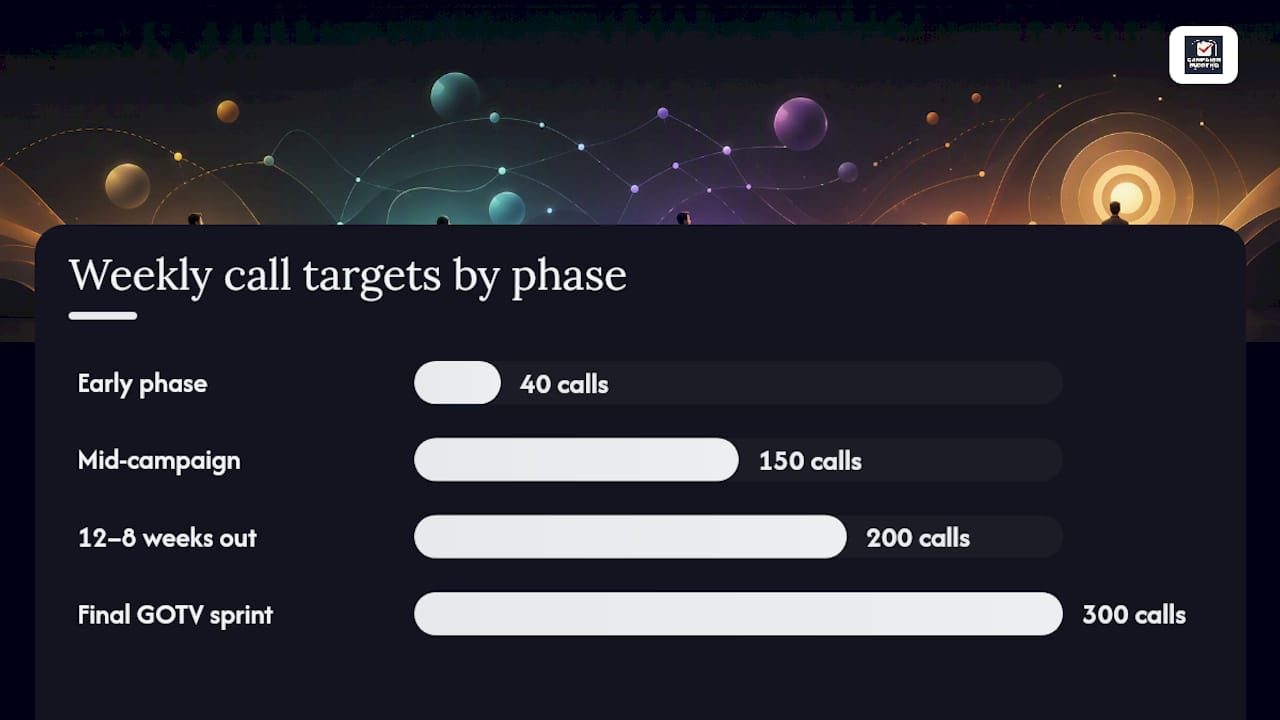
These four templates cover the arc of a campaign. Adjust the numbers to your district size, but keep the structure. A rough scaling rule: multiply targets by your universe size relative to a baseline 10,000-voter district, so a 30,000-voter district roughly triples every benchmark below.
Early phase (pre-announcement through petition/ballot access)
- Monday: staff planning meeting, review volunteer pipeline
- Tuesday to Thursday: 2 canvass shifts (goal: 300 doors), 1 phone shift focused on volunteer recruitment (goal: 40 calls)
- Friday: data cleanup and voter file updates
- Weekend: 1 larger canvass shift (goal: 200 doors), one-on-one meetings with 5 potential team leads
- Digital: one social post introducing the candidate's story, no paid ads yet
Mid-campaign persuasion (roughly weeks 16 to 12 out)
- Weekly benchmarks: 600 doors, 150 calls, 300 texts, 8 volunteer shifts filled
- Fundraising: one email ask plus one call-time block for the candidate, targeting $2,000 to $5,000 weekly depending on district size
- Digital: two social posts, one issue-focused video or graphic, light paid boost testing
12 to 8 weeks out (canvass ramp)
- Weekly benchmarks: 900 doors, 200 calls, 500 texts, 12 shifts filled
- This is the window to front-load one-on-one recruiting meetings, since shifts completed here correlate with GOTV volunteer capacity later
- Begin mail-ballot chase outreach for jurisdictions with early voting
- Fundraising: two asks weekly, start tracking burn rate against remaining budget
Final 4 to 6 week GOTV sprint
- Weekly benchmarks: 1,200+ doors, 300 calls, 800 texts, 15+ shifts filled, scaling up sharply in the final week
- Daily door, phone, and text layering in the final 72 hours, following a multi-channel GOTV sequence
- Contingency: if door targets fall more than 15% short by Wednesday of any GOTV week, shift volunteer hours from persuasion calls to direct turnout of identified supporters
Our step-by-step canvassing guide covers walk-packet logistics if you're building the door program from scratch.
When Should You Prioritize Phone Banks, One-on-Ones, and Canvassing?
Timing isn't a matter of taste, it's backed by field research. Canvass and one-on-one shifts show stronger ties to GOTV capacity than phone shifts do, and canvass impact tends to peak roughly 10 to 12 weeks before Election Day.
An additional one-on-one shift completed 13 to 14 weeks out is associated with a measurable bump in volunteer participation during GOTV. That's a narrow window, and most campaigns miss it because they're focused on visible activities like canvassing instead.
Practical rules that follow from this:
- Front-load one-on-ones in the early and mid-campaign phases, not the final sprint
- Ramp canvass volume steadily so it peaks in the 10 to 12 week window, not in the last two weeks
- Keep phones as a steady recruiting and ID channel throughout, since phone shifts predict GOTV capacity less reliably than door contact
Pro Tip: Run a small pilot in two precincts before committing your whole canvass program to a new script or contact sequence. Two weeks of local data beats a national study when you're deciding what works in your district.
What Should You Track and Report Every Week?
Your weekly dashboard doesn't need to be complicated, it needs six numbers: votes still needed, doors and calls and texts completed, volunteer shifts filled, dollars raised this week, and burn rate against budget.
- Staff huddle: 15 minutes, actuals versus weekly targets, adjust next week's assignments
- Donor-facing update: one page, showing progress against the win number, not just activity counts
- Weekly retro: what underperformed, why, and what changes next week
A platform like Campaign Buddy HQ can host these weekly plans and auto-generate the one-page snapshot, which saves the campaign manager from rebuilding a spreadsheet every Sunday night — and for more insights on outreach practices, check out the Outreach Leaders Survey. For deeper detail on what belongs in that report, see our guide to campaign reporting.
A Day-by-Day Routine for a Model Week
- Monday: staff planning meeting, review last week's actuals against targets, assign the week's shifts
- Tuesday: volunteer training session, canvass and phone shifts begin
- Wednesday: midweek check on shift fill rates, adjust texting or call lists if doors are behind
- Thursday: one-on-one meetings with potential team leads, continue canvass and phone shifts
- Friday: data cleanup, sync canvass results into the voter file before weekend shifts
- Saturday: largest canvass shift of the week, post-shift debrief with volunteer leads
- Sunday: weekly report compiled and sent to staff and key donors
Real-time syncing between your canvassing app and your call lists matters here. A voter marked as contacted Saturday morning shouldn't get a redundant call Saturday afternoon. Our guide to monitoring campaign progress walks through building that habit into your weekly routine.
Why Documented Plans Beat Campaigns Run on Vibes
The most common mistake I see isn't a bad strategy, it's no written weekly benchmarks at all. Campaigns run "on vibes" feel busy every week and still can't tell you if they're on pace for the win number.
I've watched a documented weekly plan prevent a last-minute volunteer scramble that would have gutted a GOTV weekend, simply because the shortfall showed up in Tuesday's numbers instead of Friday's panic. Build in a contingency buffer week every phase, and revise your templates based on what each week's retrospective actually tells you.
Let Campaign Buddy HQ Run Your Weekly Plan
Building the templates above in a spreadsheet works for a few weeks. It falls apart once you're juggling three volunteer captains, a donor update, and a canvass list that's out of sync with your call sheet. Campaign Buddy HQ exists for exactly this gap: it hosts your weekly plan, logs outreach activity as doors, calls, and texts happen, schedules volunteer shifts by role, and builds the one-page progress snapshot your dashboard needs without you rebuilding it every Sunday.
It's built specifically for campaigns working with rural or low-density turf, where a generic enterprise tool assumes staff and volunteer density you don't have. Start a 7-day free trial, no credit card required, import the weekly templates from this article, and generate your first weekly report before your next Monday staff meeting. Details on plans and features are on the Campaign Buddy HQ site.
Sources
- Scaling the Field Organization in Modern Political Campaigns
- How to Write a 2026 Political Campaign Plan - Why "It's All in My Head" – Huxley Strategies
- The Four Phases of Field Operations – Politibox
- What a Local Campaign Actually Looks Like: The 5 Phases