

The highest-impact voter engagement tactics, ranked by evidence, are: in-person canvassing (including deep canvassing), relational organizing and vote tripling, peer-to-peer texting, phone banking, GOTV ballot chase, community events and town halls, direct mail, digital and social layering, volunteer management, outreach tracking and dashboarding, and multilingual outreach. The Center for Campaign Innovation and Green & Gerber meta-analyses both anchor this ranking in field evidence, not theory. Campaignbuddyhq is built to log and sequence every one of these tactics.
- In-person canvassing: Highest turnout lift per contact. Prioritize when you have trained volunteers and defined turf.
- Deep canvassing: 10-minute listening conversations for persuasion. Best for low-propensity or persuadable voters.
- Relational organizing / vote tripling: Ask supporters to recruit three friends. Scales trusted-messenger contact without cold outreach.
- Peer-to-peer texting: Two-way troubleshooting and follow-up. Layer after a door or phone touch.
- Phone banking: High-volume voter ID, persuasion, and GOTV. Use branching scripts for persuasion calls.
- GOTV ballot chase: Track who has voted; redirect volunteers to those who haven't. Final 72-hour priority.
- Events and town halls: Recruit volunteers, surface supporters, generate relational contacts.
- Direct mail: Turnout reminders and credibility. Lower ROI than personal contact; use for high-density supporter parcels.
- Digital and social layering: Reinforcement and scale. Never the primary persuasion tool when personal contact is possible.
- Volunteer management: Recruit, train, and assign hyper-locally. Retention starts after the first shift.
- Tracking and dashboarding: Log contacts, conversations, commitments, and verified votes in real time.
- Multilingual outreach: Match language and cultural context to the community. Required, not optional, in diverse districts.
Key Takeaways
In-person canvassing with a specific voting plan ask remains the highest-yield voter contact method, and every other tactic works best when it reinforces that personal touch rather than replacing it.
| Point | Details |
|---|---|
| Prioritize personal contact | Door canvassing produces the largest, most consistent turnout lifts of any contact method. |
| Layer channels deliberately | Sequence digital → relational → P2P text → door → ballot chase for maximum effect per voter. |
| Start GOTV early | Universe building 12+ weeks out consistently outperforms last-minute-only mobilization pushes. |
| Track commitments, not just contacts | Log voting plan commitments and verify votes to measure real program impact. |
| Use Campaignbuddyhq to stay on track | Real-time door, call, and text logging keeps your program visible and adjustable before Election Day. |
Table of Contents
- What's the best list of campaign engagement tactics for your goal and scale?
- Why in-person canvassing still outperforms every other tactic
- How to run phone outreach that actually converts
- Peer-to-peer texting: when to use it and how to layer it
- Digital and social tactics that support (not replace) personal contact
- Direct mail: when it earns its cost and when it doesn't
- How to design events that feed your outreach funnel
- Volunteer recruitment, training, and hyper-local assignment
- How to track outreach so your data actually drives decisions
- Ready-to-use talk tracks and field templates
- How to phase tactics across your election timeline
- Multilingual and culturally competent engagement
- Rapid response and issue-based engagement
- The tactics that actually win campaigns, in my view
- Sources
What's the best list of campaign engagement tactics for your goal and scale?
Not every tactic fits every campaign. The decision comes down to three filters: your goal (identify, persuade, or mobilize), your scale (small, medium, or large), and your available resources.
| Goal | Small Campaign | Medium Campaign | Large Campaign |
|---|---|---|---|
| Identify supporters | Relational asks, door canvass | Phone bank + doors | Phone bank + digital ads + doors |
| Persuade voters | Deep canvassing | Deep canvass + P2P text | Deep canvass + paid social + mail |
| Mobilize (GOTV) | P2P text + phone | Doors + phone + text | Ballot chase + all channels |
The trade-off is simple: personal contact costs more time per voter but produces larger turnout lifts. NDI's voter contact research confirms door-to-door canvassing as the most consistently high-impact method across contexts. Digital and mail are cheaper per impression but rarely move low-propensity voters on their own. The 2026 field guide on voter contact approaches breaks down these trade-offs by district type.
Pro Tip: When resources are tight, one high-intensity personal contact beats five shallow digital impressions. Prioritize doors and relational asks before adding channels.
Why in-person canvassing still outperforms every other tactic
Door-to-door canvassing produces the largest, most consistent turnout effects of any voter contact method, a finding that holds across decades of randomized field experiments in the Green & Gerber literature and is reinforced by NDI's practitioner synthesis. No other channel reliably matches it.
Deep canvassing takes that further. Rather than a quick pitch at the door, deep canvassing uses roughly 10-minute conversations where the volunteer listens as much as they speak, asking nonjudgmental questions and eliciting the voter's own story. CCI's research shows measurable persuasion effects from this approach, driven by active processing rather than talking points.
Statistic: A Stanford neighbor-to-neighbor GOTV study found that original-design volunteers produced a statistically significant increase in turnout compared to controls. Alternate designs showed no significant effect, underscoring how much execution details matter.
Operational checklist for a canvass shift:
- Assign turf by proximity: nearest neighbors first, capped to a walkable block set
- Brief volunteers on the script as a framework, not a verbatim read
- Run a safety briefing before every shift
- Log outcomes in real time (contact, conversation, commitment, no-answer)
- Collect voting plan commitments at the door
- Debrief within 24 hours and assign follow-up contacts
Pro Tip: Assign volunteers to streets where they actually live or have connections. The Stanford study found that hyper-local design drove the significant turnout lift. Log the first assigned contact carefully — it's your baseline KPI. For a full operational walkthrough, see the step-by-step canvassing guide.
How to run phone outreach that actually converts
Phone programs remain the fastest way to reach large voter universes. The key is matching the call type to the goal. CallHub's phone banking guide breaks this into three distinct uses: voter ID calls (short, branching, focused on support level), persuasion calls (longer, dynamic scripts that respond to objections), and GOTV calls (concrete voting-plan close required).
Branching scripts outperform linear scripts for persuasion because they let volunteers respond to what the voter actually says instead of plowing through a canned pitch. For GOTV, the close must be specific: "When are you planning to vote? How will you get there?"
| Metric | What to track |
|---|---|
| Contact rate | Completed conversations / total dials |
| Conversation rate | Substantive exchanges / completed contacts |
| Voting plan commitments | Voters who stated a specific plan |
| Volunteer hours logged | Hours per shift, per volunteer |
Pro Tip: List hygiene beats list size. A clean list of 2,000 high-propensity voters outperforms a stale list of 8,000. Scrub for disconnected numbers and duplicates before every phone bank.
Peer-to-peer texting: when to use it and how to layer it
Use broadcast SMS for logistical reminders (event times, polling locations). Use peer-to-peer texting for two-way conversations: troubleshooting ride-to-polls requests, confirming RSVPs, and following up on door or phone contacts.
The layering sequence that produces the best results: digital reminder → relational ask → P2P text → door conversation → ballot chase. CCI's trusted-messenger research supports layering relational contact with digital reinforcement to scale the persuasion signal without losing the trust advantage of personal outreach.
Legal note: Peer-to-peer texting programs must comply with the Telephone Consumer Protection Act (TCPA). Obtain proper opt-ins before texting, honor opt-outs immediately, and consult legal counsel on your state's specific requirements before launching any SMS program.
Sample GOTV text: "Hi [Name], this is [Volunteer] with [Campaign]. Election Day is Tuesday — do you have a plan to vote? Reply YES if you're set, or let me know if you need a ride."
Sample RSVP follow-up: "Hey [Name], just confirming your spot at our town hall Thursday at 7 PM at [Location]. Reply CONFIRM or let me know if your plans changed."
- Track: messages delivered, replies received, requests resolved, voting plan conversions
- Flag unresolved replies for a same-day phone or door follow-up
Pro Tip: Assign P2P text shifts to volunteers who already know the voters they're texting. A familiar name in the sender field lifts reply rates meaningfully.
Digital and social tactics that support (not replace) personal contact
Digital is best for scale and reinforcement. Short video performs well for GOTV pushes on Instagram and Facebook; boosted local posts amplify event invitations; co-hosted live events with local organizations extend organic reach. None of these replace a door conversation for a persuadable voter. The role of digital outreach in political campaigns is reinforcement, not persuasion anchor.
Statistic: Organic content that features real local stories and relational asks consistently outperforms generic campaign graphics in engagement-to-action rates, according to practitioner reports on digital layering.
Practical content that moves: volunteer testimonials, local issue explainers, event countdowns, and "bring a friend" relational asks. KPIs to track: reach, engagement-to-action rate, clicks to RSVP or volunteer sign-up, and cost per volunteer acquired for paid social.
Local organization amplification works when the partner's audience overlaps your persuadable or low-propensity universe. A co-post from a trusted community group carries more weight than a boosted ad from the campaign account alone.
Pro Tip: Run paid social to warm up a universe before doors hit it. Voters who have seen your name twice before a canvasser knocks are measurably easier to convert.
Direct mail: when it earns its cost and when it doesn't
Direct mail is useful for turnout reminders and credibility building, but it is generally lower ROI than personal contact. Use it strategically, not as a default.
- Best uses: High-density supporter parcels, targeted persuasion in low-noise windows (before early voting opens), and reminder postcards timed to early vote deadlines
- Timing: Allow 10–14 days for print production and mail delivery; plan backward from your target in-home date
- Small budgets: A single well-timed postcard to your top-tier supporter list beats a broad saturation mail program
- Large budgets: Layer mail with phone and door contact for the same universe to reinforce the message across channels
Pro Tip: Mail that includes a specific voting plan prompt ("Vote at [Location] on [Date]") outperforms generic "Vote!" mailers. Make the ask concrete.
How to design events that feed your outreach funnel
Events are best used to recruit volunteers, generate relational contacts, and convert supporters into active campaign participants. A rally that doesn't produce sign-ups is a missed opportunity.
| Event flow step | Purpose |
|---|---|
| Check-in with data capture | Collect name, phone, email, and zip |
| Short program (15–20 min) | Inspire and inform; keep it tight |
| Relational ask from the stage | "Turn to the person next to you and ask them to join a shift" |
| Sign-up tables with specific asks | Date, time, and task already filled in |
| 24-hour follow-up text or call | Confirm the commitment before it fades |
Small meetups (15–30 people) convert attendees to volunteers at higher rates than large rallies. The ask needs to be low-friction and specific: "Can you knock doors this Saturday from 10 AM to noon in your neighborhood?"
Pro Tip: Have a volunteer coordinator at every sign-up table, not just a clipboard. A human conversation at the table doubles follow-through rates.
Volunteer recruitment, training, and hyper-local assignment
Recruit from your existing supporter list first. Make the ask specific: a named shift, a defined task, and a date. Vague asks ("let us know if you want to help") produce vague results.
Recruitment checklist:
- Identify your top 20% of engaged supporters and call them personally
- Partner with community organizations for volunteer pipelines (see NYSUM's volunteer program as a model for community-based outreach staffing)
- Post specific shift opportunities, not general interest forms
- Follow up within 48 hours of any sign-up
Training outline: Platform walkthrough in Campaignbuddyhq, script-as-framework practice, role-plays covering hostile responses, and a live logging exercise before the first shift. Assign new volunteers to turf they know. The Stanford study found that hyper-local design drove a significant turnout lift; that finding should shape every turf assignment you make.
Retention: Send a personal thank-you within 24 hours of every shift. Give volunteers a clear next step before they leave. Volunteers who complete a second shift are far more likely to stay through Election Day. For deeper retention tactics, see campaign volunteer power strategies.
Pro Tip: Cap turf size so volunteers finish their walk feeling successful, not defeated. A completed turf builds confidence; an overwhelming one kills retention.
How to track outreach so your data actually drives decisions
Track five fields for every contact: contact type, outcome, commitment level, next step, and timestamp. Add volunteer ID so you can measure individual performance and coach accordingly.
| Field | Options / Notes |
|---|---|
| Contact type | Door, phone, text, relational |
| Outcome | Contact, no-answer, refused, moved |
| Commitment | Voting plan confirmed, soft support, undecided |
| Next step | Follow-up door, call, text, ballot chase |
| Timestamp + volunteer | Date, time, volunteer name or ID |
Statistic: Campaigns that track commitments and verify votes against their contact list can measure actual turnout lift from their program, not just activity volume.
Campaignbuddyhq logs doors, calls, texts, and registrations in real time, with mobile-friendly data entry built for field conditions. Its weekly planning view lets organizers see where the program stands against targets before the week is out. The outreach tracking guide covers how to build a logging workflow that field teams will actually use.
Ready-to-use talk tracks and field templates
Scripts work best as flexible frameworks, not verbatim reads. NDI's candidate training materials emphasize that volunteers who internalize the structure and adapt the language sound human; volunteers who read word-for-word lose the voter at the door.
Door opener: "Hi, I'm [Name] from [Campaign]. I'm talking with neighbors about [Issue]. Do you have two minutes?"
Persuasion pivot: "I hear you. A lot of people feel that way. What would need to change for [Issue] to feel better to you?"
Voting plan close: "We really need every vote. When are you planning to vote? Is there anything that might get in the way?"
GOTV text: "Hi [Name], it's [Volunteer] with [Campaign]. Election Day is [Date]. Do you have a plan? Reply YES or let me know if you need help."
Pre-shift checklist for new volunteers:
- Review the script framework (not memorize it)
- Practice the voting plan close out loud twice
- Know how to log outcomes in Campaignbuddyhq before leaving the staging area
- Carry a charged phone and a printed turf map as backup
Pro Tip: Run a five-minute role-play before every shift. One practice conversation prevents ten awkward real ones.
How to phase tactics across your election timeline
GOTV is a sequence, not a sprint. The SDAF research report confirms that campaigns relying solely on a final-72-hour push waste volunteer hours on voters they never properly identified.
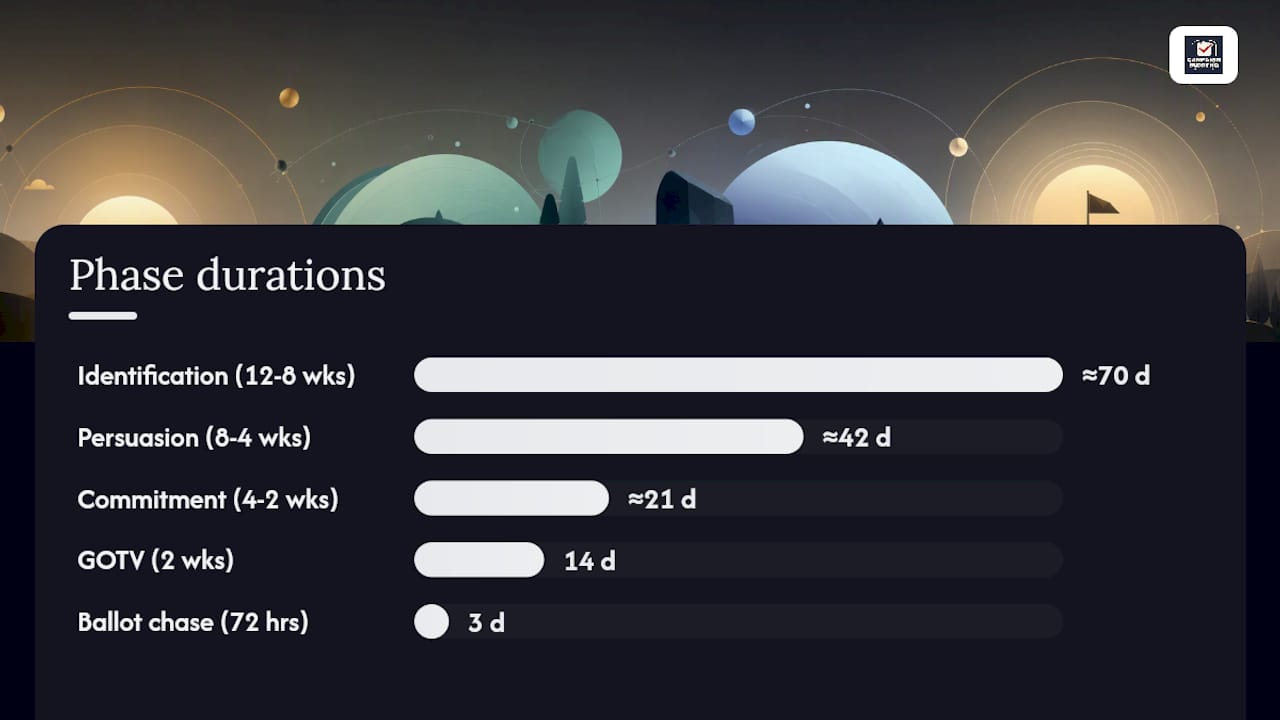
| Phase | Timing | Primary tactics | Volume targets |
|---|---|---|---|
| Identification | 12–8 weeks out | Doors, phone ID, relational asks | High percentage of universe contacted |
| Persuasion | 8–4 weeks out | Deep canvass, persuasion calls, paid social | Top persuadables hit multiple times |
| Commitment | 4–2 weeks out | Voting plan conversations, P2P text, events | Majority of supporters with a plan |
| GOTV | 2 weeks to Election Day | All channels, ballot chase begins | Daily contact with low-propensity supporters |
| Ballot chase | Final 72 hours | Phone, text, doors to non-voters | Verified-vote list updated hourly |
The layering sequence for a single voter: digital reminder → relational ask from a friend → P2P text follow-up → door conversation → phone confirmation → ballot chase if not yet voted. This layering model sequences trust, scale, commitment, and action across channels rather than treating each tactic as a standalone program.
Statistic: Campaigns that begin GOTV universe building 12 or more weeks before Election Day consistently outperform those that start in the final two weeks, per practitioner reports from the SDAF and CallHub.
Multilingual and culturally competent engagement
In diverse districts, language access is not a courtesy — it's a turnout variable. Voters contacted in their primary language are more likely to engage, ask questions, and commit to a voting plan. Translate your core scripts (door opener, voting plan close, GOTV text) before the persuasion phase begins, not the week before Election Day.
Cultural competence goes further than translation. Assign volunteers who share cultural context with the community they're canvassing. Partner with trusted local organizations — faith communities, ethnic chambers of commerce, cultural associations — to amplify your message through messengers voters already trust. CCI's trusted-messenger research shows that relational and community-embedded contact produces stronger persuasion effects than cold outreach, and that effect is amplified when the messenger shares the voter's background.
Practical steps: audit your volunteer base for language capacity early, build translated materials into your print and digital production schedule, and track contact outcomes by language to identify gaps before GOTV.
Rapid response and issue-based engagement
When a news event or policy development breaks, your campaign has a narrow window — typically 24–48 hours — to connect it to your message and mobilize supporters before the news cycle moves on.
Rapid response engagement works best when you have a pre-built infrastructure: a segmented email list you can message within the hour, a social content template you can adapt in 30 minutes, and a volunteer corps ready to amplify. Without that infrastructure, rapid response is reactive noise. With it, a breaking issue becomes a recruitment and fundraising moment.
Issue-based engagement follows a similar logic. Identify the two or three issues your persuadable universe cares most about, build specific talk tracks around each, and train volunteers to pivot to those issues at the door or on the phone. A voter who hears their specific concern named and addressed is far more likely to commit to a voting plan than one who receives a generic campaign pitch.
The tactics that actually win campaigns, in my view
Most campaigns lose not because they chose the wrong tactics but because they ran too many of them too shallowly. A phone bank that dials 10,000 voters with a stale list and a robotic script produces less than a focused canvass of 500 persuadables with trained volunteers and real conversations.
The evidence is consistent: personal contact, delivered by a trusted messenger, with a specific voting plan ask, is the highest-yield activity in any campaign's toolkit. Everything else — digital, mail, events, texting — works best when it reinforces that personal contact, not when it replaces it.
Campaignbuddyhq exists to make that personal contact trackable and repeatable. The platform's door, call, and text logging, combined with weekly planning and progress dashboards, gives organizers the visibility to know whether their program is on track before it's too late to adjust. Start with the free 7-day trial — no credit card required — and build your logging workflow before your first canvass shift.
Sources
- Reaching Voters With Trusted Messengers | CCI
- The Effectiveness of a Neighbor-to-Neighbor Get-Out-the-Vote Program (Stanford Law)
- The Complete Guide to Political Phone Banking (CallHub)
- Campaign Skills Handbook: Module 4 — Voter Contact (NDI)