

Community mobilization is defined as a participatory, empowering process through which community members identify shared needs, pool resources, and take collective action toward sustainable change. For political campaigners and community organizers, this process is the engine behind every successful grassroots effort. It differs from a simple rally or petition drive because it builds lasting local power rather than producing a single event. Understanding what is community mobilization means understanding how to shift control from outside organizers to the people most affected by the issues at hand.
What is community mobilization, and what are its core components?
Community mobilization is built on six foundational pillars: participatory, empowering, collective, goal-oriented, sustainable, and resource-driven. Each pillar reinforces the others. Remove one and the whole structure weakens.
Participation and ownership sit at the center. Mobilization only works when community members feel they own the process, not just attend it. An organizer who dictates the agenda will always produce weaker results than one who co-creates it with residents.
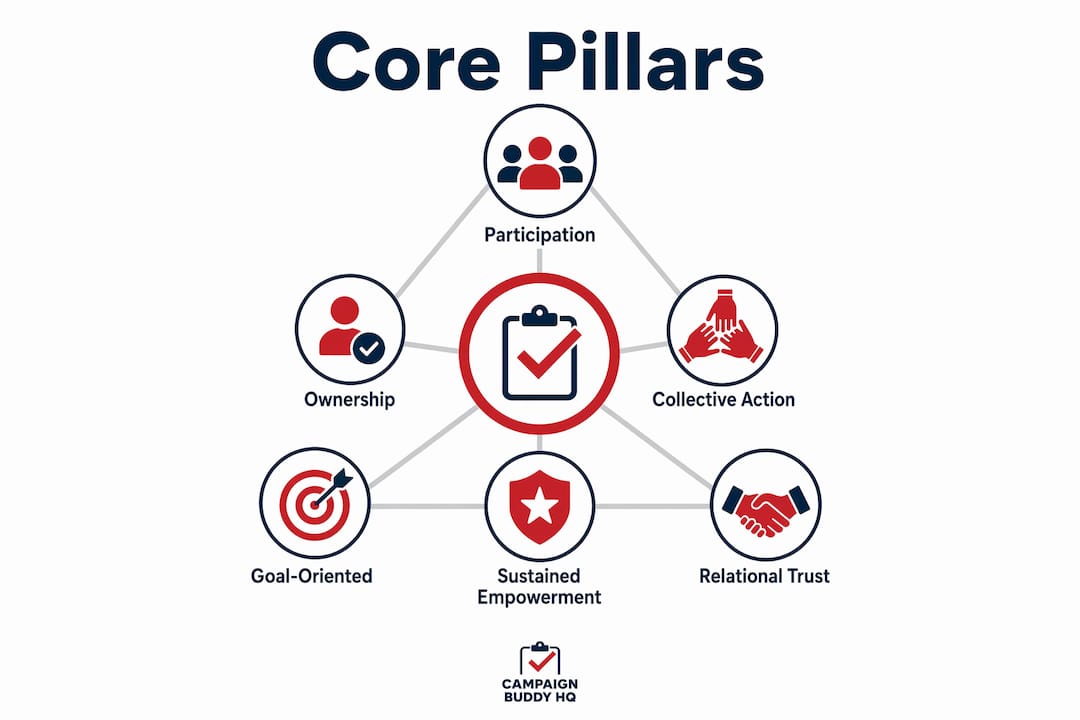
Collective action toward shared goals separates mobilization from individual advocacy. The group identifies a problem together, agrees on a target, and moves as a unit. This shared direction is what creates political pressure that decision-makers cannot ignore.
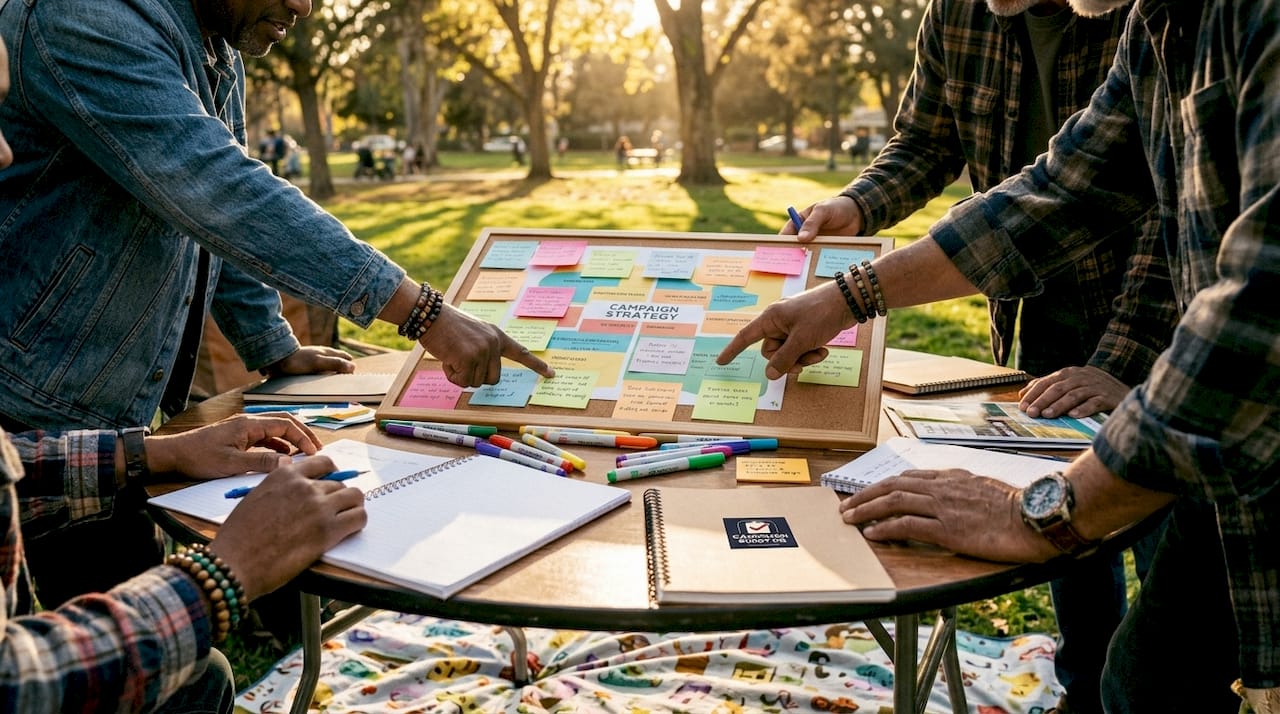
Sustainability and resource leverage are what distinguish mobilization from a one-off action. Effective mobilization enables communities to solve their own problems, positioning organizers as facilitators rather than fixers. That shift in control creates lasting empowerment.
One distinction every campaigner must understand: mobilizing is not the same as organizing. Mobilizing rallies participation for immediate action, while organizing builds sustainable local leadership over time. The strongest campaigns do both. They use mobilization to generate visible momentum and organizing to develop the leadership that keeps the coalition alive after election day.
- Psychological empowerment: Members believe their participation matters and produces real results.
- Collective efficacy: The group trusts its shared ability to achieve goals, which reinforces continued involvement.
- Internal and external resources: Effective mobilization draws on both the community's own assets (time, relationships, local knowledge) and outside support (funding, media, technical help).
Pro Tip: Before you build any structure, map your community's existing assets. Who already runs the neighborhood Facebook group? Who organizes the block party? Those people are your first calls.
How do you mobilize a community effectively?
The most common mistake campaigners make is skipping straight to public action before doing the relational groundwork. Lack of relational trust is the primary reason early coalitions fail. The steps below correct that error.
-
Start with one-on-one conversations. Meet people individually before you convene a group. Ask about their concerns, their history with the issue, and what they are willing to do. These conversations reveal who is ready to act and who needs more time.
-
Identify natural connectors. Natural connectors hold organic relational capital and accelerate coalition-building faster than official leaders. The block captain who everyone trusts is more valuable than the city council member who no one calls back.
-
Build trust before building structure. Resist the urge to form committees and elect officers in week one. Let relationships develop first. Structure imposed too early feels bureaucratic and drives people away.
-
Aim for a small, visible win early. Coalitions with visible wins are more likely to transition into permanent organizations. A win in the first few months, even a small one, recruits hesitant participants who were waiting to see if the effort was real. For campaign-specific ideas, progressive activity ideas can help you find the right early action.
-
Assign meaningful, role-based tasks. Roles like storyteller, strategist, and liaison keep members invested far longer than generic "volunteer" assignments. Match tasks to people's actual talents and interests.
-
Reach sideways, not just upward. Coalition-building across peer groups, faith communities, labor groups, and neighborhood associations creates horizontal power. Vertical appeals to institutional leaders alone produce dependency, not movement.
-
Document everything from day one. Documentation of goals, values, wins, and roles is the infrastructure that transforms passion into a scalable organization. Without it, institutional memory lives only in one person's head and disappears when they leave.
Pro Tip: Use a shared document or campaign tracking tool to log every commitment, conversation, and decision. When your coalition doubles in size, you will thank yourself for starting this habit early. Campaignbuddyhq's outreach logging feature is built exactly for this.
What common pitfalls hinder community mobilization?
Most mobilization efforts do not fail because of bad ideas. They fail because of avoidable process errors. Knowing these pitfalls in advance gives you a real edge.
-
Scaling before trust is built. Launching a public campaign before your core group is solid produces a hollow show of numbers. When pressure mounts, people who were never truly committed disappear.
-
Ignoring power dynamics. Failing to address existing power dynamics causes mobilizations to backfire. When only the loudest voices shape the agenda, vulnerable populations disengage or feel actively excluded. Elevating less-heard voices and compensating participants for their time signals that equity is real, not rhetorical. For examples of inclusive community practices, inclusive community initiatives offer useful models.
-
Assigning busywork to volunteers. Handing someone a stack of flyers to stuff in envelopes when they have real skills to offer is a fast path to attrition. People stay when their contribution feels meaningful.
-
Overreliance on hierarchy. Top-down structures concentrate knowledge and decision-making in one or two people. When those people burn out or move on, the coalition collapses. Horizontal structures distribute leadership and build resilience.
-
Skipping documentation. A coalition that runs on group chats and verbal agreements cannot scale. When new members join, they have no way to understand the history, the goals, or the norms. This creates confusion and conflict.
-
Burning out your core team. Urgency is real in political campaigns, but a team that runs on adrenaline alone will not survive a long cycle. Relationship-building and celebration of wins are not luxuries. They are maintenance.
What are the benefits of community mobilization for political campaigns?
The benefits of community mobilization extend well beyond the immediate campaign cycle. When done right, mobilization creates assets that outlast any single election.
Sustained local leadership is the most durable benefit. When residents develop the skills and confidence to organize themselves, they do not need an outside organizer to convene every meeting. That local ownership creates lasting empowerment that no single campaign can manufacture from the top down.
Voter engagement and volunteer power grow together. A mobilized community produces more doors knocked, more calls made, and more votes turned out. Campaigners who invest in volunteer power strategies see compounding returns as each mobilized person brings in others from their own network.
Social capital, meaning the trust and connections between community members, increases as a direct result of the process. That social capital then becomes a resource for future campaigns, issue advocacy, and community problem-solving long after the election is over.
| Benefit | What it means for your campaign |
|---|---|
| Sustained local leadership | Community members lead future actions without needing outside direction |
| Increased voter turnout | Mobilized networks produce higher participation rates on election day |
| Expanded volunteer base | Each engaged person recruits others from their own relationships |
| Social capital growth | Trust built during mobilization funds future organizing efforts |
| Coalition permanence | Well-structured coalitions outlast individual campaigns and address systemic issues |
Key Takeaways
Community mobilization succeeds when organizers prioritize relational trust, assign meaningful roles, document progress, and build horizontal coalitions that outlast any single campaign.
| Point | Details |
|---|---|
| Define mobilization correctly | It is a participatory, empowering process built on six pillars: participation, empowerment, collective action, shared goals, sustainability, and resources. |
| Trust before structure | Build one-on-one relationships and identify natural connectors before forming committees or launching public actions. |
| Win early and visibly | A small, concrete win in the first few months sustains momentum and recruits hesitant participants. |
| Assign meaningful roles | Match volunteers to tasks that use their real talents. Generic assignments drive attrition. |
| Document from day one | Written records of goals, decisions, and wins are the infrastructure that allows coalitions to scale and survive leadership changes. |
What I have learned from watching coalitions rise and fall
The hardest thing to teach a new organizer is patience. Every instinct says to move fast, hold the big rally, get the press coverage. But the coalitions I have watched fall apart almost always collapsed for the same reason: they built the roof before they poured the foundation.
The organizers who get it right spend the first month doing nothing that looks impressive from the outside. They have coffee. They listen. They find the person who everyone in the neighborhood already trusts and they ask that person what they think needs to change. That conversation is worth more than any town hall.
What also gets overlooked is the equity piece. Mobilization that only amplifies already-powerful voices is not mobilization. It is just organized favoritism with better branding. The real work is creating conditions where the quieter voices, the ones who have been burned before or who do not believe anyone is listening, feel safe enough to speak. That requires explicit reciprocity: showing up for people before you ask them to show up for you.
The organizer's job is not to solve the problem. It is to create the conditions where the community solves it together. That shift in mindset changes everything about how you run a meeting, how you assign tasks, and how you measure success. When you get it right, you become unnecessary. That is the goal.
— Billy
How Campaignbuddyhq supports your mobilization work
Political campaigners and community organizers need more than good intentions. They need systems that keep outreach consistent, volunteers accountable, and progress visible across every phase of a campaign.
Campaignbuddyhq is built for exactly this kind of work. The platform helps you log doors knocked, calls made, and texts sent, so your coalition's effort shows up as real data rather than gut feeling. Its daily and weekly planning tools keep your team focused even when the campaign gets chaotic. Whether you are running a rural district or a dense urban precinct, Campaignbuddyhq gives you the structure to track your outreach activities and build momentum that compounds over time. Start with a free 7-day trial at Campaignbuddyhq and see what organized mobilization actually looks like.
FAQ
What is community mobilization in simple terms?
Community mobilization is the process of bringing people together to identify shared problems and take collective action to solve them. It emphasizes participation, local ownership, and sustainable change rather than one-time events.
How does community mobilization differ from community organizing?
Mobilizing rallies people for immediate, visible action, while organizing builds long-term leadership and sustained power within a community. Effective campaigns use both together.
What is the first step in mobilizing a community?
The first step is one-on-one trust-building conversations with individual community members before any public action. Relational trust is the foundation that determines whether a coalition holds together under pressure.
Why do community mobilization efforts fail?
Most efforts fail because organizers scale public actions before building relational trust, ignore existing power dynamics, or assign volunteers meaningless tasks that drive attrition. Documentation gaps also cause coalitions to lose institutional memory as they grow.
What are the long-term benefits of community mobilization for campaigns?
Successful mobilization builds sustained local leadership, increases voter engagement, expands the volunteer base through peer networks, and generates social capital that funds future organizing efforts well beyond a single election cycle.