

A workable daily target for most campaign teams is to have a modest number of targeted touches split across calls, texts, doors, and email, paired with a moderate positive-reply expectation. That's an activity target paired with an engagement target, and the engagement number matters more than the activity number.
The single metric to watch above everything else is positive reply rate. It tells you faster than any other number whether your list, your message, and your timing are actually working, or whether you're just generating busywork.
- Activity target: a moderate number of touches per day across mixed channels
- Engagement target: a positive reply rate within a reasonable range
- Rule of thumb: a sustainable daily routine beats sporadic bursts of volume
Pro Tip: If your positive reply rate is under 2% for a full week, stop increasing volume. Fix the list or the message first. More touches won't fix a broken message.
Key Takeaways
Setting daily outreach goals correctly requires bottom-up math from your outcome target, a three-layer diagnostic model, and consistent daily tracking of positive reply rate.
| Point | Details |
|---|---|
| Start with a modest target | Aim for around 25 daily touches with a 3 to 5% positive reply rate before scaling volume. |
| Watch reply rate, not activity | Positive reply rate diagnoses list and message quality faster than raw touch counts. |
| Work backward from outcomes | Calculate required daily activity from your monthly goal using known conversion rates. |
| Run a 4-week pilot | Test one profile and one sequence, review weekly, then recalibrate before scaling. |
| Log daily, review weekly | Track activity, replies, and follow-ups every day; adjust targets on a weekly cadence. |
| Use a dedicated workflow | Campaign Buddy HQ centralizes daily planning, logging, and supporter tracking for consistent execution. |
Table of Contents
- Why Daily Outreach Goals Matter for Campaign Momentum
- How to Set Realistic Daily Outreach Goals
- Building a Daily Plan: Timeboxing and Channel Mix
- Tracking Daily Progress Without Drowning in Spreadsheets
- Running the Optimization Loop: Pilot, Review, Scale
- How Campaign Buddy HQ Supports This Workflow
- Daily Outreach Goals Across Different Campaign Roles
- What Most Advice on Outreach Goals Gets Wrong
- Run Your Daily Goals Through One System, Not Five Spreadsheets
- Sources
Why Daily Outreach Goals Matter for Campaign Momentum
Daily targets work because they create a steady stream of data. A campaign that sends 25 touches a day for three weeks generates enough signal to know what's working. A campaign that sends 200 touches on Tuesday and nothing for the rest of the week never gets that clarity, no matter how the raw numbers look at the end of the month.
Think of daily goals as diagnostic instruments across three layers:
- Activity (inputs): the various outreach actions performed
- Engagement (leading indicators): responses and interactions indicating interest
- Outcome (lagging results): final conversions such as meetings booked, volunteer sign-ups, or donations closed
This three-layer model matters because activity alone tells you almost nothing about whether the campaign is actually landing. You can hit every activity number and still be losing, if your engagement layer is flat.
Consistency tends to beat intensity here, and not just anecdotally. A predictable outreach rhythm builds recognition with voters and supporters the same way a regular posting schedule builds an audience: repetition compounds. Coordinators who run the same 25 touches every weekday for a month tend to see steadier engagement curves than those who alternate between all-out pushes and quiet stretches. It usually takes several weeks of disciplined outreach before a campaign's numbers settle into something you can actually trust and plan around.
How to Set Realistic Daily Outreach Goals
Most coordinators set daily goals backward: they pick a big number that sounds ambitious, then wonder why the team burns out by week two. The better approach works from the outcome down.
1. Start with your outcome target. Say you need 40 meetings or volunteer commitments this month.
2. Apply your known conversion rates. If 1 in 5 positive replies converts to a meeting, you need 200 positive replies.
3. Adjust for team capacity. If 225 touches a day isn't realistic for your current staffing, either add capacity or accept a longer timeline. Do not just increase the daily number and hope quality holds.
4. Set your engagement checkpoints. Track open rates on digital touches and positive reply rate on all channels combined.
5. Apply SMART framing to the daily number itself. "Make 25 quality touches by 5 PM, tracked in the daily log, with a goal of at least one positive reply" is specific, measurable, achievable, relevant, and time-bound in a way "do more outreach" never will be.
For a first pilot, start lower than feels ambitious. Quality-first numbers in week one, scaled only once you know your real conversion rates, produce a cleaner signal than a big number that collapses under its own weight.
| Funnel Stage | Sample Target | What It Tells You |
|---|---|---|
| Daily touches | a measured number of touches per coordinator | Whether the activity is happening at all |
| Positive reply rate | a moderate positive reply rate | Whether the message and list are resonating |
| Replies to meetings | 20% conversion | Whether your follow-up process converts interest |
| Meetings to commitments | Varies by campaign stage | Whether the ask itself is landing |
Small gains at the bottom of this funnel matter more than they look. Improving your reply-to-meeting conversion from 15% to 25% can cut your required daily touches by a third, without adding a single hour of outreach work.
Building a Daily Plan: Timeboxing and Channel Mix
The most effective daily routines are boring on purpose. Pick two focused blocks, say 45 minutes in the morning and 30 in the afternoon, and treat them like appointments you can't skip. A 15-minute timeboxed session with a curated list of 20 to 30 targets consistently outperforms a rambling two-hour session with no structure, because the timer forces prioritization.
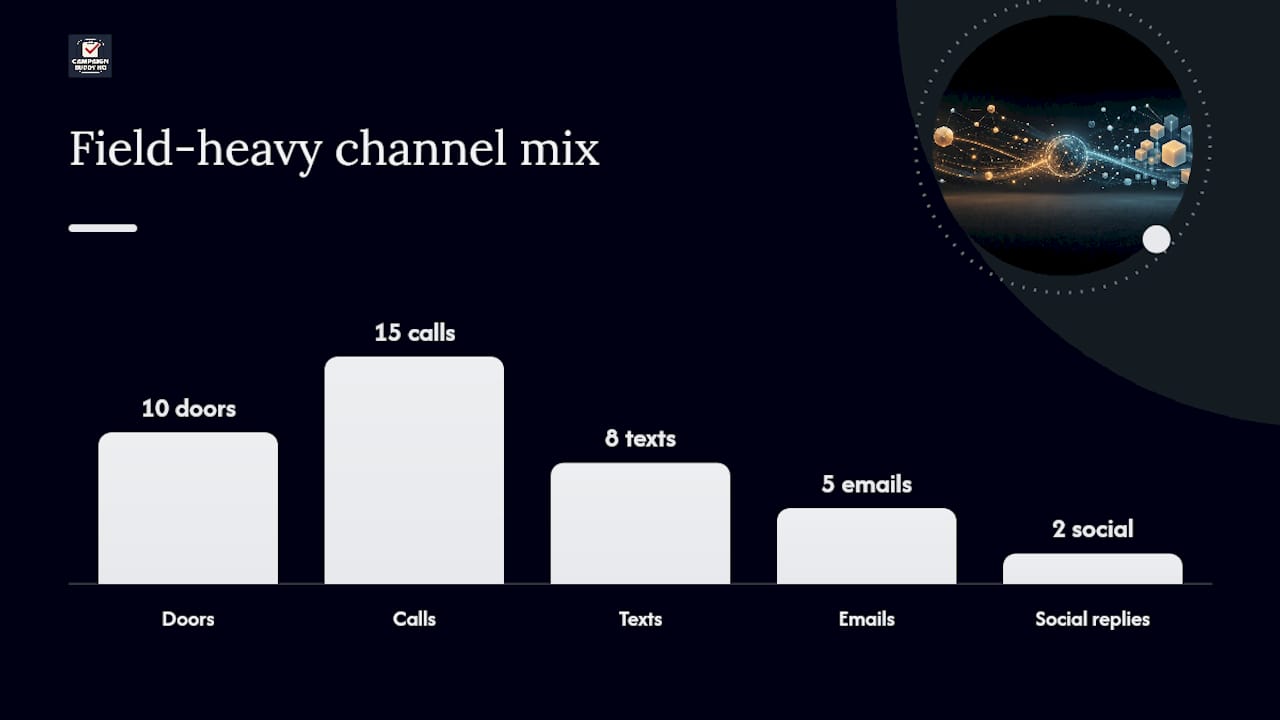
Sample channel mix for a field-heavy campaign:
- 10 doors or 15 calls (whichever fits the day's geography)
- 8 texts to warm contacts
- 5 emails to a segmented list
- 2 social media replies to recent local posts
Sample channel mix for a digital-first advocacy push:
- 15 emails split across two segments
- 5 social replies
- 5 texts to recent event attendees
Micro-personalization is what keeps reply rates from collapsing as you scale. You don't need a custom paragraph for every contact. You need one specific detail per touch: their neighborhood, their last interaction, or a shared connection. Segmenting your list by goal before you write a single message makes this dramatically easier, because you're writing one template per segment instead of one message per person.
A solo coordinator running this plan alone should expect the morning block to cover calls and doors, and the afternoon block to cover digital follow-up and logging. A small team of three or four can split by channel: one person owns calls, one owns digital, one owns door coverage, with a shared list pulled from a properly built supporter list.
Pro Tip: Batch your personalization research the night before. Five minutes scanning tomorrow's contact list for one detail per person saves you from stalling mid-session trying to think of something to say.
Tracking Daily Progress Without Drowning in Spreadsheets
Log these fields every single day, no exceptions:
- Activity counts by channel (calls, texts, doors, emails, social touches)
- Sequence or list enrollments (new contacts added to active outreach)
- Opens or delivery confirmations where the channel supports it
- Positive replies (anyone who responded with interest, a question, or a commitment)
- Follow-ups scheduled for the next contact attempt
From these five fields, one calculation matters more than the rest: positive reply rate, which is positive replies divided by total touches. Drop below 2% for more than a week and something upstream is broken, either the list, the message, or the timing.
- Update targets weekly, not daily. Daily numbers bounce around too much to mean anything on their own.
- Treat the end of a 4-week pilot as your first real checkpoint for raising or lowering targets.
- Watch for a slow decline in positive reply rate even if raw activity stays flat. That's usually list fatigue.
You don't need custom dashboards to run this well. A shared spreadsheet works for a team of two. Once you're coordinating more than a handful of people across multiple channels, a dedicated outreach tracking system removes the friction of reconciling five different logs into one weekly number.
Running the Optimization Loop: Pilot, Review, Scale
Run your first month as a deliberate pilot, not a full rollout. Pick one ideal contact profile and one message sequence, then hold both steady for four weeks. This gives you a clean baseline instead of a blur of variables you can't untangle later.
- Week 1: Launch at a conservative activity number. Log everything daily.
- Week 2: Review positive reply rate. If it's below 2%, adjust the message before touching volume.
- Week 3: Check reply-to-meeting conversion. Slow conversion here often means a follow-up process problem, not a targeting problem.
- Week 4: Compare actual outcomes against your original bottom-up math and recalibrate the next month's daily target.
Scale conversion before you scale volume. A campaign that jumps from 25 to 75 daily touches before fixing a weak message just produces three times the noise. And watch two specific traps: ramping outreach volume too fast on a brand-new phone number or email domain (which tanks deliverability), and chasing open rates while ignoring positive replies, since opens tell you almost nothing about actual interest.
Pro Tip: If week 2's positive reply rate looks strong but week 3's meetings stall, the problem is almost always your follow-up timing, not your original outreach.
How Campaign Buddy HQ Supports This Workflow
Everything in this framework, daily planning, activity logging, and diagnostic tracking, maps directly onto features built for campaign teams. Campaign Buddy HQ handles daily and weekly planning, outreach logging across doors, calls, texts, and registrations, supporter tracking, and campaign phase management, all in one workflow instead of scattered spreadsheets.
That consolidation matters most for consistency. When logging takes 30 seconds instead of five minutes, coordinators actually do it every day, which is the only way the positive reply rate calculation means anything.
A 7-day quick-start checklist for a new trial:
- Set your first week's activity target (start conservative)
- Log every touch daily, no batching at week's end
- Check your positive reply rate by day 5
- Review your channel mix against what's actually converting
- Adjust week 2's target based on real numbers, not guesses
Daily Outreach Goals Across Different Campaign Roles
A field coordinator running door-to-door canvassing in a rural district needs a different daily number than a digital organizer running an email and social program. Neither number is "correct" in isolation. Each one reflects the channel's realistic pace and its typical response rate.
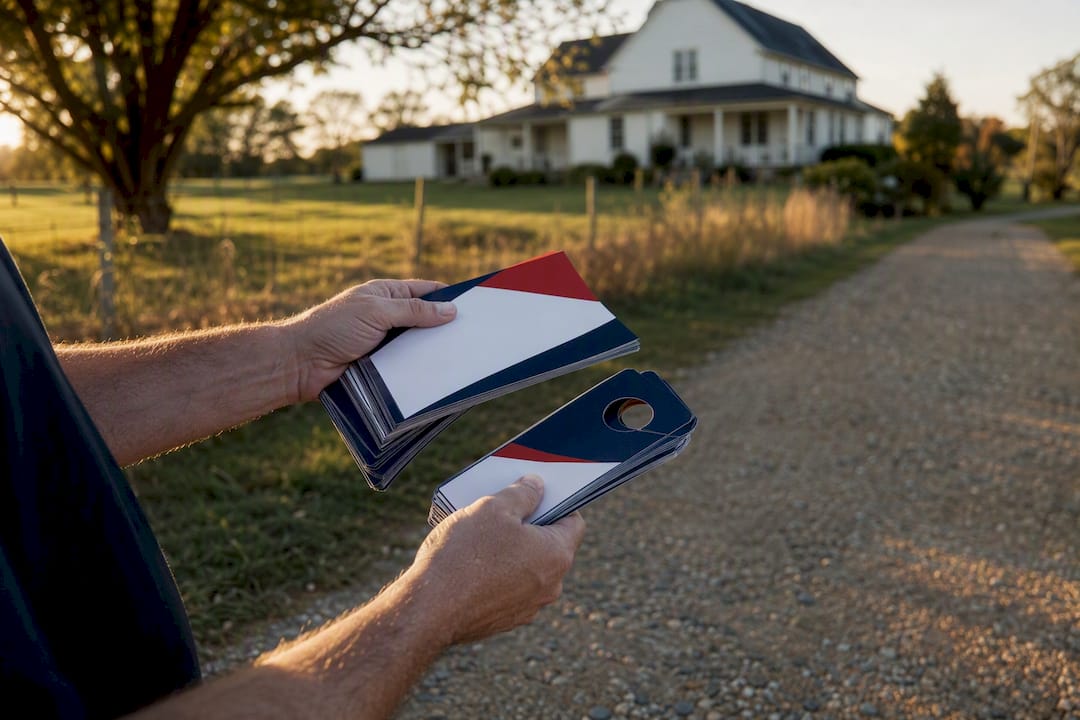
Field coordinators in low-density areas often set targets around 30 to 40 doors per day per canvasser, since travel time between houses eats into the session. The engagement metric here is conversation rate (someone answers and talks), not reply rate.
Digital organizers running email and text programs can push activity numbers higher, 100 or more touches per day, because the marginal cost of each touch is lower. The tradeoff is a positive reply rate that needs closer scrutiny, since it's easier to spam your way to a bad list.
Fundraising coordinators often blend channels: a mix of personalized fundraising emails and phone follow-ups, with the outcome metric shifting from meetings to actual contribution rate.
Volunteer recruitment leads running a broader voter contact program usually track sign-ups per hundred contacts rather than raw touch counts, since the goal is commitment, not conversation.
What Most Advice on Outreach Goals Gets Wrong
Most guidance on daily outreach goals treats the activity number as the whole story: hit your calls, hit your doors, hit your texts, and success follows. That advice produces busy coordinators and flat campaigns. The activity number is a means, not the goal, and treating it otherwise is how teams burn out chasing a metric that never moves the actual outcome.
What the evidence here actually supports is narrower and less exciting: pick a conservative daily number, watch positive reply rate like it's the only number that matters (because for diagnostic purposes, it nearly is), and resist the urge to scale volume until conversion is solid. The conventional wisdom of "more outreach fixes slow campaigns" gets it backward. A campaign stuck at 40 meetings a month usually has a message problem or a targeting problem, and no amount of extra doors knocked will fix that.
If you take one thing from this, prioritize the weekly review over the daily grind. Daily numbers are noisy. Weekly patterns tell the truth.
— Billy
Run Your Daily Goals Through One System, Not Five Spreadsheets
If you've been tracking daily touches in one spreadsheet, positive replies in your inbox, and door counts on paper, you already know where the cracks show up: nobody has the same numbers by Friday. Campaignbuddyhq exists to close that gap for progressive campaigns and advocacy groups that need real daily discipline without hiring a full data team to maintain it.
The platform's daily and weekly planning tools, outreach logging, supporter tracking, and campaign phase management were built around the exact workflow this article describes: set a target, log it in seconds, watch your positive reply rate, adjust weekly. It's also built for rural and low-density canvassing realities, not just urban phone banks. If your team is running the bottom-up framework above and needs a place to actually run it, start a free 7-day trial and log your first day's numbers before the week is out.
Sources
- How to Set Realistic Outbound Targets as a First-Time Sales Leader
- A simple system for daily X engagement in 15 minutes - Witty Playbook
- The 5-Step Outreach Strategy Cheat Sheet