
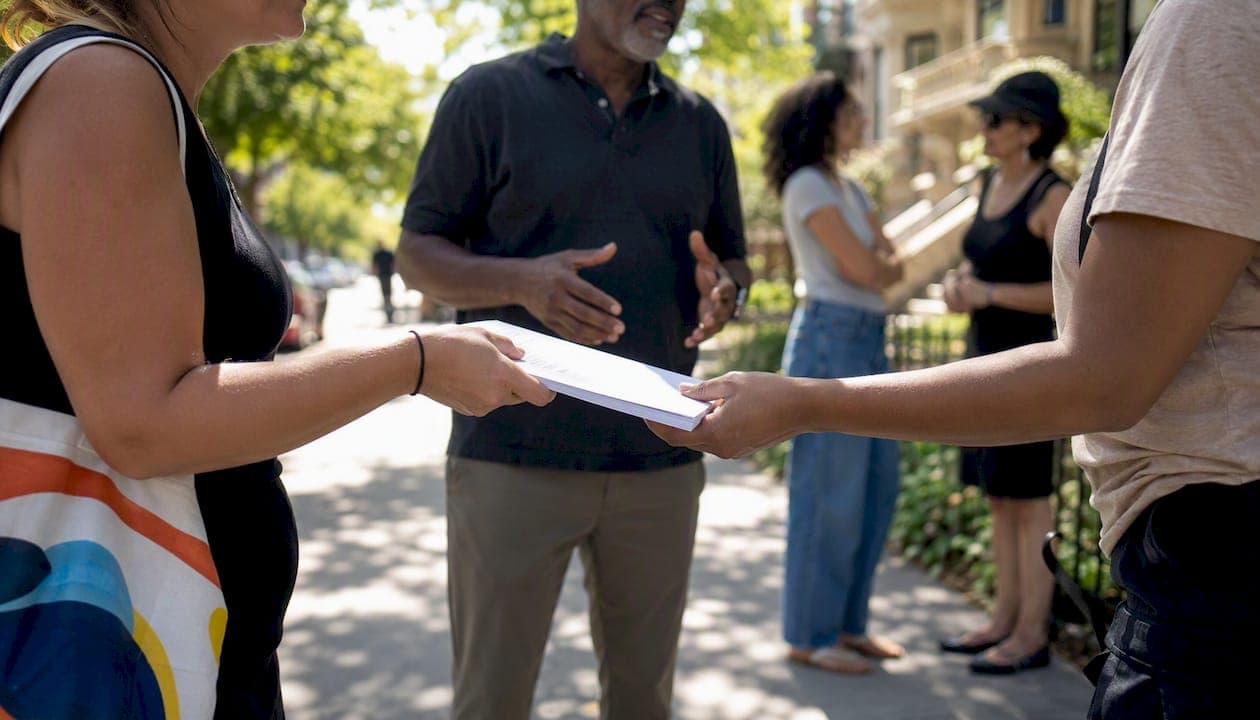
A successful petition drive runs on eight steps: set your goal, identify your target, draft the language, choose your format, recruit and train carriers, run outreach, collect and verify signatures, then deliver with intention. That sequence, executed in roughly eight weeks, is what separates a petition that moves decision-makers from one that collects dust.
Your 8-step sequence:
- Define the single, verifiable ask and name the decision-maker
- Set a signature goal, timeline, and basic budget
- Draft petition language (headline + story + ask)
- Choose paper, digital, or both
- Recruit and train carriers using the staffing formula
- Launch outreach and seed early signatures
- Collect, verify, and store signatures daily
- Deliver publicly and follow up with signers
Start within 72 hours:
- Write your one-sentence ask and confirm who has the authority to act on it
- Run the staffing math: signatures needed ÷ estimated signatures per carrier + 20% buffer = carriers to recruit
- Circulate a draft petition to 10–20 trusted supporters for feedback and early signatures
Quick staffing math: If you need 500 verified signatures and each carrier averages 50 per week, you need 10 carriers minimum. Recruit 12–13 to cover attrition. That buffer is not optional — turnover is the most predictable problem in any petition drive, and it hits hardest in the final two weeks.
Sample 8-week skeleton: Weeks 1–2: finalize ask, recruit team, train carriers. Weeks 3–4: pilot collection, verify early signatures, adjust outreach. Weeks 5–7: full-scale collection, daily tracking, media prep. Week 8: delivery event, press, signer follow-up.
Key Takeaways
A petition drive succeeds when the ask is specific, the staffing math is run before recruitment begins, and the delivery is planned as a public event from the start.
| Point | Details |
|---|---|
| Define the ask first | Name one decision-maker and one verifiable action before writing a word of petition text. |
| Run the staffing math early | Divide your signature goal by per-carrier output, then add a 20–25% buffer for attrition. |
| Seed before launch | Circulate to 10–20 trusted supporters before going public so the petition never shows zero. |
| Verify daily, not at the end | A 20–30% invalidation rate in contested drives means daily verification is the only way to protect your count. |
| Campaignbuddyhq | Tracks outreach, manages carrier rosters, and visualizes progress against your signature goal in real time. |
Table of Contents
- What is a petition drive, and which type do you need?
- How to set your goal, pick your target, and build a realistic budget
- How to draft petition language and choose paper vs. online
- How to staff your petition drive: roles, math, and carrier training
- How to promote your petition and build momentum fast
- Collecting, verifying, and storing signatures the right way
- How to deliver the petition and turn it into organizing leverage
- Your ready-to-use checklist and 8-week sample timeline
- Templates, sample language, and where to check legal rules
- What the checklist won't tell you
- Campaignbuddyhq keeps your petition drive organized from day one
- Sources
What is a petition drive, and which type do you need?
A petition is a formal written request, signed by supporters, asking a named decision-maker to take a specific action. Organizers typically work with three types:
- Informational/awareness petitions: Designed to demonstrate public concern and generate media coverage. No legal threshold required. Best when speed and visibility matter more than legal durability.
- Advocacy petitions directed at institutions: Submitted to a school board, city council, corporation, or agency. Carry political weight when the signer count is credible and the ask is specific. Most community campaigns fall here.
- Governmental/ballot petitions: Legally regulated. Must meet jurisdictional signature thresholds, residency rules, and witness or notarization requirements. Used to qualify ballot measures or trigger official reviews.
When to choose each:
- Need a response in two weeks? Go digital advocacy.
- Targeting a local elected body with a specific policy ask? Paper or hybrid, with verified constituent data.
- Qualifying a ballot measure? Paper only, with strict legal compliance from day one.
Pro Tip: A statistic tells people there's a problem. A story makes them feel it. Before you finalize your petition text, find one person whose situation illustrates the issue and lead with their experience. Petitions grounded in personal testimony consistently outperform data-heavy versions when it comes to recruiting signers and earning media attention.
How to set your goal, pick your target, and build a realistic budget
The most common mistake organizers make is writing the petition before they know exactly who can act on it. Identify one decision-maker or body first, then frame the ask around what that person or body can actually do.
Frame a single, verifiable ask:
- Wrong: "We want better parks."
- Right: "We call on Mayor [Name] to allocate $200,000 in the FY2027 budget for Riverside Park maintenance."
The ask must be specific enough that a decision-maker can say yes or no. Vague asks give officials an easy out.
SMART goal-setting for your signature target:
- Specific: Name the exact number (e.g., 1,000 verified signatures from district residents)
- Measurable: Track daily and weekly against a target rate
- Achievable: Base it on your carrier count and collection window
- Relevant: Match the threshold to what the decision-maker will take seriously
- Time-bound: Set a hard delivery date and work backward
Basic budget checklist:
- Printing (petition sheets, training materials, carrier packets)
- Clipboards, pens, ID badges for carriers
- Travel or transit reimbursement for carriers
- Tabling supplies (table, banner, tent if outdoor)
- Paid canvassers, if used (factor in compliance costs)
- Digital platform fees, if applicable
For outreach cost considerations, the fundraising outreach guide covers budget planning frameworks that translate directly to petition drives.
Sample milestone timeline:
| Phase | Weeks | Key Milestone |
|---|---|---|
| Pilot | 1–2 | First signatures collected and verified |
| Scale-up | 3–6 | Over half the goal reached; outreach channels active |
| Final push | 7 | Goal plus buffer collected |
| Delivery | 8 | Public handoff with press and documentation |
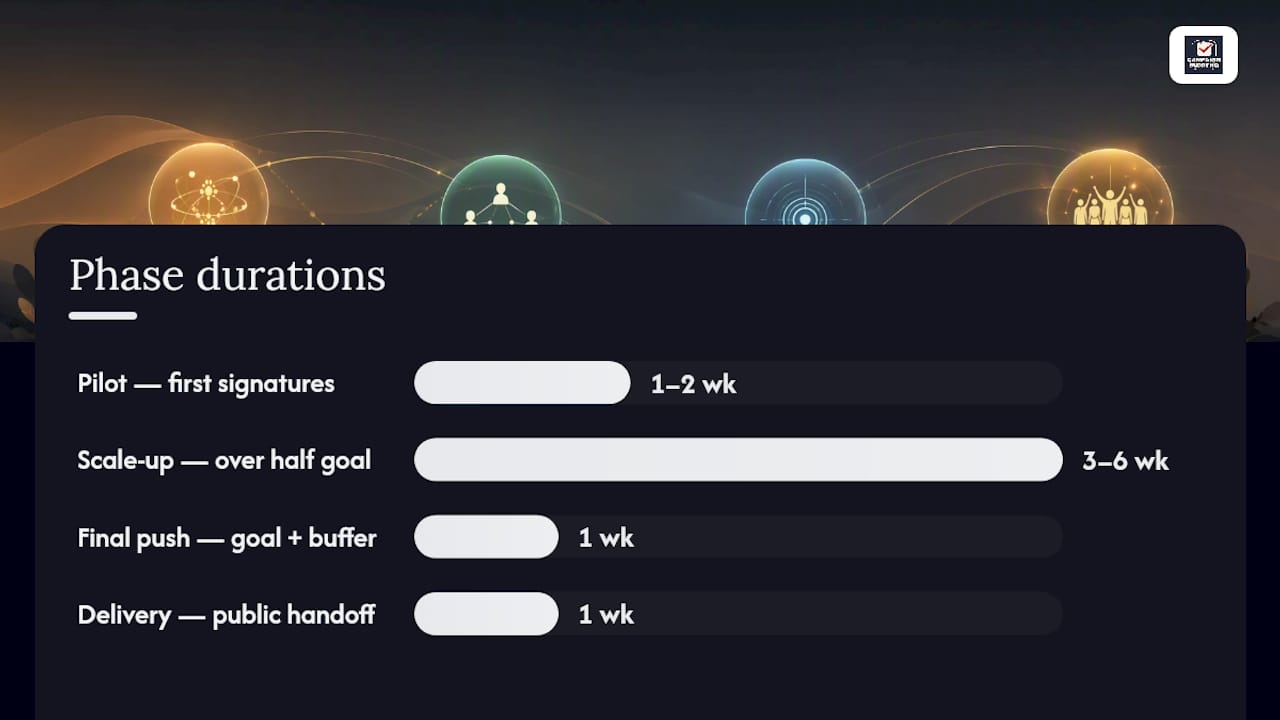
The five-phase model used by experienced grassroots organizers maps closely to this structure: issue framing, platform selection, recruitment and training, collection and verification, then delivery and follow-up.
How to draft petition language and choose paper vs. online
Petition text does not need to be long. It needs to be clear, human, and specific. Use this three-sentence framework:
- The problem: State what is happening and why it matters.
- The human example: One concrete situation that shows the real-world impact.
- The ask: Name the decision-maker, state the action, and include a deadline.
Sample petition text (adapt freely):
That is 47 words. It answers what, why, and who — the three questions every strong petition must answer before a signer will commit.
Required data fields to collect:
- Full name (legibility matters for verification)
- Street address or zip code (confirms constituent eligibility)
- Email address (for follow-up and ongoing engagement)
- Date signed (establishes validity window)
- Signature (wet ink for paper; checkbox or typed name for digital)
According to AAUW's petition guidance, zip codes are particularly useful for verifying that signers are constituents of the targeted decision-maker's district.
Online vs. offline: the real tradeoffs
| Factor | Online/Digital | Paper/Offline |
|---|---|---|
| Speed of collection | Fast; shares multiply reach | Slower; requires physical presence |
| Cost per signature | Low | Higher (printing, travel, carrier time) |
| Legal durability | Weak for ballot measures | Strong; required for most ballot drives |
| Political credibility | Can appear low-effort without offline pairing | High when signatures are verified constituents |
| Verification ease | Depends on platform | Manual but auditable |
Change makes the tradeoff explicit: digital platforms scale quickly but paper collection is the durable standard for ballot-qualifying drives. The practical answer for most advocacy campaigns is a hybrid: collect digitally for speed and reach, then follow up with paper for any signatures that need to survive official scrutiny.
How to staff your petition drive: roles, math, and carrier training
Defining the core roles
Every petition drive needs six functions covered, even if one person handles two of them:
- Campaign lead: Owns the goal, timeline, and decision-making
- Volunteer coordinator: Recruits, schedules, and retains carriers
- Trainer: Runs the carrier briefing and handles script practice
- Petition carriers: Collect signatures in the field or online
- Data verifier: Reviews sheets daily for legibility and completeness
- Delivery coordinator: Plans the handoff event and press logistics
For volunteer recruitment strategies that go beyond your immediate network, the Campaignbuddyhq blog covers sourcing channels and retention tactics that apply directly to carrier recruitment.
The staffing formula
The Community Tool Box lays out the math plainly:
Required signatures ÷ estimated signatures per carrier = carriers needed
Worked example: 500 required ÷ 50 per carrier = 10 carriers.
Adjust the "per carrier" estimate based on your collection method. A carrier tabling at a farmers market for four hours might collect 40–60 signatures. A carrier doing door-to-door in a low-density neighborhood might collect 15–25.
Carrier training checklist
- Explain the ask in one sentence and practice saying it aloud
- Review required data fields and legibility standards
- Walk through the opening script
- Practice two refusal-handling responses
- Cover prohibited conduct (no payment for signatures, no pressure tactics)
- Confirm daily check-in and sheet submission process
Opening script for carriers:
"Hi, I'm [Name] with [Organization]. We're asking [City/District] residents to sign a petition calling on [Decision-Maker] to [specific action]. It takes about 30 seconds. Would you be willing to sign?"
Refusal-handling lines:
- "No problem at all. If you'd like to learn more, here's our card."
- "I understand. We're also collecting signatures online at [URL] if you change your mind."
Pro Tip: Before public launch, seed the petition with 10–20 signatures from trusted supporters. A petition showing zero signatures is a harder sell than one showing 18. That early social proof changes how strangers perceive the campaign's legitimacy from the first moment they see it.
How to promote your petition and build momentum fast
Signatures do not collect themselves. Petitions build momentum when paired with active outreach, not when left to spread organically.
Outreach channels that work:
- Peer-to-peer sharing (ask every signer to send the link to three contacts)
- Neighborhood apps and local Facebook groups
- Tabling at high-traffic community events (farmers markets, transit stops, community centers)
- Cross-promotion with allied organizations (faith groups, unions, PTAs)
- Email to existing supporter lists
- Earned media: local newspaper, radio, community newsletter
48-hour launch plan:
- Hour 1: Send petition to your 10–20 seed signers
- Hours 2–24: Share in three to five targeted community groups
- Hours 24–48: Post on organizational social channels, ask partners to share, and pitch one local media outlet with a brief story angle
Tracking metrics to watch daily:
- Total signatures collected vs. daily target
- Signatures by source channel (which channels convert best)
- Carrier performance (signatures per carrier per shift)
- Verification pass rate (how many submitted signatures are clean)
Reallocate effort weekly based on what the numbers show. If tabling at the library is producing three times the signatures per hour as door-to-door, shift carriers accordingly. For broader campaign promotion tactics, the Campaignbuddyhq blog covers visibility strategies that translate well to petition outreach.
A media-ready delivery needs a spokesperson, a visual (a stack of printed sheets or a large signature count banner), and a one-page factsheet. Reporters need a story, not a number. Prepare a two-sentence pitch: what the petition demands, and what happens if the decision-maker ignores it.*

Collecting, verifying, and storing signatures the right way
Sloppy collection is the fastest way to lose signatures you already earned.
What to capture on every sheet:
- Full legal name (printed, not just initials)
- Street address and zip code
- Email address
- Date signed
- Signature (wet ink for paper)
Legal note: Before collecting a single signature, check your jurisdiction's rules on signer residency requirements, witness or notarization obligations, and prohibitions on paying per signature. State and county election offices publish these rules; a single compliance error can invalidate an entire batch.
Daily verification process:
- Review each sheet the same day it is collected
- Flag illegible names, missing fields, or out-of-district addresses immediately
- Log verified signatures in a central spreadsheet or tracking tool
- Separate clean sheets from flagged ones; contact carriers about recurring errors
Secure storage practices:
- Store physical sheets in a locked location with limited access
- Digital records go in a password-protected, backed-up system
- Limit access to the data verifier and campaign lead
- Do not share full contact lists with carriers
Pro Tip: Add a brief consent line to your petition sheet: "By signing, I consent to receive updates about this campaign." That one sentence covers your legal basis for follow-up emails and keeps your list compliant with basic data-privacy expectations. Collect only what you need — name, zip, email, and signature — and nothing more.
How to deliver the petition and turn it into organizing leverage
Delivery is not a formality. Treating it as a public political event converts your signature count into visible pressure and gives signers a reason to stay engaged.
Delivery checklist:
- Certified copies of all signature sheets (keep originals)
- Cover letter stating the total count, the ask, and a response deadline
- One-page factsheet summarizing the issue and signer demographics
- Witness or notarization if required by your jurisdiction
- Press advisory sent 48 hours in advance
- Spokesperson briefed and ready for questions
Three delivery formats and their tradeoffs:
- In-person public handoff with press: Highest visibility. Brings signers, media, and allied groups to the decision-maker's office or a public location. Creates a record and a story.
- Formal hearing submission: Appropriate for regulatory or legislative bodies. Less dramatic but creates an official record that must be acknowledged.
- Certified mail: Lowest visibility, but creates a legal paper trail. Use only when in-person delivery is genuinely impossible.
After delivery:
Send a follow-up email to every signer within 48 hours. Keep it short:
"We delivered [X] signatures to [Decision-Maker] on [Date]. Thank you for being part of this. We'll update you when we receive a response. In the meantime, share this with one person who should know what we did."
If the decision-maker goes silent:
- Set a public response deadline in your cover letter (14–21 days is standard)
- Escalate to a city council meeting, a press statement, or a follow-up action
- Use the signer list to mobilize for the next step: calls, emails, or attendance at a public meeting
For voter contact and follow-up strategies that apply to post-delivery engagement, the Campaignbuddyhq field guide covers escalation tactics in detail.
Your ready-to-use checklist and 8-week sample timeline
Print this section and assign an owner to every row.
One-page organizer checklist:
- Single ask written and decision-maker named
- Signature goal set with buffer (goal + 25%)
- Budget drafted and approved
- Petition text finalized (headline + story + ask)
- Data fields confirmed (name, address/zip, email, date, signature)
- Format decided (paper, digital, or hybrid)
- Roles assigned (lead, coordinator, trainer, carriers, verifier, delivery)
- Staffing math run and carriers recruited
- Carrier training completed
- Seed signatures collected (10–20 before public launch)
- Outreach channels activated
- Daily tracking in place
- Verification process running
- Delivery event planned with press advisory
- Signer follow-up email drafted
Sample 8-week timeline with staffing estimates:
Recruitment math embedded: If your goal is 600 verified signatures and each carrier averages 50 per week over a four-week active collection window, you need 3 carriers at minimum. That is too thin. Recruit 6–8 to cover attrition and allow for low-output shifts. The Community Tool Box formula holds: always recruit more than the math says you need.
Templates, sample language, and where to check legal rules
Reusable templates to build now
- Petition text template: Headline (8 words max) + problem sentence + human example + named ask with deadline. Adapt the sample from Section 4.
- Carrier training script: Opening line + two refusal responses + data-field reminder card. See Section 5.
- Daily verification log: Columns for carrier name, sheets submitted, signatures collected, verified count, flagged count, and notes.
- Press release bullet points: Date, total signatures, ask, decision-maker name, spokesperson quote placeholder, and contact info.
- Signer follow-up email: Delivery confirmation + next action + share request (see Section 8 template).
The volunteer onboarding checklist from Campaignbuddyhq covers training and compliance briefing items that pair directly with the carrier training script above.
Where to check legal rules
- State election office website: For ballot petition requirements, signature thresholds, residency rules, and witness/notarization obligations. Search "[your state] Secretary of State petition requirements."
- County election office: For district-specific rules, filing deadlines, and official petition formats.
- AAUW's advocacy toolkit: Covers data fields, constituent verification, and general petition campaign structure.
- Grassroots Authority: Covers paid vs. volunteer collector tradeoffs, verification failure rates, and phase-by-phase planning.
- Archived CA petition drive PDF: Sample formatting and witness/affidavit language from a state-level campaign.
Templates shared under Creative Commons BY-NC-SA 4.— may be adapted with attribution for non-commercial use.
For civic and election-related context relevant to your petition topic, Workplace Fairness covers election-adjacent workplace and civic issues that can inform your issue framing.
What the checklist won't tell you
The hardest calls in a petition drive are not procedural. They are judgment calls about tradeoffs the checklist cannot make for you.
The one I keep coming back to: delivery timing. Most organizers wait until they hit their number, then scramble to plan the handoff. The campaigns that generate real pressure plan the delivery event at week two, then work backward. When a press advisory is already drafted and a spokesperson is already briefed, the final push feels different to the team. It creates urgency that no motivational email can replicate.
On paid collectors versus volunteers: volunteers are cheaper and more credible, but their output is inconsistent. Paid canvassers give you predictable throughput, but they raise compliance questions in jurisdictions that restrict payment per signature. The right answer depends on your verification risk and your budget, not on ideology. If you are running a ballot-qualifying drive with strict legal standards, the cost of a single invalidated batch from an untrained volunteer outweighs the savings. If you are running an advocacy petition with no legal threshold, volunteers with good training are almost always the better choice.
That is when most campaigns quietly die. The fix is almost always the same — a public milestone event, a new allied organization joining, or a media hit that resets the energy. Plan for that stall in advance. Build a "re-launch moment" into week 5 or 6 so you have something to announce when the numbers plateau.
Campaignbuddyhq keeps your petition drive organized from day one
Running a petition drive means tracking carriers, logging daily signature counts, managing outreach across multiple channels, and hitting delivery on a hard deadline. Campaignbuddyhq is built for exactly that kind of campaign work: daily and weekly planning templates, outreach logging for doors, calls, and texts, supporter tracking, and progress visualization that shows you where you stand against your goal in real time.
The platform's phase management feature maps directly to the eight-step sequence in this article, so your team always knows what week it is in the campaign and what needs to happen next. For organizers running rural or low-density collection routes, the workflow tools are designed for those conditions specifically, not retrofitted from a high-density urban model.
Start with a free 7-day trial at Campaignbuddyhq — no credit card required. Set up your timeline, load your carrier roster, and start logging signatures on day one.
Sources
- Section 9. Conducting a Petition Drive - Community Tool Box
- How to Organize an Effective Petition Campaign - AAUW
- Change