

Six practices separate campaigns that move policy from those that just make noise: name the decision-maker, lock in one harmonized ask, recruit three to five vetted partners, segment your supporter list before you launch, build a 90-day timeline with a hard end date, and set daily metrics you can read in under five minutes. Do those six things and you have the skeleton of a coordinated advocacy campaign. Everything else in this guide puts muscle on those bones.
Start this week:
- Write one sentence naming your decision-maker and the specific action you want them to take.
- Identify three to five organizations with overlapping audiences and reach out to gauge interest.
- Pull your existing contact list and tag supporters by geography, issue priority, or relationship depth.
- Draft a 90-day campaign calendar with a launch date, a midpoint review, and a hard close.
- Agree on a single shared ask before your first coalition meeting, not after.
Pro Tip: Before your first coalition call, send each prospective partner a one-page campaign brief. Partners who read it in advance make decisions in the meeting instead of asking for time to think. That alone cuts your onboarding timeline by a week.
Key Takeaways
Coordinated advocacy campaigns succeed when a named decision-maker receives a single, harmonized ask from three to five aligned partners within a time-bound campaign that tracks daily metrics and adapts its theory of change after every major event.
| Point | Details |
|---|---|
| Name the decision-maker | Every communication names one specific official and one specific action, not a general audience of "elected officials." |
| One harmonized ask | All partners deliver the identical ask; tone and framing adapt to each audience, but the bill number and vote date never change. |
| Three to five partners | Recruit partners with overlapping supporter bases; more than five adds coordination overhead faster than it adds reach. |
| 90-day time-bound timeline | Structure the campaign in three phases (launch, middle, close) with a hard end date and a midpoint review at day 45. |
| Campaignbuddyhq for workflow | Campaignbuddyhq maps supporter tagging, multi-channel outreach logging, and live dashboards to the coordination workflow in this guide. |
Table of Contents
- What is coordinated advocacy and why does alignment matter?
- Core principles every coordinated campaign should follow
- How do you recruit, vet, and structure coalition partners?
- How do you plan a campaign from goal to timeline?
- How do you create a unified ask and adaptable message templates?
- Which tactics and channels should you use, and when?
- What routines and tools keep coalition partners aligned?
- How do you measure progress and pivot when a campaign stalls?
- Common mistakes that sink coordinated campaigns
- An operational checklist and sample workflow for your campaign
- What most organizers get wrong about coalition coordination
- Sources
What is coordinated advocacy and why does alignment matter?
Coordinated advocacy, often called coalition advocacy, is a time-bound, multi-organization campaign in which two or more groups deliver a unified ask to a named decision-maker through synchronized outreach across channels. The key word is unified. When every partner sends a different message, decision-makers hear noise. When they hear the same ask from a constituent in a church pew, a union hall, and a pediatrician's waiting room in the same week, the signal is impossible to ignore.
The multiplier effect works because decision-makers track volume and source diversity, not just intensity. A single organization sending 500 emails registers as one constituency. Five organizations sending 100 emails each, all naming the same bill and the same vote, registers as five constituencies with a shared stake. That distinction shapes how staff prioritize responses and how legislators calculate political risk.
The risk of misaligned messages is equally real. If one partner asks for a full funding increase while another asks for a pilot program, a decision-maker can satisfy neither and claim they tried. Mixed asks give opponents an exit ramp. According to the AdvocacyLabs Guidebook, campaigns are most effective when they are time-bound with a clear beginning, middle, and end, and when tactics are organized around a single strategic path. Alignment is not a soft value; it is the mechanism by which coordinated campaigns produce measurable influence.
Core principles every coordinated campaign should follow
These eight principles apply regardless of issue area, coalition size, or campaign phase. Treat them as decision filters: when you hit a disagreement or a fork in the road, run the options through this list.
-
Harmonize the ask. Every partner delivers the same specific request to the same named decision-maker. Example: "We are asking Representative [Name] to co-sponsor HB 1234 before the committee vote on March 15."
-
Time-box the campaign. Set a hard end date before you launch. Example: a 90-day window closing the week before a legislative committee vote gives every partner a shared countdown.
-
Name the decision-maker. Vague campaigns aimed at "elected officials" diffuse pressure. Example: identify the one committee chair whose vote determines whether the bill advances.
-
Focus on a narrow win. Campaigns that try to move three bills at once rarely move any. Example: pick the one provision most likely to pass and build the full campaign around it.
-
Agree minimally, not maximally. Define the shared goal and core message framework, then let partners adapt tone and tactics to their audiences. The ICPA Toolkit calls this the "agree minimally" principle: requiring full consensus on every detail produces deadlock, not momentum.
-
Build a living theory of change. Write a one-paragraph explanation of how your actions lead to the outcome you want, and update it after every major event. Example: "If 500 constituents contact the chair's office by March 1, the chair will feel enough political pressure to schedule a hearing."
-
Assign, don't assume. Every tactic needs an owner and a deadline. Example: the comms lead owns the email template by day three; the logistics lead owns the meeting request by day seven.
-
Protect campaign capital. Save your highest-intensity mobilization for the moment when the decision is actually on the table. Burning out your list on a preliminary hearing leaves nothing for the floor vote.
Pro Tip: At your first coalition meeting, agree on a decision protocol before you agree on anything else. Who has final say when partners disagree on messaging? A simple rule (majority of lead organizations, or the coordination lead breaks ties) prevents a single partner from holding the campaign hostage.
How do you recruit, vet, and structure coalition partners?
Coalitions work best with three to five partner organizations whose supporter bases overlap enough to multiply reach without requiring a full-time staff member just to manage internal coordination. More partners add complexity faster than they add capacity.
Partner vetting: questions to ask before you invite anyone
| Vetting question | What you are assessing |
|---|---|
| Does this organization's audience include constituents of the target decision-maker? | Geographic and demographic reach |
| Has this organization taken a public position on this issue before? | Reputational alignment and risk |
| Can they commit a named staff contact for weekly check-ins? | Operational capacity |
| Do they have an active email list, phone bank, or social following? | Channel reach |
| Are there any conflicts of interest or past public disputes with other partners? | Coalition friction risk |
| What is their realistic time commitment per week? | Capacity fit |
Coalition structure and role expectations
| Role | Core responsibilities | Estimated weekly time |
|---|---|---|
| Coordination lead | Runs weekly calls, maintains shared docs, escalates conflicts | 8 hours |
| Comms lead | Owns messaging platform, drafts templates, approves partner adaptations | 5–8 hours |
| Policy lead | Tracks legislative calendar, briefs partners on decision-maker status | 3–5 hours |
| Logistics lead | Schedules meetings, manages Hill day logistics, tracks RSVPs | 3–6 hours |
Onboarding checklist for new partners
- Sign a memorandum of understanding (MOU) that covers the shared ask, decision protocol, data-sharing rules, and exit terms.
- Confirm which shared assets each partner can use (logos, data, constituent stories).
- Add the partner's comms lead to the shared messaging platform and outreach tracker.
- Schedule the first weekly check-in before the partner leaves the onboarding call.
- Clarify opt-in vs. required activities so partners know what they can skip without breaking the coalition agreement.
A "give to get" culture matters here. Partners who share their lists, lessons, and honest debriefs build coalitions that last beyond a single campaign. Those who treat their data as proprietary tend to drift toward silent-partner status within six weeks.
How do you plan a campaign from goal to timeline?
A 90-day campaign structure with a segmented supporter list and a named, one-sentence goal is the most repeatable structure for small-to-midsize advocacy campaigns. The goal sentence follows a simple template: "We will persuade [decision-maker] to [specific action] by [date]."
Theory of change template: "If [coalition actions] reach [volume threshold] by [date], then [decision-maker] will face enough constituent pressure to [specific action], which advances [policy outcome]."
Campaign timeline: 90-day template
Launch phase (days 0–14)
- Finalize MOU and partner roles.
- Segment supporter list by geography, relationship depth, and issue priority.
- Publish the shared messaging platform and outreach tracker.
- Send the first coalition-wide email to warm the list.
- Checkpoint: all partners have logged into shared tools and confirmed their first outreach targets.
Middle phase (days 15–60)
- Run weekly partner check-ins (30 minutes, standing agenda).
- Execute channel-specific outreach (email, SMS, phone, social, in-person).
- Track action completion rates and open rates weekly.
- Schedule legislative meetings for days 30–45.
- Midpoint review at day 45: assess progress against targets, pivot if needed.
- Checkpoint: at least 50% of supporter list has taken at least one action.
Close phase (days 61–90)
- Concentrate high-intensity mobilization in the final two weeks.
- Send final constituent contact push to the decision-maker's office.
- Debrief with all partners within one week of the campaign close.
- Publish after-action report and update the theory of change.
- Checkpoint: document lessons learned and archive all shared assets.
Sample objectives table
For effective campaign goal setting, write the objective before you choose the tactic. Organizers who pick tactics first (we will do a phone bank) often discover mid-campaign that the tactic does not connect to the decision they are trying to move.
How do you create a unified ask and adaptable message templates?
The single most important messaging decision is agreeing on one ask before any partner sends a single email. Everything else, tone, channel, constituent story, is adaptation. The ask itself does not change.
Sample coalition ask: "We urge Representative [Name] to vote yes on HB 1234 during the March 15 committee vote."
Messaging templates by channel
| Channel | Template |
|---|---|
| Email subject line | "[Your organization] urges Rep. [Name]: Vote yes on HB 1234 by March 15" |
| 30-second elevator pitch | "Hi, I'm [name] from [org]. We're asking Rep. [Name] to vote yes on HB 1234 before the March 15 committee vote. This bill would [one-sentence impact]. Can we count on your support?" |
| Phone call script | "Hello, my name is [name] and I'm a constituent in [district]. I'm calling to ask Rep. [Name] to co-sponsor HB 1234 before the March 15 vote. The bill would [impact]. Will the representative support it?" |
| Social post | ".@Rep[Name]: Your constituents are watching the March 15 vote on HB 1234. Vote yes. [#CampaignHashtag]" |
| SMS | "Hi [first name], Rep. [Name] votes on HB 1234 March 15. Text CALL to reach their office now. [org name]" |
Facts and proof points every partner must align on
- The specific bill number and vote date.
- The named decision-maker and their district.
- One or two data points that quantify the problem the bill addresses.
- At least one constituent story that illustrates the human impact.
- The coalition's name and the list of endorsing organizations.
Strategic communications coalitions should allow members to adapt language and tone to their own audiences rather than demanding identical phrasing. A faith-based partner and a labor union will frame the same ask differently. That is fine. The ask, the bill number, and the vote date stay identical.
Which tactics and channels should you use, and when?
Sequence matters as much as channel selection. Experimental evidence shows that personalization, messenger selection, and making early supporters visible all increase campaign effectiveness. A constituent call from a neighbor lands differently than a form email from a national organization.
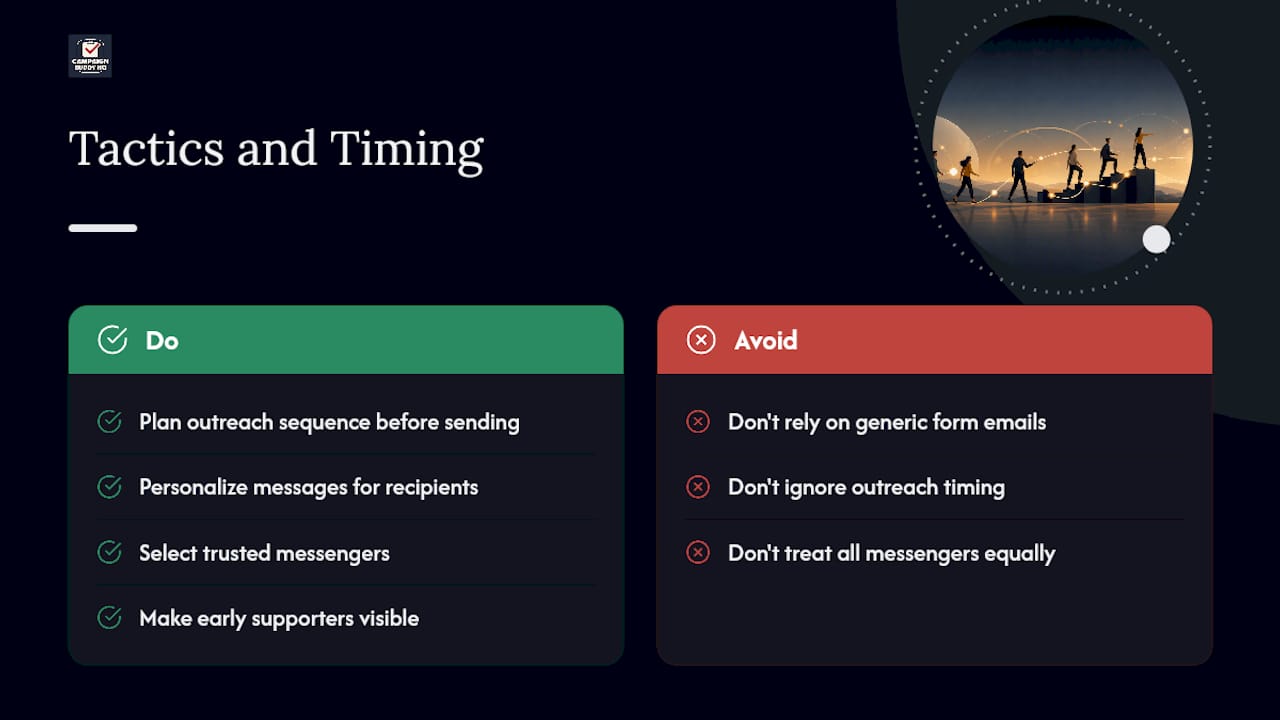
Tactics matrix
| Channel | Best moment | Metric to track | Sample KPI |
|---|---|---|---|
| Launch and close phases | Open rate, click-to-action rate | 25% open rate, 10% action rate | |
| SMS | in the final two weeks | Delivery rate, reply rate | 90% delivery, 5% reply |
| Phone bank | Days 30–45, before legislative meetings | Calls completed, contacts reached | 100 calls per partner per week |
| Social media | Throughout, peaks at launch and close | Impressions, shares, decision-maker tags | 50 decision-maker tags per week |
| In-person meetings | Days 30–45 with decision-maker staff | Meetings held, follow-up commitments | 3 meetings with staff or member |
| Legislative Hill day | days 30–45 | Meetings completed, commitments logged | 10 meetings, 3 public commitments |
Sample two-week launch calendar
| Day | Action | Owner |
|---|---|---|
| Day 1 | Send coalition launch email to full segmented list | Comms lead |
| Day 2 | Partners post on social, tag decision-maker | All partners |
| Day 3 | SMS blast to high-priority supporters | Logistics lead |
| Day 5 | Phone bank kick-off with trained volunteers | Each partner |
| Day 7 | Mid-launch check-in call (15 minutes) | Coordination lead |
| Day 10 | Submit legislative meeting requests | Logistics lead |
| day three | Second email to non-openers with updated subject line | Comms lead |
| Day 14 | Launch-phase debrief and metrics review | All leads |
Pro Tip: Organize before you mobilize. Spend the first two weeks building relationships and testing messages with small groups before you push to your full list. Networked campaigns that reserve their high-intensity mobilization for the winnable moment consistently outperform campaigns that go all-out at launch and have nothing left for the floor vote.
For a deeper look at 2026 outreach channel trends, SMS and in-person contact continue to outperform email for high-stakes action asks, particularly in the final two weeks of a campaign.
What routines and tools keep coalition partners aligned?
The biggest coordination failure is not disagreement. It is silence. Partners go quiet, miss deadlines, and duplicate outreach because no one built a system to catch those gaps early. The fix is a lightweight but consistent coordination infrastructure.

Meeting cadence
| Meeting | Who | Frequency | Agenda | Output |
|---|---|---|---|---|
| Coalition stand-up | All leads | Weekly, 30 min | Metrics review, blockers, next-week assignments | Updated tracker, decision log entry |
| Comms sync | Comms lead + partner comms contacts | weekly (30 minutes) | Message review, channel updates, approval queue | Approved templates |
| Policy briefing | Policy lead + coordination lead | As needed, 15 min | Decision-maker status, legislative calendar | Partner alert if action needed |
| Full coalition call | All partners | Monthly, 45 min | Progress against targets, pivot decisions, morale | Updated theory of change |
Shared document structure
Every coalition needs four living documents, accessible to all partners at all times:
- Campaign brief: one-page summary of the goal, ask, decision-maker, timeline, and partner roles.
- Messaging platform: approved ask, talking points, channel templates, and proof points.
- Outreach tracker: logs every supporter contact, action taken, source partner, and follow-up date.
- Decision log: records every coalition-level decision, who made it, and when.
Essential outreach tracker fields
- Supporter ID or unique contact identifier
- Action taken (email sent, call made, door knocked, meeting attended)
- Source partner (which organization owns this contact)
- Date of last contact
- Next ask and follow-up date
- Opt-in status and communication preferences
The political advocacy workflow guide covers how structured check-ins and shared tracking tools reduce the coordination overhead that kills coalitions. The goal is not more meetings. It is fewer surprises.
How do you measure progress and pivot when a campaign stalls?
Set directional baselines, not immutable targets. A baseline tells you where you started so you can read early signals. A rigid target that cannot move becomes a morale problem when external conditions shift.
Dashboard metrics
| Metric | What it tells you | Review frequency |
|---|---|---|
| Email open rate | List health and subject line relevance | Weekly |
| Action completion rate | How many supporters took the requested action | Weekly |
| Media hits | Public visibility of the campaign | Bi-weekly |
| Decision-maker contacts logged | Volume of constituent pressure reaching the target | Weekly |
| Supporter list growth | Whether outreach is expanding the base | Monthly |
After-action review template
Run this at the midpoint (day 45) and at campaign close:
- What did we set out to do, and what actually happened?
- Which tactics produced the most constituent contacts per hour of staff time?
- Where did partners fall silent or miss deadlines, and why?
- What does the decision-maker's office say about the volume and quality of contacts?
- What would we change if we had two more weeks?
Changing all three at once makes it impossible to know what worked.
Pro Tip: Treat your theory of change as a living document. After every major event (a committee hearing, a media story, a partner dropping out), spend 15 minutes updating it. Campaigns that adapt their theory of change mid-run outperform those that treat the original plan as fixed. The NIH advocacy checklist frames this as tracking outcomes against goals and adjusting tactics accordingly.
Common mistakes that sink coordinated campaigns
Most coalition failures are predictable. Here are the red flags and the one-line fix for each.
- Silent partners: a partner misses two consecutive check-ins without explanation. Fix: send a direct message within 24 hours and offer to reduce their commitment rather than let them drift.
- Mission drift: partners start promoting their own organizational priorities inside coalition communications. Fix: re-circulate the MOU and decision log; remind partners that the coalition's ask is the only shared ask.
- Duplicated outreach: two partners contact the same supporter on the same day with different messages. Fix: assign outreach by geography or list segment in the tracker before any sends go out.
- Poor list hygiene: bounced emails and disconnected phone numbers inflate your outreach numbers and deflate your action rates. Fix: run a list-cleaning pass before launch and after every major send.
- No named decision-maker: the campaign asks supporters to "contact their representatives" without naming anyone specific. Fix: name one decision-maker in every piece of communication; vague asks produce vague results.
- Consensus paralysis: the coalition cannot agree on the ask because every partner wants their priority included. Fix: apply the "agree minimally" principle and call a vote among lead organizations.
A quick illustration: a state-level housing coalition spent its first three weeks debating whether to include rent control in the ask alongside eviction protection. By the time they agreed on eviction protection alone, they had missed the committee hearing window. The fix was simple in retrospect: agree on the narrowest winnable ask at the first meeting, not the most comprehensive one.
On legal compliance: if your campaign involves direct lobbying of legislators, register as required under your state's lobbying disclosure laws and keep a record of all contacts with public officials. The Washington University advocacy meetings guide notes that professional follow-up and accurate record-keeping are baseline expectations for credible advocacy.
An operational checklist and sample workflow for your campaign
This is where the principles become a week-by-week routine. The checklist below maps tasks to owners, frequency, and a clear success indicator.
Operational task checklist
Sample weekly workflow
Monday: Each partner logs weekend outreach in the shared tracker. Coordination lead sends a one-paragraph metrics summary to all leads.
Tuesday: Comms lead reviews any partner-adapted messaging for alignment with the approved ask. Approves or flags within 24 hours.
Wednesday: Coalition stand-up call (30 minutes). Agenda: metrics, blockers, assignments for the week.
Thursday: Targeted sends go out based on supporter segmentation. High-priority contacts get a personalized message; warm contacts get a standard template.
Friday: Logistics lead confirms any upcoming meeting requests or event logistics. Policy lead sends a one-sentence legislative calendar update.
Platform feature checklist: what your campaign tool needs to do
| Campaign need | Platform feature |
|---|---|
| Track supporter actions across partners | Supporter tagging and action logging |
| Assign outreach by geography or segment | List segmentation and territory assignment |
| Monitor progress toward daily and weekly goals | Dashboard with real-time metrics |
| Control what each partner can see and edit | Role-based permissions |
| Log calls, texts, doors, and emails in one place | Multi-channel outreach tracker |
| Generate reports for partner check-ins | Exportable activity summaries |
Coordinated campaigns that use a centralized tracking platform catch duplication errors and silent-partner drift weeks earlier than those relying on spreadsheets and email threads. The difference shows up in action completion rates, not just in convenience.
The role of technology in advocacy has shifted from optional to operational. A platform that maps directly to your campaign's workflow, supporter tagging, one-click action logging, role-based access, and a live dashboard, removes the coordination overhead that burns out organizers and stalls campaigns.
Pro Tip: Before onboarding partners to any platform, map your campaign's specific needs (supporter tags, action types, reporting fields) to the platform's features. Partners who log in and find a tool that matches their workflow adopt it. Partners who find a confusing interface go back to spreadsheets within a week.
What most organizers get wrong about coalition coordination
The conventional wisdom says the hardest part of coalition advocacy is getting partners to agree on the ask. That is wrong. The hardest part is keeping partners engaged after the launch energy fades, usually around week four, when the campaign feels like a grind and the decision-maker has not yet responded.
Most coordination guides focus on the launch: the MOU, the messaging platform, the kick-off call. Those matter. But the campaigns that actually move policy are the ones that built a coordination rhythm that makes week six feel as structured as week one. That means a standing weekly call with a fixed agenda, a shared tracker that every partner updates before the call, and a coordination lead who sends a written summary afterward. Not because partners are unreliable, but because structure is what makes reliability possible under pressure.
The other thing most guides understate: the "agree minimally" principle is not a compromise. It is a strategic choice. A coalition that demands identical messaging from a faith-based partner and a labor union will get watered-down language that neither audience finds compelling. Letting partners adapt tone and framing to their own constituents, while holding the ask and the decision-maker constant, produces more constituent contacts and more authentic ones. Experimental research consistently shows that messenger selection and personalization move people more than volume alone.
Campaignbuddyhq: a practical tool for running coordinated campaigns
Coordinating a multi-partner advocacy campaign across email, SMS, phone, and in-person outreach is a logistics problem as much as a political one. Campaignbuddyhq is built for exactly that: daily and weekly campaign planning, outreach logging across every channel (doors, calls, texts, registrations), supporter tagging, and a live dashboard that shows progress toward your goals in real time. Role-based permissions mean your comms lead sees what they need and your partner organizations stay in their lane without constant oversight from the coordination lead.
If you are running a 90-day coalition campaign and need a platform that maps to the workflow in this guide, Campaignbuddyhq offers a 7-day free trial with no credit card required. Start the trial, load your supporter list, and run your first week's outreach before you commit.
Sources
- Nonprofit Advocacy Campaign: 7-Step Playbook (2026) | Zeffy
- Science of Advocacy | AdvocacyLabs Guidebook (2024)
- Tips for Building and Managing a Successful Coalition | Harvard T.H. Chan School
- The Public Policy Advocacy Actions Checklist - PMC - NIH
- 10 keys to mobilise strategic communications coalitions | ICPA Toolkit