
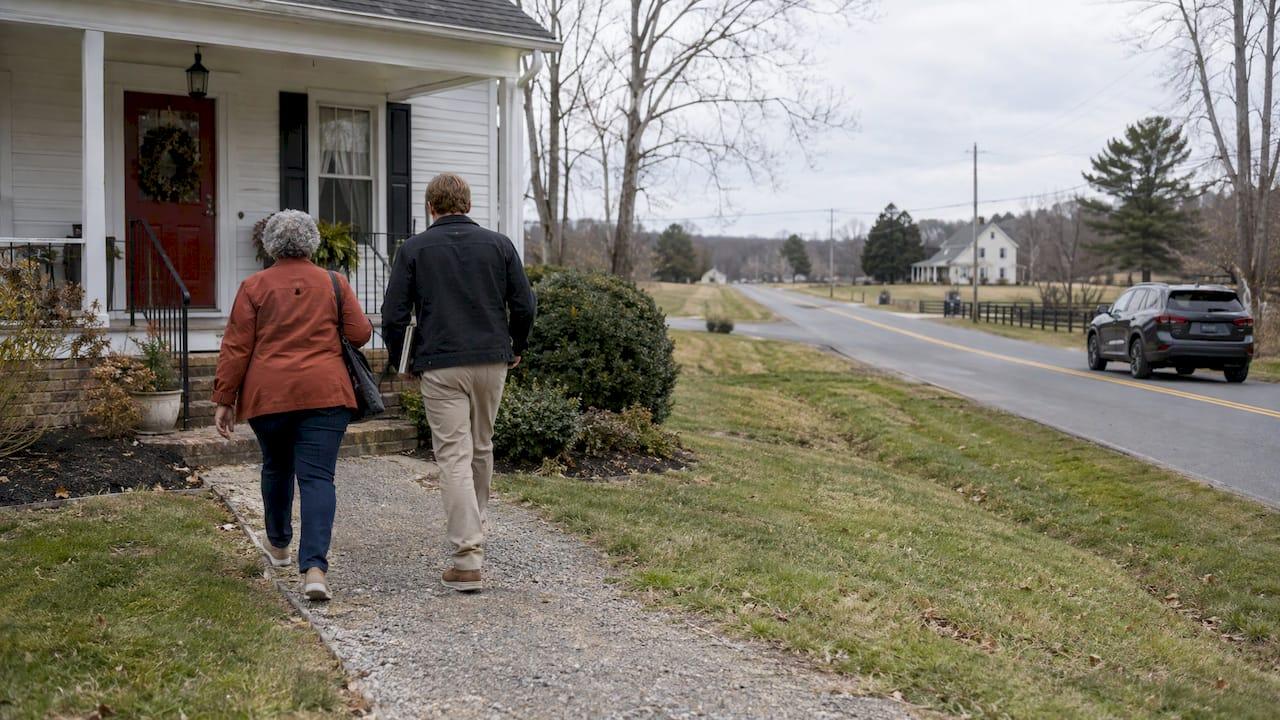
Low-density canvassing is door-to-door voter contact in places where homes are miles apart: rural counties, small towns, ranchland, and sprawling single-family suburbs. The method is the same as in a city. The math is not. Fewer doors per hour means smaller turfs, firm daily goals, a phone plan for the doors you can't reach, and a tracking routine that tells you each week whether you are on pace. This guide gives you all four, with numbers you can plan around.
Campaign Buddy HQ was built for this kind of work: planning each day and week, logging doors, calls, texts and registrations, and watching progress toward your goals, including in rural and low-density communities.
TL;DR
- Plan for about six doors an hour, not the eight you may hear quoted for dense housing, and expect roughly one conversation for every six doors on a pass.
- Cut small turfs of 10 to 20 doors where canvassers drive between houses, and don't mix far-apart neighborhoods in one packet.
- Back every rural turf with a phone list for the outliers and the doors nobody answers.
- Send people in pairs, finish before dark, and check local solicitation rules before the first shift.
- Log every attempt daily and compare it to a weekly goal, so a slow week shows up while you can still fix it.
Table of Contents
- Why density changes the cost of every vote
- Set goals with the numbers that actually apply
- Cut turf for distance, not for neighborhood lines
- Plan the drive like part of the shift
- Safety and local rules
- Make each knock count
- Back the doors with phones and texts
- Track weekly or lose the plan
- Perspective
- Put your plan in one place
- FAQ
- Sources
Why density changes the cost of every vote
In a dense area, a canvasser walks from door to door in seconds. In a spread-out one, they spend much of the shift in a car or on a road shoulder. The result is fewer attempts per hour and a higher cost for each conversation.
This is a known structural problem, not a failure of effort. A Just Security analysis notes that canvassing apartment buildings is more effective than canvassing spread-out single-family neighborhoods, because each door-knocker can reach more voters and the cost per vote falls. The same piece reports that canvassed voters turn out at rates 1.7 to 9.8 percentage points higher depending on the year, and that roughly every 14 people contacted yields one new voter.
The lesson for a rural or small-town campaign is not that doors don't work. Contact still moves turnout. But your budget is hours, and hours go further when the plan is built around distance from the start.
Set goals with the numbers that actually apply
Most canvassing advice assumes a walkable neighborhood. Political scientists Donald Green and Alan Gerber, in their research on get-out-the-vote work, put an experienced canvasser in dense, accessible housing at about eight households per hour. That rate can fall by half when doors are hard, dangerous, or slow to reach. They plan around six households per hour, and note that it is common to reach only one voter for every six doors on a pass. Contact rates above 25 percent take multiple attempts.
Here is what that means for a volunteer shift.
| Setting | Doors per hour | Doors in a 3-hour shift | Expected conversations at 1 in 6 |
|---|---|---|---|
| Dense, accessible housing | 8 | 24 | 4 |
| Planning figure | 6 | 18 | 3 |
| Hard-to-reach doors | about 4 | about 12 | 2 |
The last row is simple arithmetic from the halving the researchers describe. Treat it as a floor for a very spread-out county, then adjust after your first week of real data.
So a volunteer who knocks 18 doors and has three real conversations has had a normal shift. If you told that volunteer to expect 40 doors, they will feel like they failed. Setting the number honestly is the first retention tool you have.

Build a weekly target from the shift math
Work backward from your universe. Say you need 600 persuadable and supporter households contacted before a deadline and you can field 12 volunteer shifts a week. At 18 doors a shift that is 216 attempts a week, and at a one-in-six contact rate about 36 conversations. Now you can see whether the plan closes. If it doesn't, you have three levers: more shifts, a tighter universe, or moving some of the list to phones.

Our step-by-step canvassing guide walks through setting the basic goals for a field program, and you can apply the six-doors-an-hour figure to every step.
Cut turf for distance, not for neighborhood lines
Turf is the list of doors one canvasser or pair takes in one outing. In a city you cut it by blocks. In a low-density area you cut it by drive time.
The Minnesota Democratic-Farmer-Labor Party's turf-cutting guide gives the clearest rule: where canvassers drive between houses, cut much smaller turfs of 10 to 20 doors, because driving takes longer than organizers expect. It also advises against turfs that combine neighborhoods far from each other, and says to leave out one or two houses that are way out of the way, unless every house in the area is far apart, in which case the outliers are the turf.
A practical way to apply that:
- Cluster first. Group doors that sit within a few minutes of each other. A cluster of 14 doors on two connected county roads is a good turf. Fourteen doors spread across three townships is not.
- Keep the packet to one shift. At the planning rate of six doors an hour, 18 doors fills three hours. A 10 to 20 door packet fits that range.
- Move true outliers to a phone list. A single house that needs a long detour costs more than it returns. Call it instead.
- Match the packet to the person. Hand compact town packets to volunteers who don't want long walks, and the longer, sparser routes to those who do.
- Don't overtrim the universe. If your targeting is so narrow that the remaining doors are scattered, canvassers drive far and talk to few people. Where the geography forces it, widen the list enough to build a workable cluster, while still keeping off people who don't belong on it.
Our turf cutting guide for organizers covers packet sizing in more depth, including the 10 to 25 door range that suits spread-out areas.
Plan the drive like part of the shift
In low-density work, transportation is a line in the plan, not an afterthought.
- Mark clusters that need a car. Tell volunteers before they arrive that this packet is a drive-and-walk packet.
- Pair people. Pairs can share a car, split the cost of fuel, and cover each other's safety. Decide in advance whether the campaign reimburses mileage, and say so up front.
- Brief on the roads. Gravel, no shoulders, unmarked driveways, long lanes, and spotty cell service all slow the shift. A two-minute briefing prevents an hour of confusion.
- Print maps. Rural coverage can drop out, so don't depend on a phone for the only route.
Timing and weather
Green and Gerber report that most campaigns canvass 5:00 to 7:00 p.m. on weeknights and 10:00 a.m. to 5:00 p.m. on Saturdays, with Sunday afternoons, 1:00 to 5:00 p.m., rare outside some regions. In the country, the evening window can be shorter than it looks, because there are no streetlights once the sun goes down. Plan earlier end times for fall shifts and keep a rain plan, since the same authors warn that storms leave canvassers demoralized and wet. A fallback such as phone banking from a living room keeps the shift from being canceled.
Safety and local rules
This part is not optional.
Safety. Green and Gerber's guidance is to send canvassers out in pairs, give them maps and an emergency number, assign them to familiar areas where you can, make them identifiable with campaign shirts, buttons or clipboard stickers, and set a time and place to meet at the end so you can count heads. In rural settings add two more habits: tell someone the route and expected return time, and have each pair check in by text at the halfway point. Agree beforehand that nobody goes inside a home, even when invited, and that anyone who feels uneasy about a dog, a gate or a resident skips the door and marks it for follow-up.
Local rules. Door-to-door political canvassing is protected speech in the United States, and courts have struck down overly broad limits. In New Jersey Citizen Action v. Edison Township, the Third Circuit held that ordinances restricting evening canvassing before 9 p.m. unconstitutionally burdened First Amendment rights. That is one decision in one circuit from 1986, not a blanket rule for your county. Before the first shift, check your town or county for registration, permit or hours rules, and confirm with a lawyer if an ordinance looks restrictive. Also look up posted "No Soliciting" signs and private-road or gated-property policies where you plan to knock.
Make each knock count
When a door costs you five or ten minutes of travel, a rushed lit drop wastes the trip. Treat each answered door as a conversation.
- Give canvassers a short, human script. One question about what matters locally, one clear ask, one piece of literature. In small communities, people often know the candidate's name or family before you arrive, so listening matters more than pitching.
- Record the outcome every time. Not home, spoke with supporter, undecided, moved, refused, needs a registration form. Without that data you can't tell a bad turf from a bad week.
- Use fewer, deeper visits. Where the nearest neighbor is a mile away, a second pass costs twice as much. Save repeat visits for supporters and undecided voters who showed real interest.
- Collect phone numbers. A number gained at the door opens the cheaper follow-up channel.
Our guide to small-town campaigning and our post on building rural campaign momentum look at how these habits add up over a full campaign.
Back the doors with phones and texts
No low-density program should rely on doors alone. A phone list does three jobs:
- It covers the outlier households you cut from turfs.
- It reaches doors where nobody answered, without another drive.
- It handles the second and third touches on supporters, so canvassers can spend their drive time on new doors.
The International Association of Fire Fighters' field and canvassing guide frames the decisions a field plan has to make: how many passes to run, doors versus phones, how many volunteer shifts are needed, how to recruit and keep volunteers, and whether the candidate will knock doors and how many. Answer those early, in writing, and the rest of the plan follows.
For a longer look at sequencing channels, see our 2026 voter contact field guide and our post on multichannel voter contact.
Track weekly or lose the plan
In a dense city, a bad canvass shows up fast, because you see the numbers by the end of the night. In a rural campaign, the lag is longer. A volunteer drives an hour, knocks eleven doors, and the notes sit on a clipboard in a truck until Sunday.
A tracking routine that works:
- Set a daily number for each channel: doors, calls, texts, registrations.
- Log at the end of every shift, not at the end of the week.
- Compare weekly actual to target. If doors per hour is running under six, fix the turf. If contact rate is under one in six, fix the timing or the list.
- Adjust the phase. Early weeks are for building lists and recruiting. Later weeks are for persuasion and turnout. Your targets should change with the phase.
Our post on canvassing tracking methods compares ways to record what happens in the field, and our volunteer onboarding checklist helps you get new canvassers to their first shift with the right expectations.
Perspective
Most field advice is written for places where a volunteer can knock forty doors in an evening. In a county where the nearest neighbor is a mile away, that advice sets people up to feel like they failed.
We built Campaign Buddy HQ around the opposite assumption. A campaign in a low-density place needs honest daily and weekly targets, a clear record of every door, call, text and registration, and a way to see whether the campaign phase you are in matches the work being done. When a volunteer knocks eighteen doors and has three real conversations, that is progress, and it should look like progress on the page.
Consistency wins small-town races. Day after day, a campaign that plans its week, logs its work and sees its pace will outlast one that relies on memory and good intentions. That is the tool we want in organizers' hands.
Billy
Put your plan in one place
If you are planning a spread-out canvass now, you need a way to turn the numbers above into daily and weekly goals and then track what your team does. Campaign Buddy HQ lets you plan each day and week, log doors, calls, texts and registrations, track supporters, and watch progress toward your goals, with workflows shaped for rural and low-density communities. You can start with a free 7-day trial, no credit card required, and then continue on a monthly subscription. Start your free trial at Campaign Buddy HQ.
After the trial, the question is simple: are your weekly numbers matching the plan you set on day one?
FAQ
What is low-density canvassing?
It is door-to-door voter contact in areas where homes are far apart, such as rural counties, small towns and spread-out single-family subdivisions. Canvassers spend more time traveling between doors, so each shift covers fewer households. Campaigns respond with smaller turfs, realistic goals and a phone backup.
How many doors can a canvasser knock per hour in a rural area?
Research by Green and Gerber puts an experienced canvasser at about eight households an hour in dense, accessible housing, with that rate falling by half when doors are hard to reach. They use six per hour for planning. A new rural program should start with six and adjust after a week of logged results.
How big should a rural canvassing turf be?
The Minnesota DFL's guidance for areas where canvassers drive between houses is 10 to 20 doors per turf. Keep each packet to clustered doors that fit one shift, and leave truly remote houses for the phone list.
Do I need a permit to canvass door to door for a campaign?
It depends on your town or county. Courts have protected door-to-door political speech, including striking down some evening-hour limits, but local rules vary and some places have registration or posted-sign requirements. Check your local ordinances before the first shift, and ask a lawyer if a rule looks restrictive.
When should a campaign switch from doors to phones?
Use phones for outlier households that need a long detour, doors where nobody answered, and follow-up with supporters. Doors remain the best way to start a conversation in the places your canvassers can reach efficiently.
Sources
- Canvassing Deserts: When Obstacles to Reaching Urban Voters Becomes Suppression (Just Security)
- Get Out the Vote: How to Increase Voter Turnout (Green and Gerber)
- Turf Cutting How To and Best Practices (Minnesota DFL)
- New Jersey Citizen Action v. Edison Township (Third Circuit, 1986)
- Field and Canvassing Guide (IAFF)